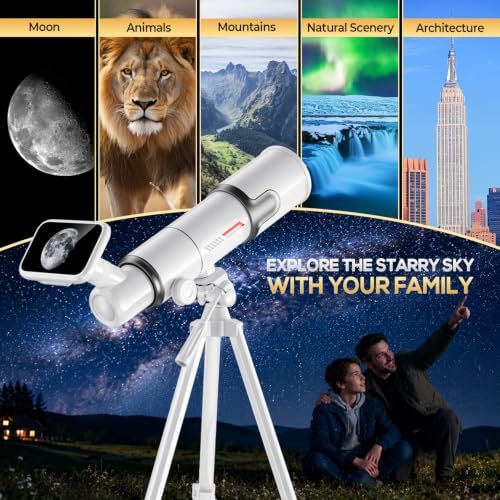
A 400mm focal length telescope offers a wide, bright view that suits beginners, travel, Moon watching, and simple astrophotography.
Many new stargazers want a telescope that feels easy from the first night. A long, heavy setup can quickly turn a fun hobby into a chore. A 400mm focal length telescope gives you a useful balance of wide views, simple handling, and enough reach for the Moon, bright planets, landscapes, and large star groups. I reviewed five models with different goals in mind. Some suit families and beginners, while one is built for serious visual work and astrophotography.
See the differences between my top picks at a glance.
| Model | Aperture | Mount or Design | Best For | Key Advantage | Shop |
|---|---|---|---|---|---|
| HD LCD Refractor | 70mm | Refractor with LCD and remote | Families and beginners | Easy viewing format | View on Amazon |
| 70mm AZ Travel Telescope | 70mm | Refractor with AZ mount | First-time users | Simple travel setup | View on Amazon |
| 70mm AZ Refractor | 70mm | Refractor with AZ mount | Casual Moon viewing | Beginner-friendly format | View on Amazon |
| Askar FRA400C APO | 72mm | Quintuplet APO | Astrophotography | Advanced optical design | View on Amazon |
| Kids’ 70mm Refractor | 70mm | Refractor | Young children | Approachable first scope | View on Amazon |
HD LCD 70mm 400mm Refractor Telescope

This 70mm refractor stands out because it adds a 4.5-inch HD LCD viewing screen to the usual telescope format. The 400mm focal length gives it a broad field of view, so it can frame the Moon with room around it. The listed remote control may also make basic operation easier for family viewing. Its fully multi-coated optics aim to improve light transmission and reduce unwanted reflections.
I see this model as a comfort-first choice rather than a traditional purist telescope. The screen can help several people view the target without taking turns at the eyepiece. It also makes the product more appealing to users who find eye placement hard to manage. Still, buyers should confirm the current box contents, power needs, and screen functions on the Amazon listing before ordering, since included accessories can change.
Pros:
- 70mm aperture suits basic Moon and bright-object viewing.
- 400mm focal length offers a wide, easy-to-find view.
- HD LCD screen can help groups share the view.
- Fully multi-coated optics support clearer light transmission.
- Remote control adds convenience for family use.
- Refractor design needs little routine maintenance.
Cons:
- An LCD system may need power and setup beyond a simple eyepiece.
- Wide views are not ideal for very high planetary magnification.
- Buyers should verify all included accessories before purchase.
What Amazon Buyers Are Saying
Buyer feedback for products in this class often focuses on ease of use, the fun of sharing views, and the appeal of the screen. Families tend to value a setup that feels less intimidating than a complex astronomical system. Common concerns with entry-level electronic telescope packages include learning the controls, managing power, and keeping expectations realistic about deep-sky detail. I recommend reading the newest verified-purchase reviews for comments about the actual screen, tripod, and included accessories.
My Recommendation
I recommend this model for families who want a more social viewing experience. It is a sensible pick for Moon watching, landscapes, and first steps into astronomy. I would not choose it for a buyer who wants a fully manual, upgrade-focused optical system. Its mix of a 70mm aperture and 400mm focal length makes it a useful beginner telescope when convenience matters most.
70mm 400mm AZ Travel Telescope

This compact refractor uses a 70mm aperture and a 400mm focus length. It comes in a beginner-focused format with an AZ mount. An altazimuth mount moves up, down, left, and right, which feels natural for Moon and landscape viewing. That simple motion can help a new user learn the sky without dealing with polar alignment.
The travel design makes this telescope appealing for backyards, camping trips, and school projects. A short focal length gives a wide view, which helps users locate large targets and keep them in frame. It will not replace a larger deep-sky instrument, but that is not its goal. I think it works best when the buyer values quick setup and easy handling over advanced control.
Pros:
- 70mm aperture offers a useful starting point for visual astronomy.
- 400mm focal length creates a broad field for easy target finding.
- AZ mount has simple up-down and left-right movement.
- Travel format suits storage and outdoor use.
- Beginner-friendly design reduces the learning curve.
- Useful for both the Moon and daytime landscapes.
Cons:
- A basic AZ mount may show movement when touched.
- Short focal length limits very high magnification.
- Buyers should check tripod height and accessory details carefully.
What Amazon Buyers Are Saying
Reviews for beginner travel telescopes often praise fast assembly, low weight, and the ability to see the Moon without a long learning process. Many new users also like the simple AZ controls. The usual complaints in this category involve light tripods, loose adjustment parts, or unrealistic expectations about seeing colorful galaxies and planets. Because accessory quality can affect the experience, I suggest checking recent buyer photos and comments about stability and setup.
My Recommendation
This is one of the safer choices for a first-time buyer who wants a basic, portable setup. I would choose it for a child with adult help, a casual observer, or someone who wants a scope for travel. The 400mm focal length telescope format gives it a pleasant balance of width and reach. It earns a strong value score, but serious users may soon want a sturdier mount.
70mm 400mm AZ Refractor Telescope

This second 70mm refractor follows the same useful beginner formula: a 400mm focal length, an AZ mount, and a simple viewing style. Its wide optical view should make large targets easier to find than they would be with a narrow, high-power scope. The refractor tube also keeps the optical path enclosed, so users do not need to learn mirror alignment. That makes it a friendly choice for casual observing.
I would compare this telescope closely with the other 70mm AZ model before buying. Small differences in included eyepieces, tripod design, phone adapters, or carrying parts can change the real value. Its best role is Moon viewing, nature watching, and family use. It can teach basic focus and tracking skills without overwhelming a new owner.
Pros:
- 70mm aperture gives beginners a practical starting point.
- 400mm focal length supports wide views of the Moon.
- AZ mount is easy to understand and operate.
- Refractor construction needs no mirror collimation.
- Suitable for daytime landscape viewing.
- Simple controls encourage frequent use.
Cons:
- Basic mounts can feel less steady at higher power.
- Wide views are better for large targets than tiny details.
- The product may overlap with similar beginner scopes, so compare the bundle.
What Amazon Buyers Are Saying
Common feedback on similar Amazon beginner refractors highlights the fun of seeing the Moon, the simple setup, and the value of a complete starter package. Buyers often differ in their view of the tripod because stability depends on how carefully it is extended and placed. Some users also expect a small starter telescope to show deep-sky objects like professional observatory images. I advise buyers to focus on verified comments about clarity, focus control, assembly, and the condition of the package on arrival.
My Recommendation
I recommend this model when the price and included kit are better than the competing 70mm AZ telescope. It offers the core features that most beginners need without adding complex electronics. As a 400mm focal length telescope, it is a good match for wide Moon views and simple landscapes. I would give it priority for value only after checking the latest listing details and buyer photos.
Askar FRA400C 72mm APO Telescope

The Askar FRA400C is a very different product from the entry-level scopes above. It uses a 72mm aperture, a 400mm focal length, and an f/5.6 quintuplet dual-ED air-spaced APO design. This optical layout targets users who care about clean color control and strong image quality. It suits visual observation, but its design also points toward astrophotography.
This is not the model I would buy as a child’s first telescope. It makes more sense for an experienced observer who already owns a suitable mount, camera, and accessories. The short focal length can frame large nebulae and star fields well, while the apochromatic design aims to reduce color errors. Buyers should check the exact package because advanced optical tubes often require separate support hardware.
Pros:
- 72mm aperture gathers more light than many small starter scopes.
- 400mm focal length suits wide-field visual observation.
- Quintuplet optical design targets refined image quality.
- Dual ED glass helps control color fringing.
- f/5.6 speed can suit wide astrophotography targets.
- More suitable for advanced users than basic starter refractors.
Cons:
- Advanced optical performance comes with a higher buying commitment.
- It may require a separate mount, camera, and imaging accessories.
- Its short focal length is not designed for tight views of tiny planets.
What Amazon Buyers Are Saying
Specialty astrophotography products usually attract a more experienced buyer. Reviews often focus on star shape, color correction, mechanical fit, and performance with a camera. Those are more useful measures than simple comments about seeing the Moon. I would study recent reviews from users with similar cameras and mounts, and I would check for notes about packaging, focuser feel, and the exact accessories supplied.
My Recommendation
I recommend the FRA400C for an experienced astronomer who wants a compact, wide-field APO tube. It is the strongest technical choice in this group, but it is not the best value for a casual beginner. Its 72mm aperture and 400mm focal length make a capable pairing for large sky targets. I would buy it only after planning the full imaging system around it.
Kids’ 70mm 400mm Refractor Telescope

This telescope targets young children and families who want an approachable introduction to sky watching. Its listed 70mm aperture gives it a useful amount of light for basic Moon viewing. The 400mm focal length offers a wide view, which can make it easier for a child to locate and follow a large target. A simple refractor also avoids the mirror care that some larger designs require.
Adult guidance remains important, especially for setup, focus, and safe handling. A child may enjoy the first view more if an adult finds the target before handing over the controls. This telescope is best for short sessions, bright targets, and learning through hands-on use. I would not present it as a professional instrument, but it can help build a lasting interest in astronomy.
Pros:
- 70mm aperture is suitable for simple first observations.
- 400mm focal length makes large targets easier to locate.
- Refractor design is simple for family use.
- Child-focused format can make astronomy feel approachable.
- Useful for Moon viewing and bright daytime scenes.
- Short sessions can fit a young child’s attention span.
Cons:
- Young children need adult help during setup and use.
- The included mount or tripod may limit high-power steadiness.
- It is not intended for advanced astrophotography.
What Amazon Buyers Are Saying
Parents who buy beginner telescopes often care about assembly, simple controls, and whether children stay interested after the first night. Positive comments in this product class tend to mention the Moon and the excitement of seeing a real sky target. Complaints often relate to unstable tripods, unclear instructions, or expectations that a small telescope will show every planet in great detail. I recommend checking current parent reviews for setup time and accessory quality.
My Recommendation
This is a reasonable first telescope for a child when an adult plans to take part. Its simple optical format is less intimidating than an advanced system. The 400mm focal length telescope design gives young users a broad view that can reduce the frustration of searching. I would choose it for family learning, not for demanding optical work.
How to Choose a 400mm Focal Length Telescope
Choosing the right telescope involves more than reading the focal length. A 400mm focal length telescope can feel very different when paired with a 70mm beginner refractor, a digital screen, or a 72mm APO tube. I suggest matching the optical tube, mount, and intended target before comparing price. The best model is the one you will set up often and use with confidence.
1. Match the Aperture to Your Targets
Aperture is the width of the front lens or mirror. It controls how much light the telescope can collect. The 70mm models in this guide suit the Moon, bright planets, landscapes, and basic star viewing. The 72mm Askar model collects slightly more light and uses a more advanced optical design, but aperture alone does not decide image quality.
For a first telescope, 70mm is a practical size. It keeps the tube fairly compact and does not demand a large support system. If you want faint nebulae or detailed deep-sky work, you may eventually want a larger aperture. However, a larger telescope that stays in a closet gives worse results than a smaller one that you use often.
2. Study the Mount Before the Accessories
The mount holds the telescope steady. It also controls how easily you can track a target. An AZ mount works with simple up-down and left-right movement. This style suits beginners because it feels much like moving a camera on a basic tripod. It works well for the Moon, landscapes, and short viewing sessions.
Watch for a weak tripod. A shaky mount can ruin a sharp optical tube. Touching the focus knob may make the image jump. Let the vibration settle before judging the view. Advanced buyers should also check whether the telescope tube requires a separate mount, dovetail plate, camera adapter, or field flattener. This point matters most with the Askar FRA400C.
3. Consider Viewing Style, Portability, and Value
Decide how you want to observe. A traditional eyepiece gives a direct view and does not need a screen or battery. An LCD telescope may help a family share the view. A child-focused scope may offer a less complex path into the hobby. An APO telescope may suit an experienced user who wants clean wide-field images and plans to add a camera.
Also check the complete package. Look for the actual eyepieces, tripod, finder, remote, power parts, and carrying case listed at the time of purchase. Amazon listings can change, so I always compare the current description with recent buyer photos. A good 400mm focal length telescope should fit both your skill level and your storage space. That practical match often matters more than a small price difference.
Final Verdict: Which Should You Buy?
For advanced users, the Askar FRA400C is the best optical choice. For most beginners, I prefer the 70mm AZ travel telescope because it keeps setup simple and offers a useful 400mm focal length.
Choose the LCD model for shared family viewing, or the kids’ scope for supervised learning. Compare the current bundle and reviews before buying any 400mm focal length telescope.
FAQs Of 400mm focal length telescope
What can I see with a 400mm focal length telescope?
You can view the Moon, bright planets, large star groups, bright stars, and daytime landscapes. Results depend on aperture, sky darkness, eyepiece choice, and mount stability.
Is a 400mm focal length telescope good for beginners?
Yes. Its wide view can make large targets easier to find. A 70mm refractor with an AZ mount is often simple for a first-time user.
Is 400mm focal length good for astrophotography?
It can work well for wide-field astrophotography. The Askar FRA400C is designed for more advanced use, but you still need a suitable mount, camera, and related accessories.
What is the difference between focal length and aperture?
Focal length affects the telescope’s view and magnification. Aperture controls light gathering and helps set the level of detail and brightness you can see.
Should I choose an LCD telescope or a regular eyepiece?
Choose an LCD model if several people will share the view. Choose a regular eyepiece if you want a simpler setup with fewer electronic parts.