
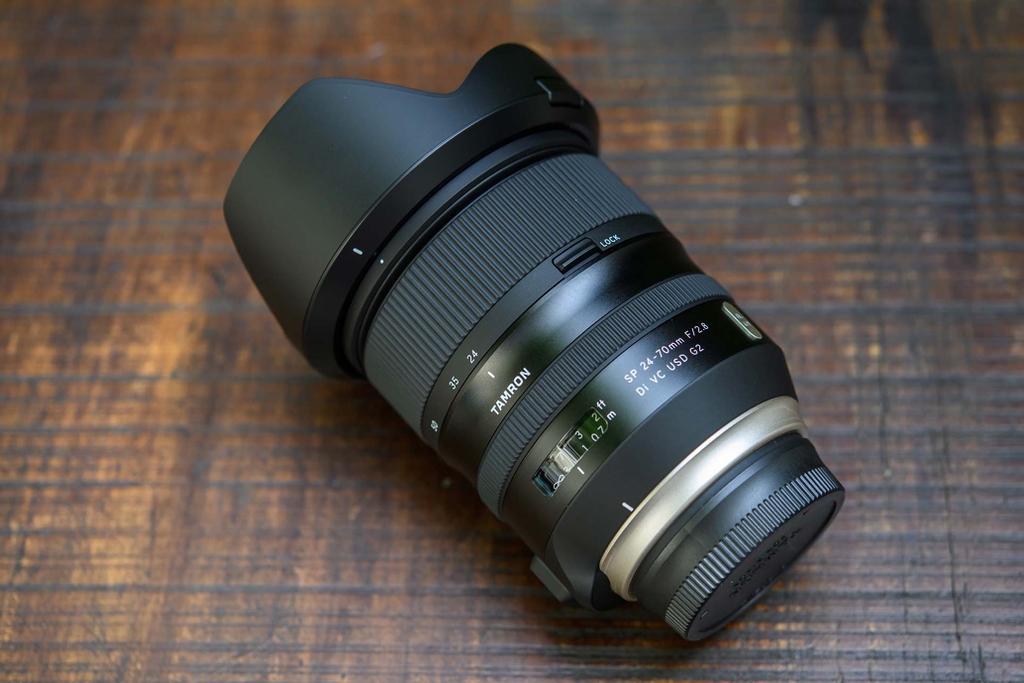
The Tamron SP 24-70mm F/2.8 Di VC USD G2 is a full-frame standard zoom lens for Nikon F-mount DSLR cameras. It covers wide-angle to short telephoto views, keeps a bright f/2.8 aperture through the zoom range, and includes Vibration Compensation (VC) image stabilization.
For photographers in the United States, this lens remains a useful option for weddings, events, portraits, travel, landscapes, and everyday work with Nikon FX DSLRs. It can also work on some Nikon Z cameras with an FTZ-series adapter, but compatibility may depend on the camera, adapter, lens firmware, and shooting mode.
Introduction
The Tamron 24-70mm F2.8 G2 for Nikon is designed for photographers who need one fast lens for many common subjects. Its 24mm setting helps with groups, rooms, streets, and landscapes. Its 70mm setting gives a tighter view for portraits and detail shots.
The lens is known by several names, including Tamron SP 24-70mm F/2.8 Di VC USD G2, Tamron A032, and Tamron 24-70mm G2 for Nikon. “Di” means it is made for full-frame digital cameras. “VC” refers to optical stabilization. “USD” is Tamron’s ultrasonic autofocus motor system.
The key trade-off is simple: this lens offers strong range, low-light capability, and stabilization, but it is larger and heavier than a basic 24-70mm f/4 lens or a compact prime lens.

Tamron 24-70mm F2.8 G2 Nikon specifications
The table below lists the main documented specifications for the Nikon F version. Small differences may appear between regional manuals and product listings, so confirm the exact model before buying used.
| Feature | Tamron 24-70mm F2.8 G2 Nikon |
|---|---|
| Full product name | SP 24-70mm F/2.8 Di VC USD G2 |
| Model number | A032 |
| Lens mount | Nikon F |
| Format coverage | Full frame |
| Focal length | 24-70mm |
| Maximum aperture | f/2.8 throughout the zoom range |
| Minimum aperture | f/22 |
| Optical design | 17 elements in 12 groups |
| Diaphragm | 9 rounded blades |
| Minimum focus distance | About 0.38 m, or 1.25 ft |
| Maximum magnification | About 1:5 |
| Filter size | 82mm |
| Stabilization | Tamron VC |
| Autofocus motor | USD ultrasonic drive |
| Focus method | Internal focusing |
| Front coating | Fluorine coating |
| Weather protection | Moisture-resistant construction |
| Approximate weight | About 900 g, or 2 lb, for the Nikon version |
The lens uses an 82mm filter thread. That size is larger than the 77mm thread found on many older professional zooms. If you plan to use a circular polarizer or variable neutral-density filter, include the filter cost in your budget.
The lens has a constant f/2.8 aperture. This means the maximum aperture does not become smaller as you zoom from 24mm to 70mm. That helps keep exposure settings more consistent during an event or video shot.
What “Nikon mount” means
This lens uses the Nikon F mount, not the newer Nikon Z mount. It fits many Nikon DSLR bodies, such as FX models in the D600, D700, D800, D810, D850, D3, D4, D5, and D6 families. It also fits many DX bodies, including selected D7000-series and D500 cameras.
On a Nikon DX camera, the lens gives a narrower field of view. Nikon’s 1.5x crop factor makes it look similar to a 36-105mm lens on full frame. That makes it useful for portraits and events, but less wide indoors.

Image quality and real-world performance
The Tamron 24-70mm G2 can produce sharp images across a useful professional range, but results depend on aperture, focal length, focus accuracy, camera body, and sample condition. A lens specification sheet cannot prove that every copy performs identically.
At 24mm, the lens is useful for architecture, landscapes, groups, and environmental portraits. Wide-angle zooms can show barrel distortion at the short end. Modern Nikon cameras and editing software may correct much of this effect.
At 70mm, the lens gives a more flattering view for head-and-shoulder portraits than 24mm. The f/2.8 aperture can help separate a subject from the background, although background blur will not match a dedicated 85mm f/1.4 or f/1.8 prime.
Sharpness
The lens is generally strongest when stopped down slightly from f/2.8. For many subjects, settings between f/4 and f/8 can improve edge detail and depth of field. This is a practical guideline, not a rule. At a wedding reception or indoor event, f/2.8 may be the better choice because shutter speed matters more than maximum corner detail.
Center sharpness is often the main strength of a standard professional zoom. Corners may show more softness at wide apertures, especially at 24mm. The effect can be less visible in portraits, where the subject is often near the center.
Distortion, vignetting, and flare
At 24mm, some barrel distortion may appear. At longer focal lengths, pincushion distortion can become more visible. Camera profiles and raw-processing software can correct these effects, but correction may slightly change the image edges.
Wide-aperture vignetting can darken the corners. This may be useful for portraits, but it can be distracting in flat scenes such as skies or studio backgrounds.
The lens includes advanced coatings, but any large front element can show flare when a bright light source is near the frame. Use the supplied hood and change the shooting angle when possible.
Bokeh and color
The nine-blade diaphragm is designed to keep the aperture opening relatively smooth when the lens is stopped down. At 70mm and f/2.8, the lens can create pleasant background separation when the subject is close and the background is far away.
Bokeh quality depends on the subject, background, focus distance, and light pattern. Bright points in the background may show a shape or outline in some conditions. This is normal for a zoom lens and should not be judged from aperture count alone.

Autofocus, vibration compensation, and handling
The lens combines a USD autofocus motor with VC stabilization. These systems solve different problems.
- Autofocus helps place focus on the subject.
- VC reduces the effect of camera shake.
- VC does not freeze a moving person or animal.
- A fast shutter speed is still needed for moving subjects.
Tamron rates the VC system at up to about five stops under its stated test conditions. Real results vary with technique, focal length, subject distance, and the camera body. At 70mm, VC can help with a still subject in low light. It cannot replace a faster shutter speed when the subject moves.
Autofocus for people and events
For weddings, concerts, and indoor events, use the camera’s continuous autofocus mode when the subject is moving. Select a suitable focus-area mode and check the first few images at high magnification.
The lens may focus quickly in good light. Low light, low contrast, backlighting, and subjects moving toward the camera can reduce focus reliability. The camera body often has as much influence on autofocus as the lens.
Focus controls
The lens includes an autofocus/manual-focus control and a VC control. Some versions also support a focus-distance scale and a distance-limited focus system through the Tamron TAP-in Console.
If autofocus seems inaccurate, first check the camera’s AF settings, shutter speed, subject contrast, and lens contacts. Do not assume that every missed frame is caused by front focus or back focus.
Size and weight
At about 2 lb, the lens is not light. It can feel front-heavy on a small Nikon DSLR or a compact DX body. A camera strap attached to the camera may also place strain on the mount during long walks.
For extended events, use a comfortable strap or support system. When storing or transporting the lens, keep both caps attached and avoid placing pressure on the zoom barrel.

Compatibility with Nikon DSLR and Z cameras
The Tamron lens is made for Nikon F-mount DSLRs. It is not a direct-fit Nikon Z lens.
Nikon FX DSLR cameras
On a Nikon FX DSLR, the lens provides its intended 24-70mm field of view. This is the best match for its design. It works well as a general-purpose professional zoom for full-frame photography.
Check the exact camera manual for electronic aperture control, autofocus behavior, and exposure features. Older Nikon bodies may not support every modern lens function in the same way as newer cameras.
Nikon DX DSLR cameras
On a Nikon DX body, the lens behaves like a 36-105mm equivalent in terms of angle of view. The lens still works, but 24mm is no longer very wide.
This combination can be useful for:
- Portraits
- Sports from the sidelines
- Weddings
- Street photography
- Detail shots
- Outdoor events
It is less suitable when you need a genuinely wide view inside a small room.
Nikon Z mirrorless cameras
To use the lens on a Nikon Z camera, you need an Nikon FTZ or FTZ II adapter. The adapter adds length and weight. It also keeps the system larger than a native Z-mount lens.
Compatibility can depend on firmware. Before buying a used copy, check Tamron’s compatibility information for the exact lens model and firmware version. Test autofocus, aperture control, vibration compensation, and exposure functions with your specific Z body.
Do not assume that an F-mount lens will provide every feature available from a native Z lens. Eye-detection behavior, video autofocus, lens corrections, and continuous autofocus may differ.

Who should buy the Tamron 24-70mm G2?
This lens makes sense for a Nikon photographer who wants one bright zoom for several types of work. It is especially useful when changing lenses would cause missed moments or expose the camera to dust and rain.
It fits these photographers well
- Nikon FX DSLR owners who need a professional everyday zoom
- Wedding and event photographers
- Portrait photographers who also shoot groups and environments
- Travel photographers who value f/2.8
- Photographers who work in dim indoor spaces
- Nikon DX users who want a portrait-oriented standard zoom
- Buyers who want VC stabilization without moving to a slower f/4 lens
It may not fit these photographers
A different lens may be better if you need a very light kit, extreme background blur, or a wider field of view.
Consider another option if:
- You mainly shoot landscapes and need ultrawide coverage.
- You carry your camera all day and want low weight.
- You use a Nikon Z camera and want a native mirrorless lens.
- You shoot fast sports and need a longer focal length.
- You often work in dark venues where an f/1.8 prime would provide more light.
- You need close-up work with high magnification.
The Tamron 24-70mm G2 is a flexible middle ground. It is not the smallest, widest, longest, or brightest lens in every category.
How to set up the lens for common uses
The best settings depend on the subject and camera, but these starting points can help.
| Use | Starting focal length | Aperture | Shutter speed | Practical note |
|---|---|---|---|---|
| Group photo | 24-35mm | f/5.6-f/8 | At least 1/125 sec | Keep faces near the center when possible |
| Portrait | 50-70mm | f/2.8-f/4 | At least 1/125 sec | Focus on the nearer eye |
| Indoor event | 24-70mm | f/2.8 | 1/125-1/250 sec | Raise ISO before using a shutter speed that is too slow |
| Landscape | 24-35mm | f/8-f/11 | Based on light | Use a tripod for long exposures |
| Street photography | 24-50mm | f/4-f/8 | 1/250 sec or faster | Use continuous autofocus for moving subjects |
| Static low-light subject | 50-70mm | f/2.8 | May be slower with VC | VC helps only when the subject stays still |
These are starting points, not fixed rules. A child running indoors may need 1/500 sec or faster. A building at night may allow a much slower shutter speed on a tripod.
For video, test autofocus noise before recording important footage. The USD motor may be quiet in many situations, but “quiet” does not mean completely silent. An external microphone can help reduce lens and camera sounds.

Used buying checklist for the Nikon version
The Tamron 24-70mm G2 is often found on the used market. Inspect the exact lens instead of relying only on product photographs.
Check these points before purchase:
- Confirm the mount. The Nikon version should be marked for Nikon F mount. Canon and Sony versions are not interchangeable.
- Inspect the glass. Look for deep scratches, haze, fungus, separation, or heavy cleaning marks.
- Test the zoom ring. It should turn smoothly without grinding or sticking.
- Test autofocus. Try single-shot and continuous autofocus in good light.
- Test VC. Listen for abnormal sounds and check whether stabilized images improve at slow shutter speeds.
- Check the contacts. Dirty or damaged electronic contacts can cause communication problems.
- Check the hood and caps. Missing accessories may add replacement cost.
- Ask about firmware. Firmware can affect compatibility with newer cameras and adapters.
- Review sample images. Test near and far subjects at 24mm and 70mm.
- Confirm the return policy. A short testing period is valuable for used equipment.
Do not judge alignment from one image. Repeat the test with a flat subject, a detailed subject, and a three-dimensional subject. Poor technique, a slow shutter speed, or a moving target can look like a lens defect.

Common problems and practical fixes
Autofocus does not work
First, confirm that the lens switch is set to AF. Clean the electronic contacts with a dry, clean cloth. Then test the lens in bright light with a stationary subject.
If the lens works on one camera but not another, check the camera manual and lens firmware. An FTZ adapter adds another possible compatibility point.
Images look soft
Use a faster shutter speed and take a test image with VC enabled and disabled. Check whether the subject moved. Also inspect focus placement at 100 percent.
If softness appears on only one side of the frame across several careful tests, the lens may need professional inspection. Avoid making a repair decision from a single handheld frame.
VC makes an unusual sound
A faint movement or click can occur when stabilization starts or stops. Loud grinding, repeated knocking, or unstable framing is less normal. Compare the behavior with the camera held still, and seek service if the issue continues.
The lens will not fit the camera
Do not force the mount. Confirm that the camera uses Nikon F mount and that the lens is not a Canon, Sony, or other version. For a Nikon Z body, use a compatible FTZ-series adapter.

Maintenance and care
The lens has moisture-resistant construction, but this does not make it waterproof. Avoid heavy rain, spray, sand, and rapid temperature changes. Use a rain cover or sealed camera bag in harsh conditions.
If the lens becomes cold, place it in a sealed bag before bringing it into a warm room. This reduces condensation. Let the lens reach room temperature before removing the bag.
Use a blower before wiping the front or rear glass. A soft lens cloth can remove light marks. Do not use household cleaners or excessive fluid.
Keep the 82mm front cap attached when the lens is not in use. Store the lens with both caps in a dry, moderate environment.
Key takeaways
- The Tamron 24-70mm F2.8 G2 is a Nikon F-mount full-frame standard zoom.
- Its 24-70mm range covers wide-angle, normal, and short telephoto views.
- The constant f/2.8 aperture helps in low light and supports background separation.
- VC can reduce camera shake but cannot freeze moving subjects.
- The lens is relatively large and weighs about 2 lb.
- Nikon DX cameras give it a 36-105mm equivalent field of view.
- Nikon Z users need an FTZ or FTZ II adapter and should check firmware compatibility.
- Used buyers should test autofocus, VC, zoom movement, optics, and electronic contacts.
Frequently asked questions
Is the Tamron 24-70mm F2.8 G2 compatible with Nikon cameras?
Yes, the Nikon version is made for Nikon F-mount cameras. Confirm the exact camera model, because supported functions can vary between older and newer Nikon bodies.
Is this lens compatible with Nikon Z cameras?
It can be used with a Nikon FTZ or FTZ II adapter, but it is not a native Z-mount lens. Check Tamron’s current compatibility and firmware information for your exact lens and camera.
Does the Tamron 24-70mm G2 have image stabilization?
Yes. Tamron calls its optical stabilization system Vibration Compensation, or VC. It helps reduce camera shake with still subjects.
Is the lens good for wedding photography?
It can be a strong wedding and event lens because 24-70mm covers groups, preparation scenes, portraits, and ceremony moments. Its f/2.8 aperture also helps in dim venues. A second body or a longer lens may still be useful for distant subjects.
Can the lens be used on a Nikon DX camera?
Yes. The field of view becomes similar to a 36-105mm lens on full frame. This is useful for portraits and events but less useful for very wide scenes.
What filter size does the lens use?
The lens uses 82mm filters. Buy the correct size, and check that thick filter frames do not cause unwanted vignetting at 24mm.
Conclusion
The Tamron 24-70mm F2.8 G2 for Nikon is a versatile professional zoom for photographers who use Nikon F-mount DSLRs. Its constant f/2.8 aperture, VC stabilization, useful focal range, and weather-resistant design make it well suited to events, portraits, travel, and everyday full-frame work.
Its main limits are its weight, large 82mm filters, and reduced wide-angle coverage on Nikon DX cameras. Nikon Z owners should also treat adapter compatibility as a feature to verify, not an assumption.
For a Nikon FX DSLR owner who wants one fast lens for many common subjects, the Tamron 24-70mm G2 remains a practical and capable choice.

