
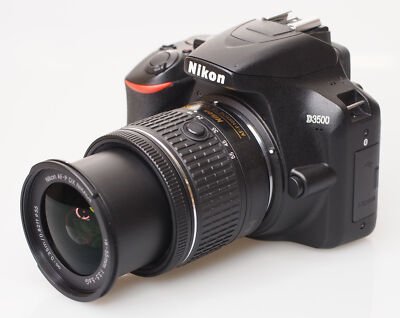
For photographers in the United States, the Nikon D3500 with the AF-P DX NIKKOR 18-55mm lens remains a simple and capable entry-level DSLR. Its 24.2-megapixel DX sensor gives clear photos, while the included zoom lens covers useful everyday views from wide-angle scenes to short telephoto portraits.
The Nikon D3500 is a good fit for beginners, students, families, travelers, and anyone who wants a camera with physical controls and long battery life. It is less suitable if you need 4K video, a touch screen, built-in Wi-Fi, or fast subject tracking for sports.
The camera is now an older model, so U.S. buyers should check whether a listing is new, refurbished, or used. Condition, shutter count, battery health, lens version, and seller return terms can matter as much as the camera specifications.

Nikon D3500 Key Specifications
The Nikon D3500 combines a 24.2MP APS-C-size sensor with a compact body and a basic 18-55mm kit lens. The main specifications are listed below.
| Feature | Nikon D3500 specification |
|---|---|
| Camera type | Digital single-lens reflex camera |
| Sensor | 24.2MP Nikon DX-format CMOS sensor |
| Effective resolution | 24.2 million pixels |
| Image processor | EXPEED 4 |
| ISO range | ISO 100–25,600 |
| Autofocus | 11-point phase-detection AF system |
| Continuous shooting | Up to approximately 5 frames per second |
| Viewfinder | Optical pentamirror viewfinder |
| Monitor | 3-inch fixed LCD monitor |
| Video | Full HD 1080p, up to 60 frames per second |
| Lens mount | Nikon F mount |
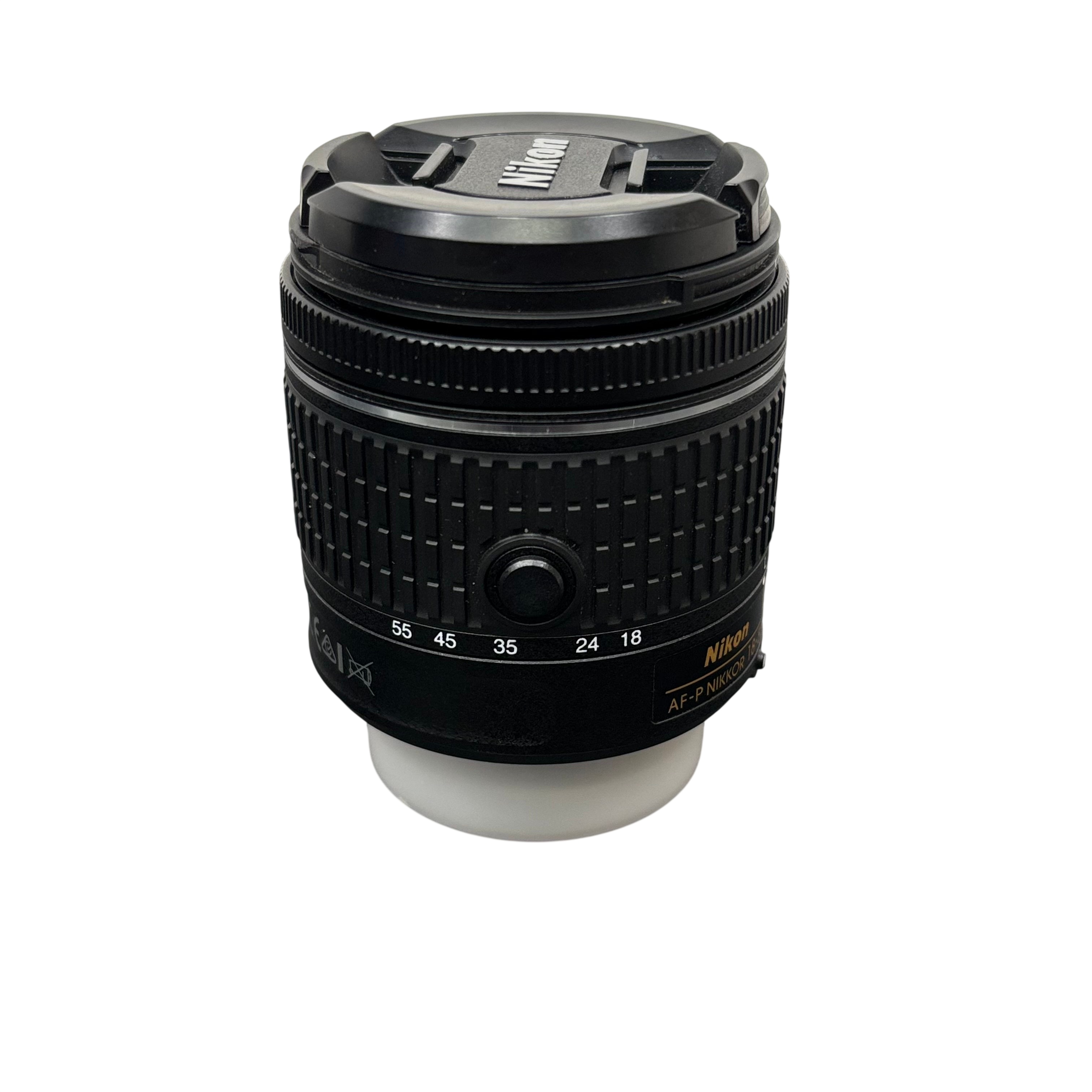
| Included lens | AF-P DX NIKKOR 18-55mm, commonly the f/3.5-5.6G VR version |
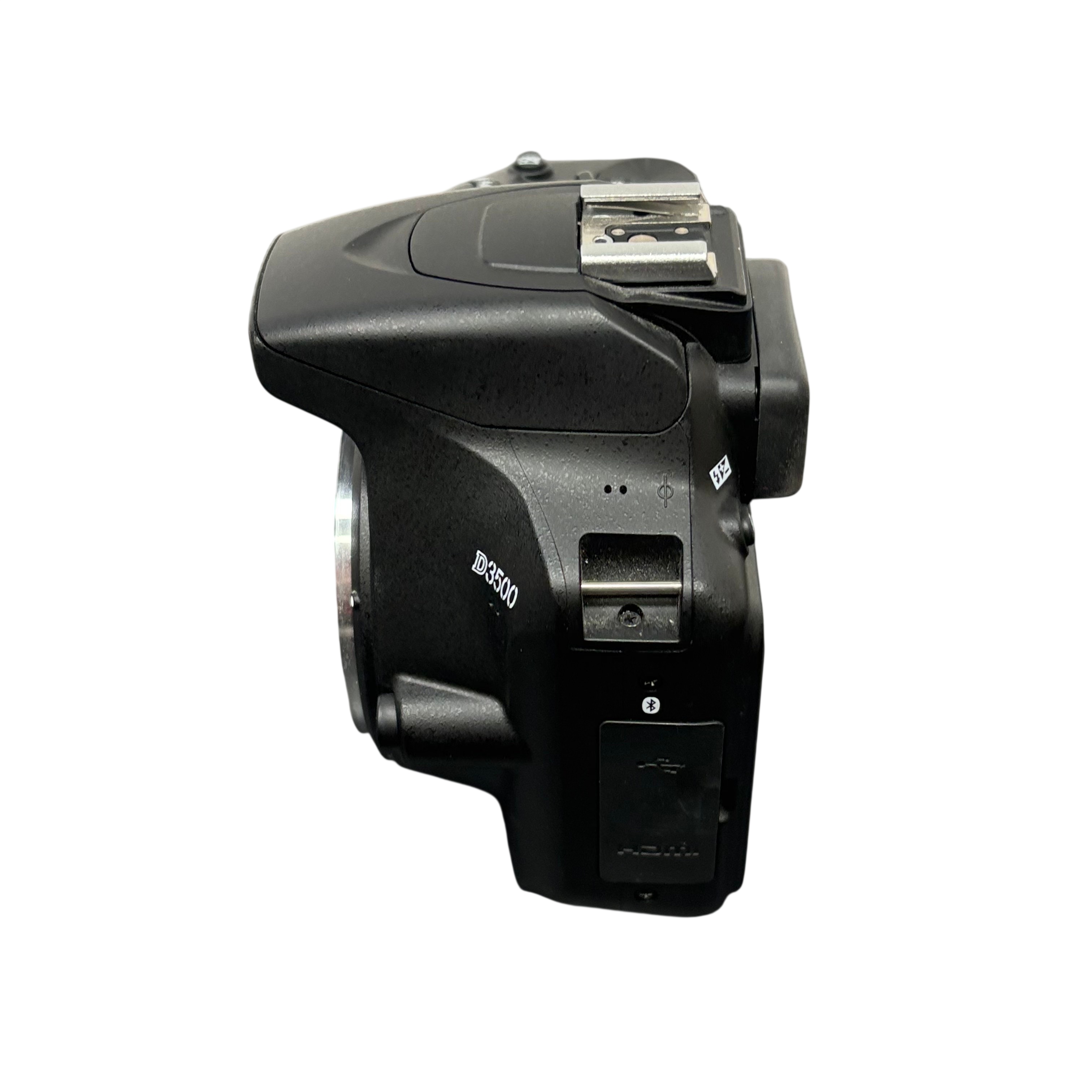
| Wireless connection | Bluetooth Low Energy through SnapBridge |
| Battery rating | Up to approximately 1,550 shots under Nikon’s test conditions |
| Storage | SD, SDHC, and SDXC memory cards |
| Body-only weight | Approximately 365 grams |
| Dimensions | Approximately 124 × 97 × 69.5 mm |
These figures come from Nikon’s published specifications and depend on test conditions. Battery life, for example, can fall with frequent flash use, Live View, video recording, cold weather, or repeated wireless transfers.
The camera uses a DX-format sensor, which is Nikon’s name for its APS-C sensor size. Compared with a typical smartphone sensor, it is much larger. That larger sensor can capture more light and gives the photographer more control over background blur.
The included lens is often sold as the AF-P DX NIKKOR 18-55mm f/3.5-5.6G VR. Some kits may include a version without VR, or may be sold with a similar lens. Read the exact listing before buying.

What the 24.2MP Sensor Means for Photos
The 24.2MP sensor gives the Nikon D3500 enough resolution for family photos, travel images, school projects, online publishing, and many medium-to-large prints. It also leaves room to crop an image when the subject does not fill the frame.
Resolution is only one part of image quality. The camera’s larger DX sensor, interchangeable lenses, RAW support, and manual controls give it an advantage over many basic point-and-shoot cameras. Good light, accurate focus, and a steady camera still matter.
Image size and cropping
A 24.2MP image contains about 6,000 × 4,000 pixels at the camera’s highest setting. A photo with this much detail can support common prints and web use. Cropping reduces the remaining pixels, so heavy cropping works best when the original photo is sharp and well exposed.
For example, cropping away half the width and half the height leaves about one-quarter of the original image area. The file may still look good online, but it will not provide the same detail as the full image.
ISO performance
The standard ISO range runs from 100 to 25,600. ISO controls the sensor’s sensitivity to light. A higher ISO can help you shoot indoors or at dusk with a faster shutter speed, but it also adds image noise and reduces fine detail.
A practical starting point is:
- ISO 100–400: Bright outdoor scenes
- ISO 400–1,600: Indoor rooms with reasonable light
- ISO 1,600–6,400: Dim interiors or evening scenes
- ISO 12,800–25,600: Emergency settings when capturing the moment matters more than clean detail
These are starting points, not strict rules. The best ISO depends on the light, lens aperture, shutter speed, and how large you plan to display the image.
JPEG and RAW files
JPEG files are ready to share and take up less card space. RAW files retain more original image data and allow stronger edits to exposure, white balance, shadows, and highlights.
The D3500 can record Nikon NEF RAW files. A RAW file needs software that supports the camera and file type. It also needs editing before it looks like a finished JPEG. New users can start with JPEG or use the camera’s RAW plus JPEG option when learning.

AF-P DX NIKKOR 18-55mm Lens: What It Can Do
The AF-P DX NIKKOR 18-55mm lens is a flexible starter lens for daily photography. On the D3500’s DX sensor, its view is similar to about 27-82.5mm on a 35mm full-frame camera.
That range covers many common subjects:
- 18mm: Landscapes, buildings, rooms, and group photos
- 24-35mm: Street scenes, travel, food, and everyday snapshots
- 50-55mm: Portraits, details, and subjects that need a tighter frame
The lens is small and light. It is easy to carry and costs less than many specialized lenses. Its main limit is the relatively narrow maximum aperture, especially at the 55mm end.
What VR does
If the included lens is the VR version, VR means vibration reduction. Optical VR can reduce the effect of small hand movements when you take still photos at slower shutter speeds.
VR does not freeze a moving person, child, or pet. If the subject moves, you still need a faster shutter speed. VR also does not replace a tripod for long exposures.
Lens aperture limits
The lens has a maximum aperture of approximately:
- f/3.5 at 18mm
- f/5.6 at 55mm
A wider aperture lets in more light and can create a softer background. Since this kit lens becomes darker as you zoom in, indoor portraits may need a higher ISO, a flash, a brighter lens, or better room lighting.
Close focusing
The 18-55mm lens can focus fairly close for flowers, food, documents, and small objects. It is not a dedicated macro lens, so it will not reproduce tiny subjects at true 1:1 macro size.
Nikon D3500 Autofocus and Shooting Performance
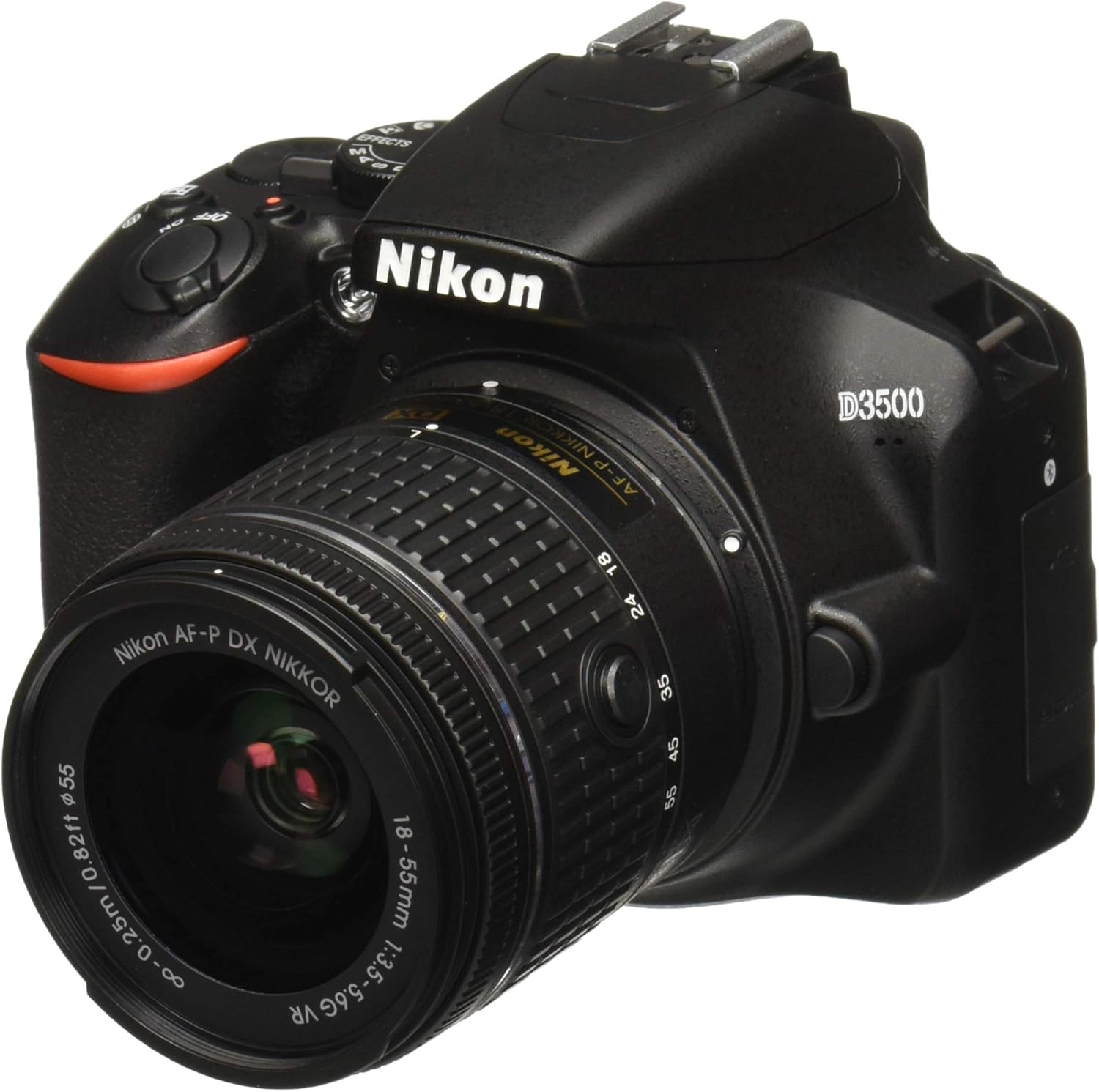
The D3500 uses an 11-point autofocus system through its optical viewfinder. It focuses quickly enough for family events, travel, casual portraits, landscapes, and many everyday subjects.
Its autofocus system is simpler than the systems found in newer mirrorless cameras. The 11 focus points cover a smaller area of the frame, so the photographer may need to place a focus point over the subject or focus and recompose carefully.
Best autofocus modes
For still subjects, AF-S is usually the useful choice. The camera focuses once when you half-press the shutter button.
For moving subjects, AF-C continuously adjusts focus while the camera works to follow the subject. It can help with children, pets, and casual action, but the D3500 does not offer the advanced subject recognition found in newer cameras.
The D3500 also includes Live View autofocus. Live View uses the rear screen instead of the optical viewfinder. It is useful for low-angle shots, tripod work, and video, but it is not the camera’s strongest mode for fast action.
Continuous shooting
The camera can shoot at up to about 5 frames per second under Nikon’s stated conditions. This is helpful for a short sequence of a jump, smile, or simple sports moment.
The actual speed and number of frames depend on shutter speed, focus mode, file type, memory card, and buffer space. Continuous shooting is not a guarantee that every frame will be in focus.
When the D3500 works best
The D3500 performs well for:
- Family and holiday photos
- School and college photography
- Beginner portrait work
- Travel photography
- Landscapes and architecture
- Basic product photos
- Learning manual exposure
It is less suited to professional sports, wildlife that moves quickly, low-light video, or work that requires silent shooting and advanced tracking.

Video Features and Wireless Sharing
The Nikon D3500 records Full HD video rather than 4K. It supports common 1080p frame rates, including up to 60 frames per second in suitable settings.
Full HD is enough for family clips, online videos, school work, and casual travel footage. It does not provide the extra detail or cropping flexibility of 4K video.
The camera does not include a microphone input. The built-in microphone can record basic sound, but users who need clear dialogue may prefer a separate audio recorder or a newer camera with an external microphone jack.
SnapBridge connection
The D3500 supports Nikon SnapBridge through Bluetooth Low Energy. A compatible phone can receive selected photos and may record location data when the app and phone settings allow it.
This is not the same as full Wi-Fi control. The D3500 does not offer the broad wireless features found on many newer Nikon cameras. App support can also change with mobile operating system updates, so U.S. buyers should check Nikon’s current SnapBridge compatibility information before relying on wireless transfer.
A USB card reader is often the simplest way to move many full-size photos to a phone, tablet, or computer.

Nikon D3500 Controls and Beginner-Friendly Features
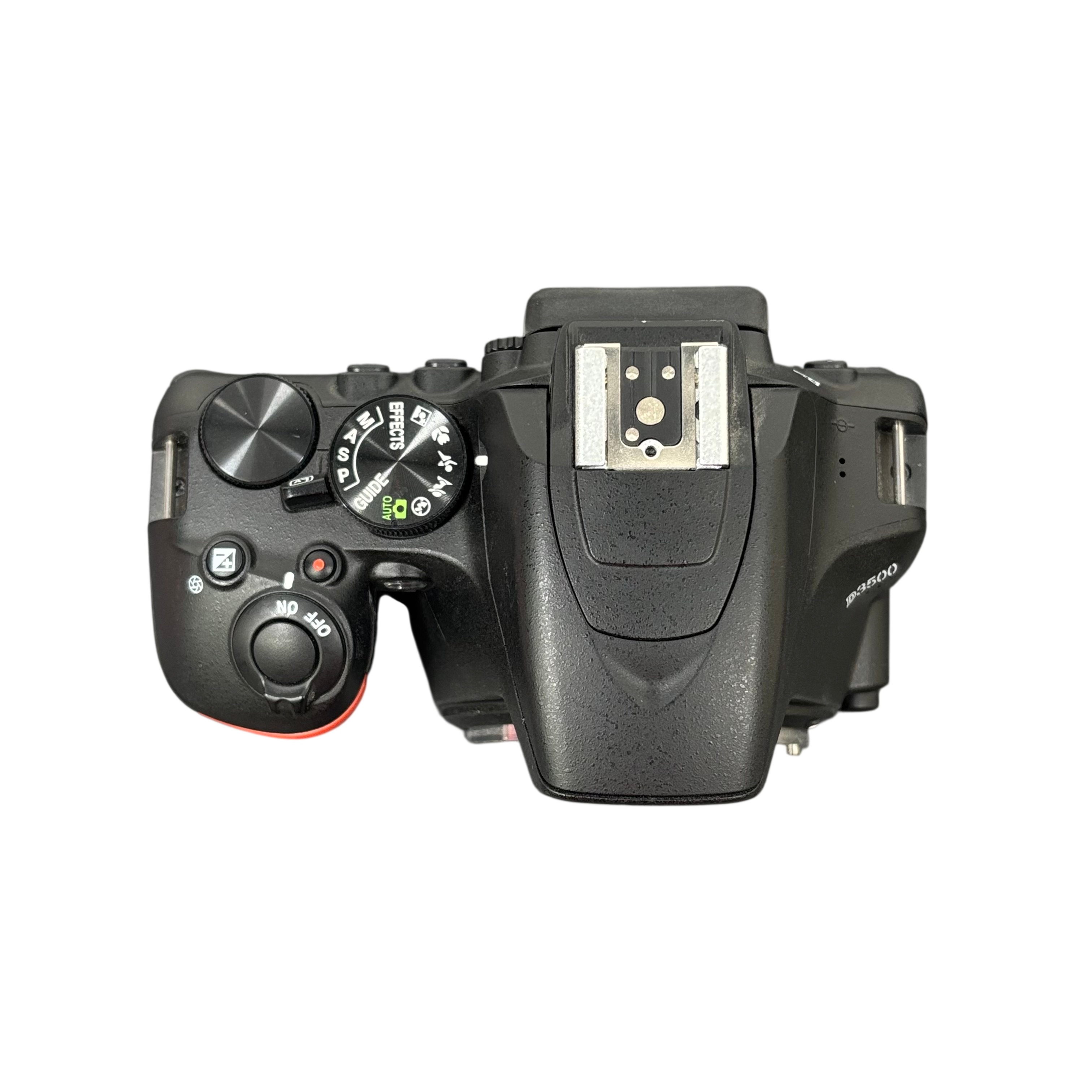
The D3500 is designed to make DSLR photography easier to learn. Its physical mode dial gives direct access to common settings, and its Guide Mode explains basic camera choices in simple steps.
Useful beginner features include:
- Auto exposure for quick snapshots
- Guide Mode for learning camera controls
- Scene modes for common subjects
- Manual exposure mode
- Aperture-priority and shutter-priority modes
- Built-in pop-up flash
- Optical viewfinder
- RAW image capture
- Interchangeable Nikon F-mount lenses
The optical viewfinder shows the scene through the lens using a mirror and prism system. It has no electronic display delay and uses very little battery power compared with constant screen use.
The rear screen is fixed and does not tilt or rotate. This makes the camera less convenient for selfies, video presentations, and low-angle compositions. It also does not have touch controls, so settings are changed with buttons and dials.
A simple setup for new owners
Start with these settings:
- Charge the battery and insert a compatible SD card.
- Set the mode dial to A for aperture priority.
- Choose an aperture near f/5.6 for general outdoor photos.
- Use Auto ISO if you are still learning exposure.
- Select AF-S for subjects that are still.
- Use the optical viewfinder for normal still photography.
- Review the first few photos for focus, exposure, and unwanted blur.
As you gain control, try a lower aperture for background blur, a faster shutter speed for action, and manual white balance when indoor colors look wrong.

Nikon D3500 Pros and Limitations
The D3500’s strongest qualities are its image sensor, simple controls, light body, and long battery rating. Its limitations are tied mainly to its age and entry-level design.
Advantages
- High resolution: The 24.2MP sensor provides useful detail and cropping room.
- Large sensor: The DX sensor offers more control than a typical phone or small compact camera.
- Easy lens system: Nikon F-mount lenses give owners room to expand.
- Long battery life: Nikon’s published rating is unusually high for this class of camera.
- Light body: The camera is easier to carry than many larger DSLRs.
- Optical viewfinder: It offers a clear, direct view with no electronic lag.
- Guide Mode: New photographers can learn core settings inside the camera.
- Affordable used market: Older bodies may cost less than current interchangeable-lens cameras.
Limitations
- No 4K video
- No built-in Wi-Fi
- No touch screen
- No articulating monitor
- No microphone input
- Basic 11-point autofocus system
- Limited Live View autofocus for moving subjects
- Older Bluetooth and app support
- Small optical viewfinder compared with many newer cameras
- Kit lens is not especially bright indoors
- Used batteries and shutters may show wear
The key trade-off is simple: the D3500 offers strong basic photo quality at a lower cost, but it lacks many features now common on modern mirrorless cameras.
Is the Nikon D3500 Still Worth Buying in the United States?
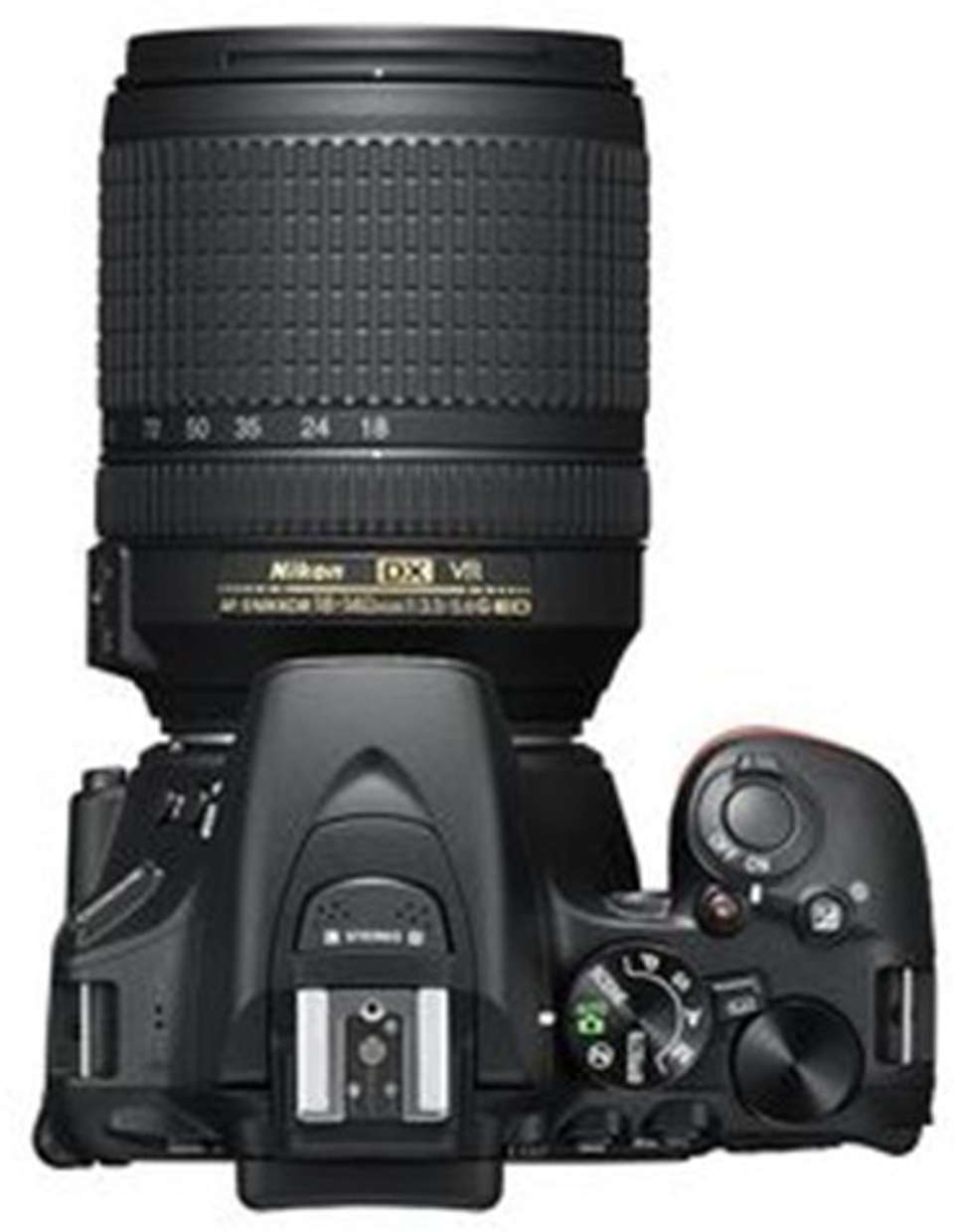
The Nikon D3500 can still be worth buying when the price is low, the condition is clear, and the buyer mainly wants still photos. It is especially practical for someone who wants to learn photography without paying for advanced video or complex autofocus features.
A newer camera is usually the better choice when you need reliable smartphone control, 4K video, an adjustable screen, USB charging, silent shooting, or stronger autofocus for moving subjects.
Before buying a used D3500 in the U.S., check the following:
- Exact camera model and included lens
- Whether the lens has VR
- Shutter count, if available
- Battery condition and charger type
- Sensor and lens glass for dust, scratches, or fungus
- LCD screen for cracks or dead areas
- SD card slot and flash operation
- Autofocus at both 18mm and 55mm
- Return policy and seller reputation
- Whether the kit includes the original battery and charger
Avoid judging a used camera only by body appearance. A few marks may be harmless, while a damaged mount, faulty shutter, swollen battery, or fungus inside the lens can create a much larger problem.
Recommended Accessories for the Nikon D3500
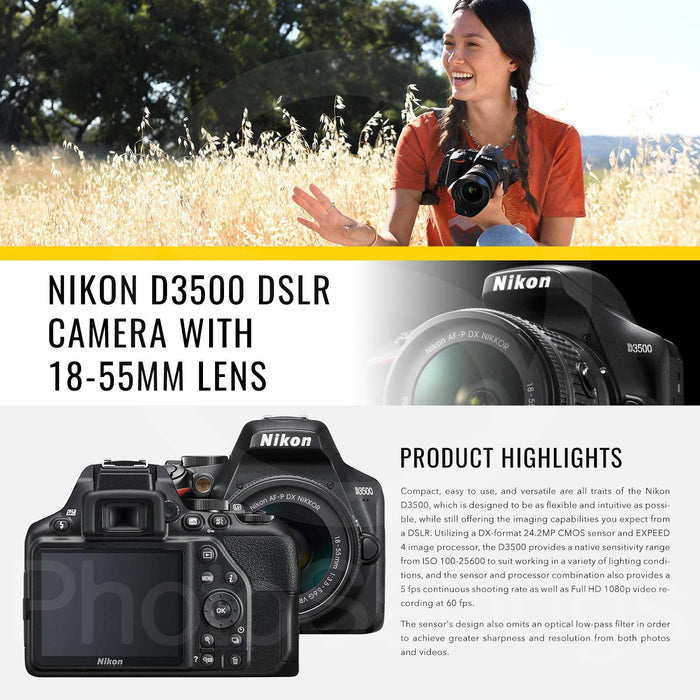
The best first accessories are practical rather than expensive. A spare battery, a reliable SD card, and a small camera bag usually help more than a large accessory kit.
Useful additions
- Spare EN-EL14a battery: Helpful for travel and long days.
- SDHC or SDXC card: Choose a reputable card with enough capacity for RAW files and video.
- Camera bag: Protects the body and lens during transport.
- Lens hood: Reduces stray light and offers some front-element protection.
- Tripod: Useful for landscapes, night scenes, group photos, and video.
- Blower bulb: Removes loose dust without touching the sensor.
- Extra lens: A 35mm or 50mm prime lens can offer a brighter aperture for portraits and indoor work.
Do not use household cleaners or canned air on the sensor. If dust remains after using safe blower methods, consult Nikon service guidance or a qualified camera repair shop.
Nikon D3500 vs. a Modern Mirrorless Camera
The D3500 and a modern mirrorless camera serve different buyers. The Nikon is often simpler and less expensive on the used market, while a current mirrorless model usually offers better autofocus, video, displays, and wireless tools.
| Need | Better fit |
|---|---|
| Low-cost entry into interchangeable-lens photography | Nikon D3500 |
| Long battery life with an optical viewfinder | Nikon D3500 |
| 4K video | Modern mirrorless camera |
| Self-recording or high-angle video | Modern mirrorless camera |
| Advanced face and eye autofocus | Modern mirrorless camera |
| Small travel kit with electronic preview | Modern mirrorless camera |
| Learning traditional shutter, aperture, and ISO controls | Either, with the D3500 often costing less |
The choice depends on what you photograph. If still photos are the main goal and the used price is attractive, the D3500 remains useful. If you expect to grow into video, fast action, or advanced autofocus, a newer mirrorless body may save money over time.
Common Nikon D3500 Problems and Simple Checks
Many problems have simple causes. Check the battery, card, lens connection, and camera mode before assuming the body has failed.
The camera will not turn on
Confirm that the battery is charged and inserted in the correct direction. Check that the battery contacts are clean and that the card door is fully closed. If the battery is old, it may show a charge but lose power quickly under load.
The camera shows “Card” or will not record
Turn the camera off before removing the card. Confirm that the SD card’s lock tab is not set to the locked position. Back up important photos, then format the card in the camera rather than repeatedly using a card that produces errors.
Photos look soft
Check whether the shutter speed is too slow, the focus point is on the wrong subject, or the lens is set to manual focus. Use a faster shutter speed for moving people. Clean only the outside lens surfaces with suitable lens-cleaning materials.
The lens will not autofocus
Make sure the lens is fully mounted. Confirm that the lens and camera switches are set to autofocus when appropriate. AF-P lenses depend on compatible camera firmware, so check Nikon’s support information if an older lens or camera behaves incorrectly.
Images look too dark or too bright
Review exposure compensation and confirm that the exposure mode is not set in a way you do not understand. In manual mode, check shutter speed, aperture, and ISO together. Bright skies can also cause a foreground subject to look dark; use exposure compensation or fill flash.
Frequently Asked Questions
Is the Nikon D3500 good for beginners?
Yes. The D3500 has a simple control layout, Guide Mode, automatic settings, and a capable sensor. It also lets beginners move into aperture priority, shutter priority, manual exposure, and interchangeable lenses as their skills improve.
Does the Nikon D3500 have Wi-Fi?
The D3500 does not have built-in Wi-Fi. It supports Bluetooth Low Energy through Nikon SnapBridge for selected wireless functions. A card reader or USB connection may be more practical for transferring many full-resolution photos.
Can the Nikon D3500 record 4K video?
No. The Nikon D3500 records Full HD video, including frame rates up to 60 frames per second in supported settings. Buyers who need 4K should consider a newer camera.
Is the 18-55mm lens good for portraits?
It can produce good casual portraits, especially at 55mm and with the subject placed away from the background. A brighter prime lens can create stronger background blur and work better in dim indoor light.
What memory card does the Nikon D3500 use?
The camera uses SD, SDHC, and SDXC memory cards. Use a reliable card from a known brand, and format it in the camera after backing up its contents. The camera does not use CFexpress or XQD cards.
Does the Nikon D3500 have image stabilization?
The camera body does not have sensor-shift stabilization. If the included lens is the VR version, stabilization comes from the lens. VR helps reduce camera shake in still photos, but it does not freeze a moving subject.
Final Verdict
The Nikon D3500 24.2MP DSLR with the AF-P DX NIKKOR 18-55mm lens is a sensible entry-level camera for U.S. buyers who mainly want still photography, an optical viewfinder, simple controls, and a low-cost path into Nikon lenses.
Its 24.2MP sensor remains capable, and the 18-55mm lens covers many everyday subjects. Its age shows in the lack of 4K, touch controls, built-in Wi-Fi, a movable screen, and modern subject-detection autofocus.
Choose it when the condition and price are right. Choose a newer mirrorless camera when video, fast autofocus, wireless control, or long-term system growth matters more than the lowest entry cost.

