
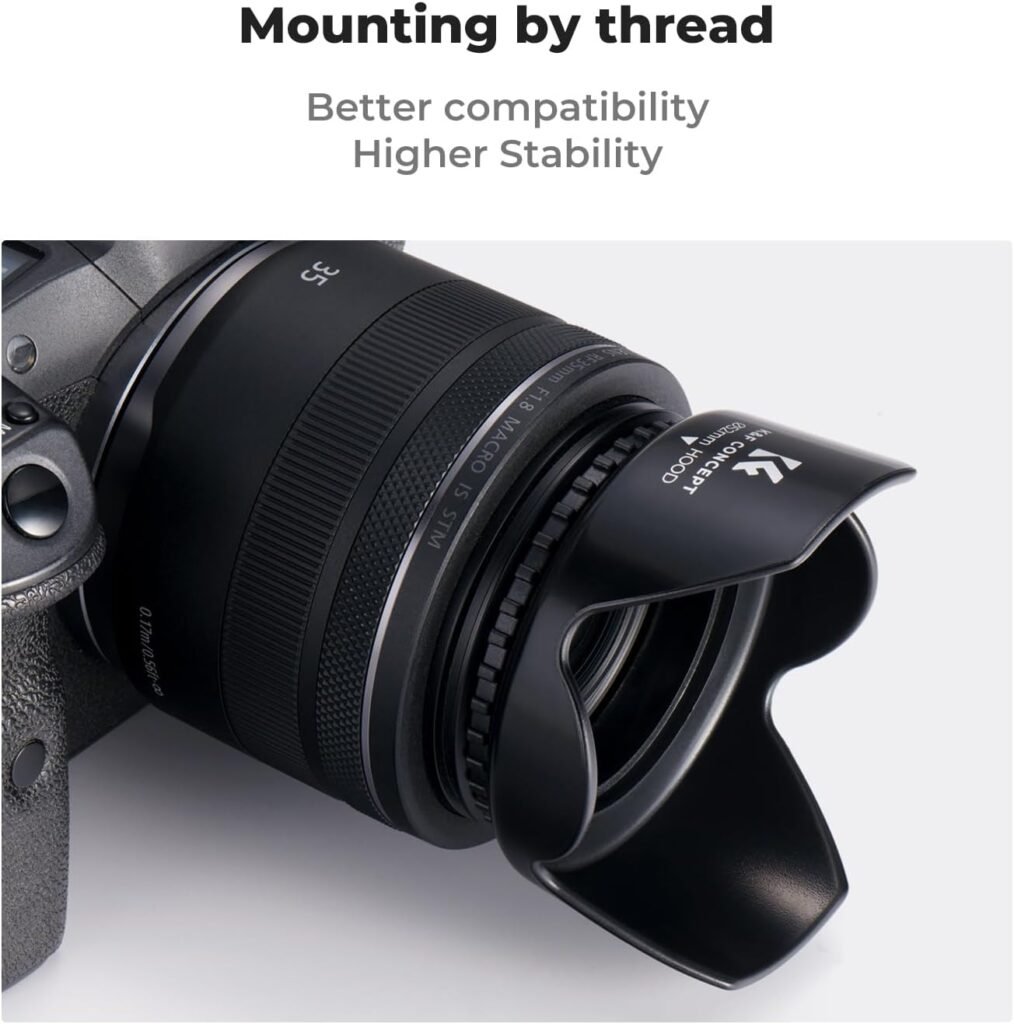
The K&F CONCEPT 52mm Tulip Flower Lens Hood can help reduce stray light, glare, and unwanted flare when used with a Nikon D3300 or D3200 lens that has a 52mm front filter thread. The hood does not attach to the camera body itself. Compatibility depends on the lens, not only the Nikon camera model.
For photographers in the United States, the key check is simple: look for the “Ø52” symbol or “52mm” marking on the front of the lens. If the lens uses another thread size, such as 55mm or 58mm, this hood will not fit directly.
Introduction: What This Lens Hood Does
A lens hood is a shield that blocks light coming from outside the lens’s normal viewing angle. That light can bounce inside the lens and create flare, washed-out contrast, or bright spots in a photo.
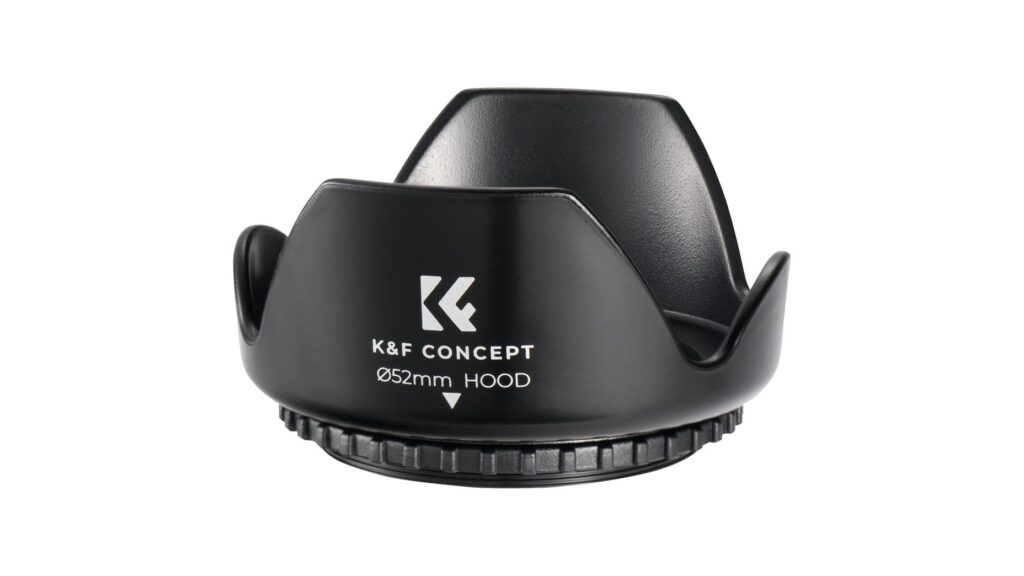
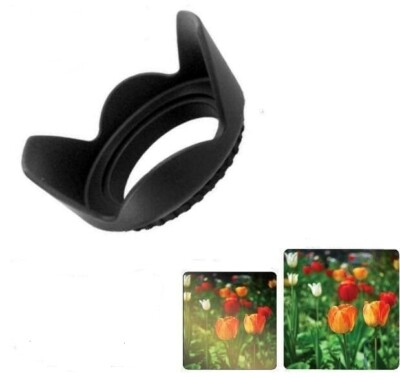
The K&F CONCEPT model uses a tulip, or petal-shaped, design. This shape aims to block stray light while leaving room for the wider field of view found at the edges of many zoom lenses.
For a Nikon D3300 or D3200 owner, this accessory may be useful for outdoor portraits, travel photos, street scenes, landscapes, and any shot taken near strong sunlight or bright lamps.

K&F CONCEPT 52mm Lens Hood Compatibility
The hood fits a lens only when the lens has a matching 52mm front thread. The Nikon D3300 and D3200 do not determine the thread size by themselves because both cameras can be used with many different lenses.
How to check your lens size
Look at the front rim of the lens. You may see a marking that looks like one of these:
- Ø52
- 52mm
- 52 mm
- A circle with a line through it followed by 52
You can also check the lens manual, the original box, or the manufacturer’s product page.
Common Nikon lenses that may use a 52mm thread
Some Nikon F-mount lenses used with the D3300 and D3200 have a 52mm filter thread. However, lens versions can differ, so confirm the marking on your specific lens before ordering.
The camera model alone is not enough to confirm compatibility. For example, a 52mm hood may fit one lens used on a D3300 but not another lens used on the same camera.
Compatibility checklist
| Check | What to confirm |
|---|---|
| Camera | Nikon D3300 or D3200 |
| Lens mount | Lens must be suitable for the camera |
| Front thread | Lens must have a 52mm filter thread |
| Hood connection | Hood must match the lens’s front thread or hood mount |
| Filter use | Confirm whether filters can remain attached |
| Lens view | Check for dark corners at the widest focal length |
A 52mm hood is not a universal Nikon accessory. It is a size-specific lens accessory.

How to Install the K&F CONCEPT 52mm Tulip Hood
Installation is usually quick if the hood uses a screw-in 52mm thread. Do not force it. Cross-threading can damage the lens filter thread or the hood.
Step-by-step installation
- Turn off the camera. This is not required for the hood, but it helps prevent accidental operation while you handle the lens.
- Remove the front lens cap.
- Check the threads. Make sure the lens and hood are clean and free of sand, grit, or dust.
- Align the hood. Place the hood straight against the 52mm front thread.
- Turn it slowly by hand. Rotate the hood in the normal tightening direction.
- Stop when it is secure. It should feel firm, but it does not need to be tightly forced.
- Set the petals correctly. If the hood has a fixed tulip shape, its longer petals should sit in the intended vertical position.
- Test the lens. Take a photo at the lens’s widest setting and inspect the corners.
Signs of correct installation
The hood is likely installed correctly when:
- It sits straight on the lens.
- It does not wobble.
- The lens can still focus and zoom normally.
- The hood does not touch the moving front element.
- No dark corners appear in the image.
- A filter, if used, can still turn as needed.
If the hood stops after only a partial turn, remove it and start again. A tilted hood can damage fine threads.
Why Use a Tulip Lens Hood?
The main benefit of a lens hood is better control of unwanted light. It is not a guaranteed fix for every flare problem, and it does not improve the camera sensor or lens sharpness by itself.
Reduced glare and flare
When bright light enters the lens from the side, it can reflect between internal lens surfaces. This may lower contrast or create colored shapes in the image.
A hood can block some of that light before it reaches the front element. It works best when the unwanted light comes from outside the frame.
Better contrast in difficult light
A hood may help preserve contrast when shooting:
- Near the sun
- Under bright outdoor lighting
- Near windows
- Around streetlights at night
- In open shade with strong light at the side
The effect depends on the lens, light angle, and scene. A hood cannot prevent flare when a strong light source is inside the image.
Basic front-element protection
A hood can also create a small barrier around the front of the lens. It may help protect the glass from light bumps, fingers, leaves, or light rain.
It is not a replacement for a lens cap or protective case. A hood also cannot protect the lens from a hard impact.

Limits of the K&F CONCEPT 52mm Hood
A tulip hood is useful, but it has limits. Understanding them can prevent frustration and unwanted dark corners.
It may cause vignetting
Vignetting is darkening near the corners of an image. It may occur when the hood extends too far into the lens’s field of view.
The risk is higher when:
- The hood is used on a lens with a wider view than expected.
- The hood is not the correct model for the lens.
- A thick filter is attached.
- Multiple filters are stacked.
- The hood is cross-threaded or mounted at an angle.
- The camera uses a crop or wide-angle lens combination that the hood does not suit.
Check the corners at the lens’s widest focal length. If dark corners appear, remove the hood and test again.
It may not fit every 52mm lens
A 52mm filter thread does not guarantee that every hood will work equally well. Lens barrels can have different shapes, front elements, filter positions, and clearance needs.
A hood may also interfere with:
- A rotating polarizing filter
- A variable neutral-density filter
- A thick protective filter
- A lens cap with an unusual design
- A built-in flash in certain close subjects
It does not block all flare
A hood only blocks light from some directions. If the sun or a lamp is in the frame, the hood cannot shield the lens from that source.
Your hand, a flag, or a change in shooting position may still be needed. Keep your hand outside the image area and away from the lens.

Using Filters With a 52mm Tulip Hood
Many photographers use a hood with a clear, UV, polarizing, or neutral-density filter. Whether this works well depends on the hood’s design and the filter’s thickness.
Standard filters
A slim or standard 52mm filter may fit between the lens and a screw-in hood if the hood is designed for that arrangement. Some hoods attach directly to the lens filter thread, while others may provide another thread for a filter or cap.
Do not assume that all versions have the same layout. Check the product diagram and the seller’s current specifications before purchase.
Circular polarizing filters
A circular polarizer needs to rotate while it is attached. If the hood covers the filter ring, adjustment may be difficult or impossible.
For a polarizer, look for a setup that lets you reach and turn the filter. Otherwise, install the filter first, set it, and then attach the hood only if the hood does not prevent adjustment.
Stacking filters
Stacking several filters increases the distance between the lens and the hood. This can raise the chance of vignetting, especially at wide focal lengths.
A practical approach is to use one filter at a time unless you have tested the full combination.
K&F CONCEPT 52mm Lens Hood: Pros and Cons
The right choice depends on your lens and shooting habits. A short comparison can make the decision easier.
| Potential advantage | Possible limitation |
|---|---|
| Helps block some off-axis light | Does not remove flare from light inside the frame |
| Tulip shape may suit many zoom lenses | The exact lens and focal range still matter |
| Can add a small amount of front-element protection | It may cause vignetting if the fit is wrong |
| Uses a common 52mm filter size | It will not fit lenses with other thread sizes |
| May be useful for outdoor photography | Filter access may be limited, depending on the design |
| Usually installs by hand | Cross-threading can damage fine threads |
The strongest reason to buy this hood is its potential to control stray light on a compatible 52mm lens. The weakest reason is expecting it to improve every photo or fit every Nikon lens.

Troubleshooting the K&F CONCEPT 52mm Lens Hood
Most problems come from the wrong thread size, poor alignment, or a hood that does not suit the lens’s field of view.
The hood will not screw on
Possible causes include:
- The lens does not use a 52mm thread.
- The hood is not aligned with the lens.
- Dirt or sand is in the threads.
- The hood or lens thread is damaged.
- A filter is already attached and changes the connection.
Remove the hood and inspect both sets of threads in good light. Never use pliers or excessive force.
The hood is loose
Remove it and reinstall it straight. If it still moves after light hand-tightening, inspect the threads for damage. A loose hood can rotate, block part of the image, or fall off.
Dark corners appear
Test the lens without the hood. If the corners become clear, the hood or filter combination is causing vignetting.
Try these steps:
- Remove any stacked filters.
- Test the hood without a filter.
- Check that the hood is fully and evenly attached.
- Test at different focal lengths.
- Confirm that the hood is intended for the lens’s angle of view.
The hood blocks the built-in flash
The D3300 and D3200 have pop-up flashes. A lens hood can sometimes cast a shadow in close subjects, especially when the hood is long or the lens is wide.
If a dark band appears, compare a flash photo with and without the hood. For close flash work, an external flash placed above the lens may provide better clearance.

Is This Hood Worth Buying for a Nikon D3300 or D3200?
The K&F CONCEPT 52mm Tulip Flower Lens Hood is worth considering when your lens has a confirmed 52mm front thread and you often shoot in bright, side-lit conditions.
It is less suitable when:
- Your lens uses a different thread size.
- You need easy access to a rotating polarizer.
- Your lens is very wide and the hood’s coverage is uncertain.
- You already have a manufacturer-approved hood that fits well.
- You expect the hood to prevent all flare.
Before buying, compare the hood’s current product listing with your lens model. Check the thread size, hood attachment method, filter compatibility, return policy, and user images if available. Product details can vary between versions and sellers.

Key Takeaways
- The K&F CONCEPT hood fits a 52mm lens thread, not every Nikon D3300 or D3200 lens.
- Check the lens for the Ø52 or 52mm marking before ordering.
- A tulip hood can reduce some side light, glare, and flare.
- It may offer limited protection for the front of the lens.
- Test for vignetting at the widest focal length.
- Use care with polarizers, thick filters, and the camera’s built-in flash.
- Never force the hood onto the lens.
Frequently Asked Questions
Does this K&F CONCEPT hood fit the Nikon D3300?
It can fit a lens used on the Nikon D3300 when that lens has a compatible 52mm front thread. The hood does not attach directly to the D3300 camera body.
Does it fit the Nikon D3200?
It can fit a compatible 52mm lens used on the Nikon D3200. Confirm the lens’s front thread size rather than relying only on the camera model.
How do I know if my Nikon lens is 52mm?
Look on the front rim of the lens for “Ø52” or “52mm.” You can also check the lens manual or manufacturer specifications.
Can I use a filter with this lens hood?
Possibly. The answer depends on the hood’s exact design and the filter’s thickness. A polarizing filter may need extra space so you can rotate it.
Will the hood stop lens flare?
It may reduce flare caused by light entering from outside the frame. It cannot block a bright light source that is inside the image or directly facing the lens.
Can I leave the hood attached while storing the camera?
Often, yes, if the hood is secure and does not press against the camera bag or lens. For storage, reverse the hood if the design allows it, or remove it to reduce pressure on the lens.
Conclusion
The K&F CONCEPT 52mm Tulip Flower Lens Hood is a lens accessory for compatible 52mm lenses used with Nikon D3300 and D3200 cameras. Its main purpose is to limit stray light and help protect the front of the lens.
The deciding step is simple: check the lens, not just the camera. If the lens has a 52mm thread, install the hood gently, test the corners at the widest setting, and confirm that your filters and flash still work as expected.

