
For photographers in the United States, the Canon RF100-500mm F4.5-7.1 L IS USM is a long-range zoom for Canon EOS R mirrorless cameras. It covers wildlife, birds, outdoor sports, aircraft, and distant details without the weight and cost of a large fixed super-telephoto lens.
The lens combines a 100-500mm focal range, optical image stabilization, fast Nano USM autofocus, and Canon’s professional L-series build. Its main trade-off is the narrow f/4.5-7.1 aperture. That means it works best in good light or with a camera that handles higher ISO settings well.
This guide explains the lens specifications, real-world uses, teleconverter limits, camera compatibility, handling, and the buyers who should consider it.

Canon RF100-500mm F4.5-7.1 L IS USM: Quick Answer
The Canon RF100-500mm F4.5-7.1 L IS USM is one of the most versatile native telephoto zooms for Canon’s full-frame EOS R system. Its 100-500mm range gives you both a useful medium telephoto view and strong reach for distant subjects.
It is a strong fit for:
- Wildlife photographers
- Bird photographers
- Outdoor sports shooters
- Aviation photographers
- Travel photographers who need reach
- Nature photographers working in daylight
- Canon EOS R users who want one long zoom instead of several lenses
It is less suitable for:
- Indoor sports in dim gyms
- Night wildlife work
- Portraits that require a very bright aperture
- Photographers who need a constant f/4 or f/2.8 aperture
- Users of Canon EF, EF-S, or non-Canon RF-mount cameras
The key decision is simple: choose this lens for reach, flexibility, stabilization, and manageable size. Choose a faster telephoto lens when shutter speed and low-light performance matter more than portability.
Key Specifications
The Canon RF100-500mm F4.5-7.1 L IS USM uses Canon’s RF mount and is designed for EOS R-series cameras. Canon lists it as a full-frame lens, but it also works on compatible Canon APS-C EOS R cameras.
| Feature | Canon RF100-500mm F4.5-7.1 L IS USM specification |
|---|---|
| Focal length | 100-500mm |
| Maximum aperture | f/4.5-7.1 |
| Minimum aperture | f/32-51 |
| Lens mount | Canon RF |
| Format | Full frame |
| Optical design | 20 elements in 14 groups |
| Diaphragm blades | 9 |
| Minimum focus distance | 0.9m at 100mm; 1.2m at 500mm |
| Maximum magnification | Approximately 0.33x |
| Image stabilization | Up to 5 stops, depending on conditions and camera |
| Filter size | 77mm |
| Approximate length | 207.6mm |
| Approximate weight | 1,370g without the tripod mount |
| Autofocus motor | Dual Nano USM |
| Extender compatibility | Canon RF 1.4x and 2x extenders in a limited zoom range |
The lens has a variable aperture. At 100mm, the maximum aperture is f/4.5. As you zoom, the aperture becomes smaller. At 500mm, the maximum aperture is f/7.1.
That change affects exposure and autofocus conditions. It does not mean the lens is poor at 500mm. It means you may need a faster shutter speed, higher ISO, more light, or exposure compensation when working at the long end.

What the 100-500mm Focal Range Means
The 100-500mm range lets you change framing without moving closer to the subject. At 100mm, the lens can include a larger animal, athlete, or aircraft. At 500mm, it can isolate a distant bird or fill the frame with a small subject.
On a full-frame Canon EOS R camera:
- 100mm works for larger wildlife, close sports action, and environmental details.
- 200-300mm suits many field sports, large birds, and medium-distance animals.
- 400-500mm provides the reach needed for small birds and distant subjects.
On a Canon APS-C EOS R camera, the field of view is narrower. Canon APS-C models use a 1.6x crop factor, so the view is similar to a 160-800mm lens on full frame. This does not change the physical focal length or aperture, but it increases the subject’s apparent size in the frame.
A longer focal length also magnifies camera shake. Even with image stabilization, good technique still matters. Use a fast shutter speed for moving subjects and support the lens when practical.
Image Stabilization and Handheld Shooting
The RF100-500mm includes optical image stabilization, which helps reduce blur caused by camera movement. Canon rates the system at up to 5 stops under its stated test conditions. The actual benefit depends on focal length, camera movement, subject movement, and shooting technique.
Stabilization helps with a stationary subject. It cannot freeze a flying bird, running athlete, or moving car. For those subjects, shutter speed remains the main control.
Useful starting shutter speeds include:
- Stationary subjects: 1/250 second or faster at 500mm
- Walking animals: 1/500 second or faster
- Birds in flight: 1/1600 second or faster
- Fast sports: 1/1000 second or faster
These are starting points, not fixed rules. A perched bird may remain sharp at a slower speed. A bird flapping its wings may need a much faster setting.
Some compatible EOS R cameras can combine in-body image stabilization with lens stabilization. Canon describes this as coordinated control, but the exact benefit varies by camera model and shooting mode. Check the manual for your camera before relying on a specific stop rating.

Autofocus Performance for Wildlife and Sports
The lens uses two Nano USM motors. This design supports fast, quiet autofocus for still photography and video. It also provides smooth focus changes in many video situations.
Autofocus performance depends on the camera body, light level, subject contrast, tracking settings, and subject movement. The lens cannot compensate for an unsuitable AF setup.
For wildlife and sports, start with:
- Use Servo AF for moving subjects.
- Select an animal, subject, or tracking mode supported by your camera.
- Set a shutter speed that matches the movement.
- Use a suitable burst mode.
- Keep the subject separated from busy backgrounds when possible.
- Review focus at 100% magnification after the session.
The lens includes a focus limiter with a range of 3 meters to infinity. Use this setting when your subject will remain beyond 3 meters. It can reduce unnecessary focus travel and help the camera reacquire distant subjects more quickly.
The lens also has a customizable control ring. You can assign functions such as aperture, ISO, or exposure compensation through a compatible camera. Turn the ring slowly to avoid accidental changes during a fast sequence.
Optical Design and Image Quality
The Canon RF100-500mm F4.5-7.1 L IS USM uses special glass elements to control common telephoto problems. Canon lists six UD elements and one Super UD element in the optical design. The lens also uses Canon’s Air Sphere Coating to help reduce flare and ghosting.
These features are designed to improve contrast and limit color fringing. Results still depend on light, atmospheric haze, focus accuracy, shutter speed, and post-processing.
At 500mm, distant subjects may look less crisp because of air pollution, heat shimmer, fog, or humidity. This is often called atmospheric distortion. It comes from the air between the camera and subject, not necessarily from the lens.
The nine-blade aperture can produce a rounded background blur when the lens is used near its maximum aperture. However, the f/7.1 maximum aperture at 500mm gives less background separation than a 400mm f/2.8 or 600mm f/4 lens.
That trade-off is central to this lens. It offers a lighter and more flexible package, but it does not deliver the same low-light performance or background blur as a large, fast prime lens.

Build Quality, Controls, and Handling
The RF100-500mm is part of Canon’s L-series. It is built for demanding outdoor use and includes sealing against dust and moisture when used correctly with a compatible sealed camera body.
Weather resistance does not mean waterproofing. Avoid heavy rain, spray, sand, and rapid temperature changes unless you use proper protection. A weather-sealed lens can still be damaged through an open mount, control area, or accessory connection.
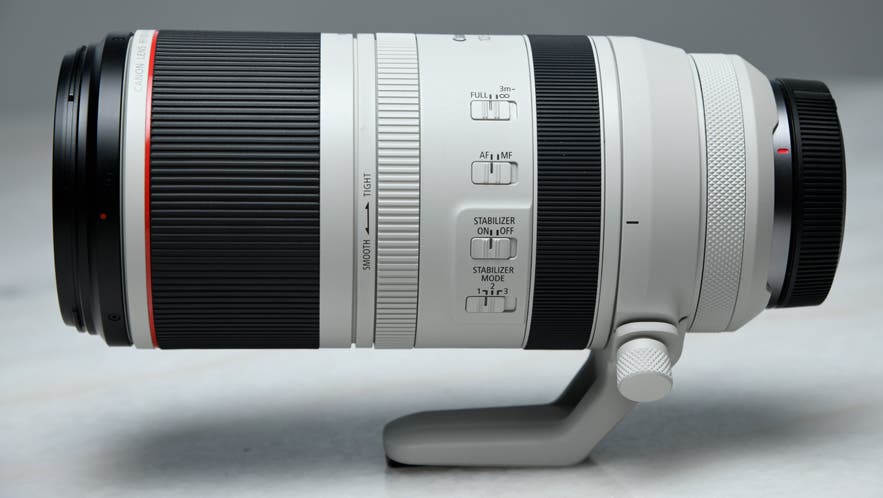
The lens includes several physical controls:
- Focus mode switch
- Focus limiter switch
- Image stabilization switch
- Stabilizer mode switch
- Custom control ring
- Zoom ring
- Focus ring
- Zoom touch adjustment ring
- Zoom lock
The zoom lock helps prevent the barrel from extending while carrying the lens. The zoom touch adjustment ring can control how quickly the lens moves through its focal range.
The lens is approximately 1,370 grams without the tripod mount. That is substantial for long handheld sessions but lighter than many professional 400mm, 500mm, and 600mm prime lenses.
A monopod, tripod, or shoulder support can reduce fatigue. Hold the lens by its barrel or tripod collar area rather than placing all the strain on the camera mount.
Canon RF Extender Compatibility
The Canon RF100-500mm F4.5-7.1 L IS USM can work with Canon RF1.4x and RF2x extenders, but only at part of its zoom range.
The lens must be set between approximately 300mm and 500mm before the extender is attached. At shorter focal lengths, the rear optical group can interfere with the extender. Do not force the extender onto the lens.
With the extenders attached, the approximate combinations are:
| Setup | Approximate focal range | Maximum aperture at the long end |
|---|---|---|
| Lens alone | 100-500mm | f/4.5-7.1 |
| RF1.4x Extender | 420-700mm | f/6.3-10 |
| RF2x Extender | 600-1000mm | f/9-14 |
The exact usable range and autofocus behavior can depend on the camera body. The extender also reduces the amount of light reaching the sensor. At the long end, the RF2x combination becomes very slow, so bright conditions and a camera with strong autofocus performance are important.
An extender is useful when you need more reach and can accept a narrower aperture. It is not a replacement for a faster, dedicated super-telephoto lens in low light.
Best Uses for the Canon RF100-500mm
Wildlife Photography
This lens is well suited to wildlife because animals may move from close range to far away in seconds. The 100mm end helps when a large animal approaches. The 500mm end helps when the animal stays distant.
Its stabilization, autofocus, and weather-resistant design also support outdoor work. Use a faster shutter speed for moving animals, and raise ISO when the light falls.
Bird Photography
Bird photographers benefit from the 500mm reach. On an APS-C EOS R body, the narrower field of view can make small birds appear larger in the frame.
The lens is strongest in daylight. Early morning and late evening may require higher ISO settings or an RF1.4x extender only when the added reach is more valuable than the loss of light.
Outdoor Sports
The 100-500mm range works well for field sports, motorsports, equestrian events, and outdoor competitions. The 100-200mm range can cover nearby action, while 400-500mm can reach distant players or subjects.
For indoor sports, the f/4.5-7.1 aperture may be limiting. A 70-200mm f/2.8 lens or a faster prime may be a better choice when lighting is poor.
Aviation and Landscape Details
The lens can isolate aircraft, distant buildings, mountain details, and compressed layers in a landscape. At 500mm, heat haze can affect distant scenes, especially over pavement or dry ground.
A tripod or monopod helps for static subjects. Use live view magnification or image review to confirm sharpness when the subject is far away.

Canon RF100-500mm vs. RF600mm F11 and RF800mm F11
The RF600mm F11 IS STM and RF800mm F11 IS STM are smaller and often less expensive options for photographers who mainly work in bright daylight. They are fixed-focal-length lenses, while the RF100-500mm is a zoom.
| Feature | RF100-500mm F4.5-7.1 L IS USM | RF600mm F11 IS STM | RF800mm F11 IS STM |
|---|---|---|---|
| Focal length | 100-500mm zoom | 600mm prime | 800mm prime |
| Maximum aperture | f/4.5-7.1 | f/11 | f/11 |
| Framing flexibility | High | Low | Low |
| Low-light advantage | Higher | Lower | Lower |
| Portability | Moderate | Higher | Higher |
| Professional build | L-series | Consumer-oriented | Consumer-oriented |
| Best strength | Versatility | Affordable reach | Maximum reach at low weight |
Choose the RF100-500mm when you need to change framing quickly or work in changing light. Choose an RF600mm or RF800mm when reach, lower weight, and a lower purchase cost matter more than zoom flexibility.
Who Should Buy This Lens?
The Canon RF100-500mm F4.5-7.1 L IS USM makes sense when you already use a Canon EOS R camera and want a single high-quality telephoto zoom.
It is especially suitable if you:
- Photograph wildlife in daylight
- Need 500mm reach but also use shorter focal lengths
- Want image stabilization for handheld shooting
- Prefer a zoom to a fixed super-telephoto lens
- Travel with camera gear
- Need weather resistance for outdoor work
- Want the option to use a Canon RF extender at the long end
Consider another lens if you:
- Often shoot in dark conditions
- Need strong subject separation
- Photograph indoor sports
- Require a constant aperture
- Use an EF-mount camera without an RF-compatible body
- Need a very light lens for long hikes
The lens is expensive compared with entry-level telephoto options, but its value comes from its range, construction, autofocus system, and native integration with Canon EOS R cameras. Check current U.S. pricing, stock, warranty terms, and refurbished options before buying because those details change.

Setup Tips for Better Results
Use these steps when setting up the RF100-500mm for a wildlife or sports session:
- Update the camera and lens firmware. Use Canon support pages for your exact body and lens.
- Set Servo AF for moving subjects. One-shot AF suits subjects that remain still.
- Choose a suitable shutter speed. Start around 1/1000 second for active wildlife or sports.
- Use Auto ISO when light changes quickly. Set an ISO limit that fits your camera’s noise performance.
- Set the focus limiter. Use 3 meters to infinity when close subjects are not part of the session.
- Select the correct stabilization mode. Follow Canon’s camera and lens instructions for panning or static subjects.
- Support the lens when possible. A monopod can help during long sessions.
- Check the histogram and highlights. Bright feathers, white uniforms, and aircraft can clip quickly.
- Review focus at full size. A small camera preview can hide missed focus.
- Protect the front element. A hood and a clean 77mm filter, when appropriate, can help in difficult outdoor conditions.
If autofocus hunts, first check the light and subject contrast. Then confirm the focus limiter, AF mode, tracking settings, and shutter speed. Do not assume that a missed frame means the lens is defective.
Common Limitations and Mistakes
Mistake: Expecting f/7.1 to perform like f/2.8
The lens cannot gather as much light as a 300mm or 400mm f/2.8 lens. In low light, you may need higher ISO, a slower shutter speed, or a different lens.
Mistake: Using too slow a shutter speed for action
Image stabilization reduces camera shake, but it does not stop subject movement. Use a fast shutter speed for birds, athletes, and animals.
Mistake: Forcing an RF extender onto the lens
Use Canon’s documented focal-length range for extender installation. Never force the extender or lens into place.
Mistake: Treating weather resistance as waterproofing
Use a rain cover in severe weather. Dry the equipment before storing it, and avoid changing lenses in blowing dust or rain.
Mistake: Judging sharpness through heat haze
Distant subjects can look soft because of warm, moving air. Test the lens on a nearby subject before assuming there is an optical problem.
Canon RF100-500mm FAQ
Is the Canon RF100-500mm compatible with Canon DSLR cameras?
No. The lens uses the Canon RF mount and is designed for EOS R mirrorless cameras. It does not mount directly on Canon EF or EF-S DSLR cameras.
Can I use the RF100-500mm on an APS-C Canon EOS R camera?
Yes, if the camera has a compatible RF mount. The camera’s crop factor gives a narrower field of view similar to about 160-800mm on full frame. The lens remains a 100-500mm lens in physical terms.
Is 500mm enough for bird photography?
It can be enough for many birds, especially in good light or on an APS-C EOS R camera. Very small or distant birds may still require an RF1.4x extender, cropping, or a longer lens.
Does the lens have a constant aperture?
No. Its aperture changes from f/4.5 at the wide end to f/7.1 at the long end. The camera may raise ISO or slow the shutter speed as you zoom in, depending on exposure settings.
Can I handhold the Canon RF100-500mm?
Yes. Its optical stabilization supports handheld shooting, especially for stationary subjects. For action, use a fast shutter speed. A monopod or tripod can improve comfort and consistency.
Is the Canon RF100-500mm good for video?
It can be useful for outdoor video because it offers a wide telephoto range, stabilization, and quiet Nano USM autofocus. Its size, variable aperture, and changing field of view may be less convenient for controlled indoor production.
Key Takeaways
- The Canon RF100-500mm F4.5-7.1 L IS USM is a full-frame RF-mount telephoto zoom for Canon EOS R cameras.
- Its 100-500mm range is useful for wildlife, birds, outdoor sports, aviation, and nature details.
- Optical stabilization and dual Nano USM autofocus support handheld shooting and moving subjects.
- The f/4.5-7.1 aperture is the main limitation in dim light.
- Canon RF1.4x and RF2x extenders can be used only within a limited long-end zoom range.
- The lens is not compatible with Canon DSLR bodies.
- It is a strong choice for daylight shooters who value reach and flexibility more than a bright aperture.
Conclusion
The Canon RF100-500mm F4.5-7.1 L IS USM is a versatile super-telephoto zoom for photographers in the United States who use Canon EOS R cameras. It offers a useful combination of reach, stabilization, autofocus, weather-resistant construction, and manageable size.
Its variable f/4.5-7.1 aperture limits low-light performance, but that compromise keeps the lens more practical than many large professional primes. For daylight wildlife, bird, sports, and aviation photography, it is a well-balanced option.
Before buying, confirm your camera uses the RF mount, decide whether you need low-light performance, and compare the current U.S. price with Canon’s RF600mm F11, RF800mm F11, and faster professional telephoto lenses.
Official Reference
Specifications and compatibility information should be checked against the current Canon USA product page and the manuals for your specific EOS R camera and RF extender. Canon may update firmware, product availability, and regional support details over time.

