
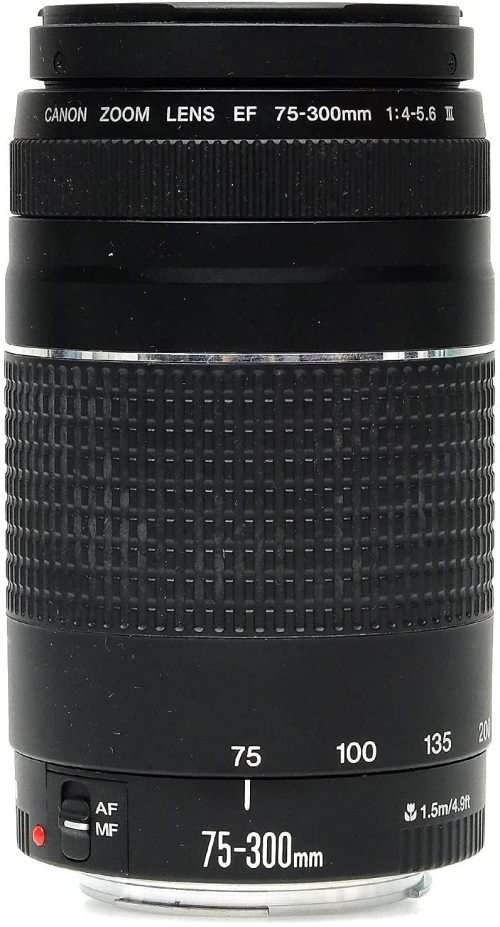
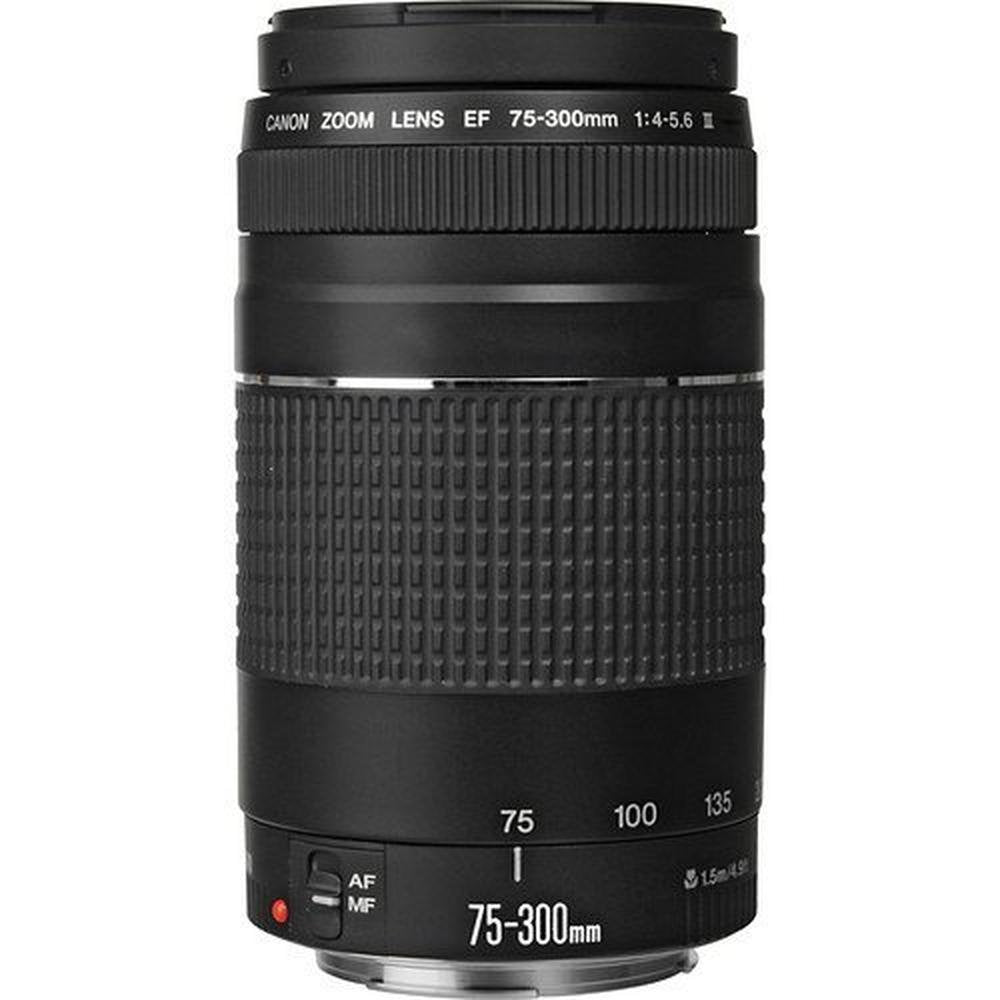
The Canon EF 75-300mm f/4-5.6 III is a basic telephoto zoom lens for Canon EOS SLR and DSLR cameras in the United States. It offers a useful 4x zoom range, low weight, and low used-market cost. Its main limits are the lack of image stabilization, the basic autofocus motor, and modest sharpness at 300mm.
This lens can work well for outdoor sports, wildlife in good light, school events, travel, and casual portraits. It is less suitable for dim gyms, fast-moving subjects after sunset, or photographers who need the sharpest detail at the long end.
The phrase “Canon SL” usually refers to a Canon SLR or DSLR camera. The lens itself is not an EOS R mirrorless lens. It uses Canon’s EF mount.
Key Takeaways
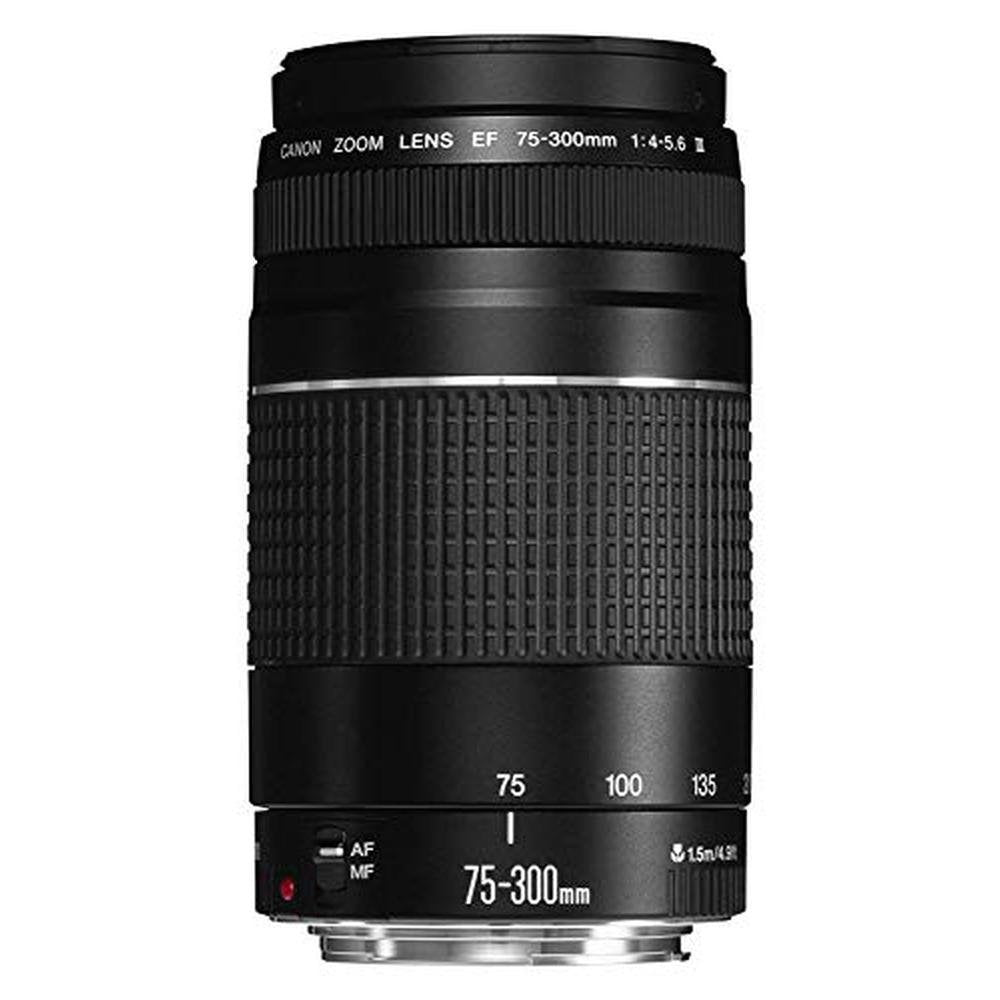
- The lens covers 75mm to 300mm.
- Its maximum aperture is f/4 at 75mm and f/5.6 at 300mm.
- It has no built-in image stabilization.
- It uses a basic autofocus motor rather than Canon USM.
- It works directly on Canon EOS cameras with an EF mount.
- It works on Canon EF-S DSLR bodies, with a crop-factor view similar to 120-480mm on full frame.
- It can work on Canon EOS R mirrorless cameras with a suitable EF-to-RF adapter.
- It is not a direct-fit lens for Canon RF mirrorless cameras.
- It uses 58mm filters.
- Its minimum focus distance is about 1.5 meters, or 4.9 feet.
- It is best used in bright outdoor light.
Canon EF 75-300mm f/4-5.6 III Specifications
The following specifications describe the standard Canon EF 75-300mm f/4-5.6 III, not the separate 75-300mm versions with image stabilization or USM autofocus.
| Feature | Specification |
|---|---|
| Lens mount | Canon EF |
| Focal-length range | 75-300mm |
| Maximum aperture | f/4 to f/5.6 |
| Minimum aperture | f/32 at 75mm; f/45 at 300mm |
| Optical design | 13 elements in 9 groups |
| Minimum focus distance | 1.5m / 4.9 ft |
| Maximum magnification | Approximately 0.25x |
| Filter size | 58mm |
| Diaphragm | 7 blades |
| Autofocus | Built-in basic DC motor |
| Image stabilization | No |
| Approximate size | 71mm diameter × 122mm long |
| Approximate weight | 480g / 16.9 oz |
Canon produced several 75-300mm lenses. The original 75-300mm models, the 75-300mm f/4-5.6 II, the 75-300mm f/4-5.6 III, the USM versions, and the IS USM version are not identical. Check the exact label before buying.
The “III” version is the basic model. It does not have USM autofocus and does not have optical image stabilization. Those missing features help explain its lower price compared with Canon’s more advanced telephoto zoom lenses.
What the focal length means
At 75mm, the lens gives a short telephoto view. This works well for head-and-shoulder portraits and subjects that are not far away.
At 300mm, the lens brings distant subjects much closer in the frame. This is useful for birds, field sports, and wildlife. The long end can feel powerful, but it also makes camera shake more visible.
On a full-frame Canon camera, 300mm is a true 300mm field of view. On a Canon APS-C DSLR, the crop factor makes the view similar to a 120-480mm lens on full frame. The lens does not become optically longer; the smaller sensor simply records a narrower part of the image.
Camera Compatibility: Which Canon Cameras Can Use It?
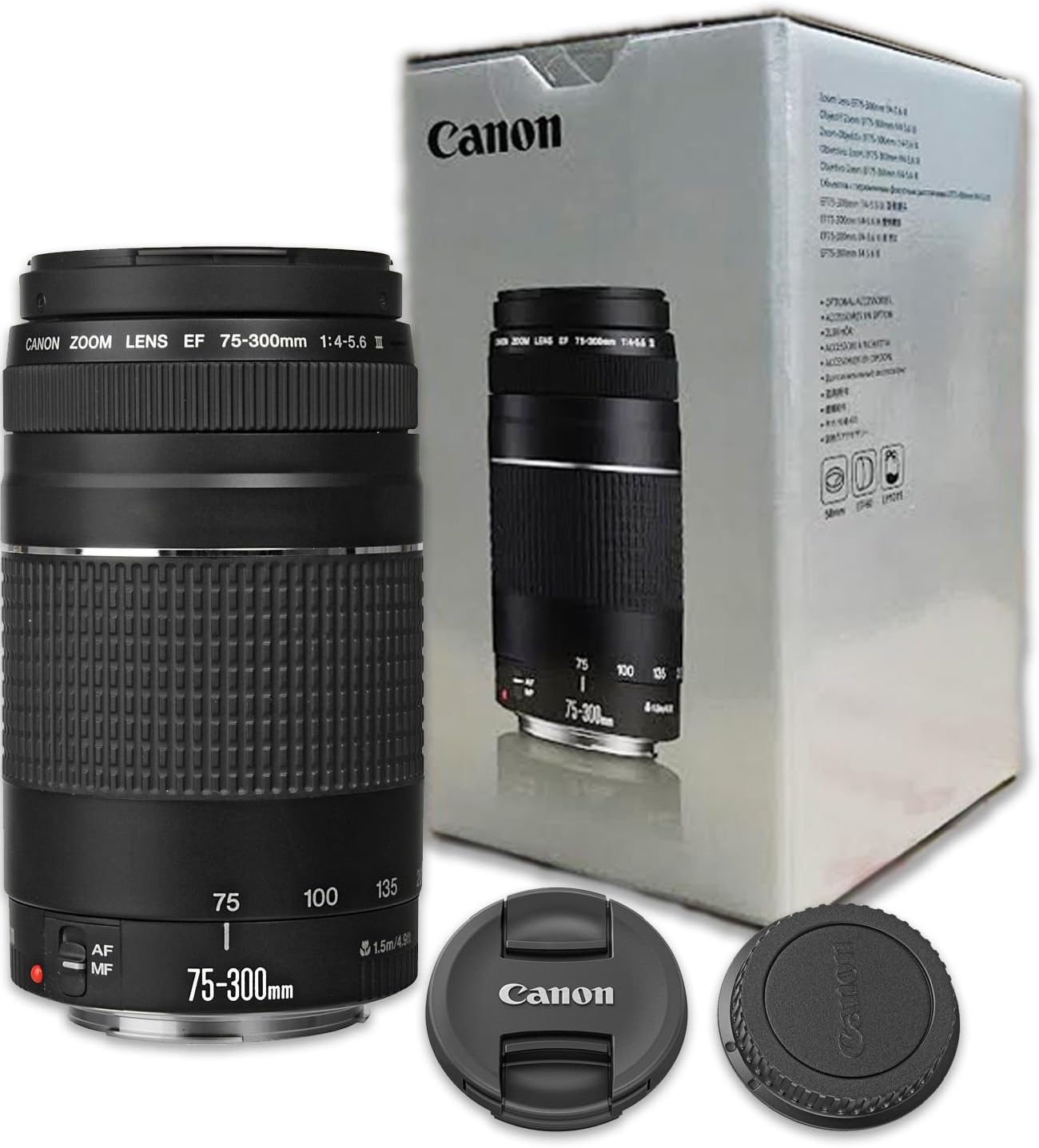
The Canon EF 75-300mm f/4-5.6 III mounts directly on Canon EOS film SLRs and Canon EOS DSLRs that accept EF lenses. It also mounts directly on Canon EOS cameras with an EF-S lens mount because EF-S bodies accept Canon EF lenses.
Examples include many Canon Rebel models, the EOS 20D through 90D family, and full-frame EOS DSLRs such as the 5D and 6D series. Compatibility can vary with very old film bodies, so check the camera manual if you use a vintage EOS model.
Canon EOS R mirrorless cameras
The lens does not mount directly on an EOS R, RP, R7, R8, R10, R50, R6, or similar RF-mount camera. You need a Canon EF-EOS R Mount Adapter or a compatible third-party adapter.
With a proper adapter, autofocus and electronic aperture control generally remain available because the adapter provides electronic communication between the EF lens and RF camera. Performance can vary by camera body, adapter, subject, and lighting.
Canon PowerShot and non-Canon cameras
The lens does not fit Canon PowerShot cameras. It also does not directly fit Canon’s older FD-mount cameras, Nikon cameras, Sony E-mount cameras, or Micro Four Thirds cameras.
Adapters for other systems may exist, but they can remove autofocus, aperture control, or electronic communication. For regular use, buy the lens only when you have a compatible EF camera or a suitable adapter system.

Image Quality and Real-World Performance
The Canon EF 75-300mm f/4-5.6 III can produce useful images, but its performance depends strongly on focal length, aperture, light, and focus accuracy.
Images are usually easier to keep sharp from 75mm to roughly 200mm. At 300mm, detail may look softer, especially when the lens is used wide open at f/5.6. Stopping down by about one stop can improve detail in good light, although the slower shutter speed may increase blur.
This lens is not a macro lens. Its close-focus distance is about 1.5 meters, so it cannot fill the frame with very small subjects. It can still make a flower, pet, or portrait subject appear larger than a standard kit lens would from the same position.
Aperture and low light
The lens becomes darker as you zoom:
- 75mm: maximum aperture of f/4
- Around the middle of the zoom range: roughly f/4.5 to f/5
- 300mm: maximum aperture of f/5.6
An f/5.6 aperture lets in less light than an f/2.8 telephoto lens. The camera may need a slower shutter speed, a higher ISO setting, or both. In a bright American outdoor setting, this may be manageable. In a dim school gym or evening stadium, it can become a major limitation.
Background blur
The 300mm setting can create a blurred background when the subject is far from the background. However, the f/5.6 maximum aperture does not create the same strong background separation as a faster professional lens.
For portraits, use 135mm to 200mm when possible. Stand farther from the subject, place the subject away from the background, and use the widest practical aperture.
Autofocus
The built-in autofocus motor is functional but basic. It is not the same as Canon’s ring-type USM system. Autofocus may be slower and noisier, and it may struggle more in low light or with subjects moving toward the camera.
For sports or wildlife:
- Use a suitable continuous autofocus mode, such as AI Servo on compatible Canon DSLRs.
- Select a focus point or zone that can stay on the subject.
- Use a fast enough shutter speed.
- Keep the subject under good light.
- Take several frames when the action is unpredictable.
The lens can focus on moving subjects, but it is not designed as a high-speed professional sports lens.

How to Use the Lens for Sharp Photos
The biggest challenge is camera shake. At 300mm, even a small movement can soften the image. Because the Canon EF 75-300mm f/4-5.6 III has no image stabilization, the photographer must control shutter speed and camera support.
A practical starting point is to use a shutter speed near 1/300 second at 300mm on a full-frame camera. On an APS-C camera, a faster speed may help because the narrower field of view makes shake more obvious. This is a starting point, not a fixed rule.
For a moving subject, use a faster shutter speed:
| Subject | Useful starting shutter speed |
|---|---|
| Still subject with steady hands | Around 1/300 sec at 300mm |
| Walking person | 1/250 to 1/500 sec |
| Children or casual action | 1/500 to 1/1000 sec |
| Field sports or fast wildlife | 1/1000 sec or faster |
These are practical starting points, not guaranteed settings. Light, subject speed, camera technique, and camera resolution all affect the result.
A simple outdoor setup
For a bright outdoor subject, try:
- Aperture: f/5.6 to f/8
- Shutter speed: 1/500 second or faster
- ISO: Auto ISO or the lowest setting that supports the shutter speed
- Autofocus: continuous autofocus for movement
- Drive mode: continuous shooting for action
- Support: monopod or tripod when practical
If the photo is blurry across the whole subject, suspect camera shake or subject movement. If one small area is sharp and the rest is not, the focus point may have landed in the wrong place.
When to use a tripod or monopod
A tripod helps with still subjects, landscapes, distant buildings, and moon photography. A monopod is often more practical for sports and wildlife because it supports the lens while allowing faster movement.
Turn off lens stabilization only if you are using another lens that has stabilization. The EF 75-300mm III has no stabilization switch because it has no optical IS system.

Common Problems and Fixes
The lens will not autofocus
First, check that the lens is firmly mounted. Remove it, inspect the contacts, and attach it again with the camera switched off.
Then check the focus switch. Set it to AF for autofocus or MF for manual focus. Clean electronic contacts only with appropriate care; do not scrape them with metal tools or apply liquid inside the mount.
If autofocus still fails:
- Test the lens in bright light.
- Try a nearby subject within the focus range.
- Test another compatible EF lens on the camera.
- Test the 75-300mm lens on another compatible camera if available.
If other lenses autofocus but this one does not, the lens may have a motor, contact, or internal cable fault.
The image is dark
The lens has a variable maximum aperture. The camera may show f/4 at 75mm and f/5.6 at 300mm. This is normal.
If the image remains too dark, raise ISO, slow the shutter speed for a still subject, add light, or use a faster lens. Do not expect the lens to maintain f/4 throughout the zoom range.
The image is soft at 300mm
Softness at 300mm can result from several causes:
- Camera shake
- Subject movement
- Atmospheric haze
- Incorrect focus
- Wide-open aperture
- A damaged or decentered lens
- Heat shimmer over long distances
Test the lens on a stationary subject in good light. Use a tripod, one-shot autofocus, a remote release or timer, and a shutter speed of at least 1/500 second. Compare results at 75mm, 200mm, and 300mm. If one side of the frame is consistently much softer than the other, the lens may need professional inspection.
The lens will not focus close up
The minimum focus distance is about 1.5 meters. Move back if the subject is too close. The focus ring cannot overcome the lens’s minimum focus limit.
The zoom feels stiff or loose
A slightly firm zoom ring can be normal on an older lens. Grinding, clicking, sudden looseness, or zoom creep may indicate wear or damage. Test the lens through its full range before buying used.
Buying a Used Canon EF 75-300mm f/4-5.6 III
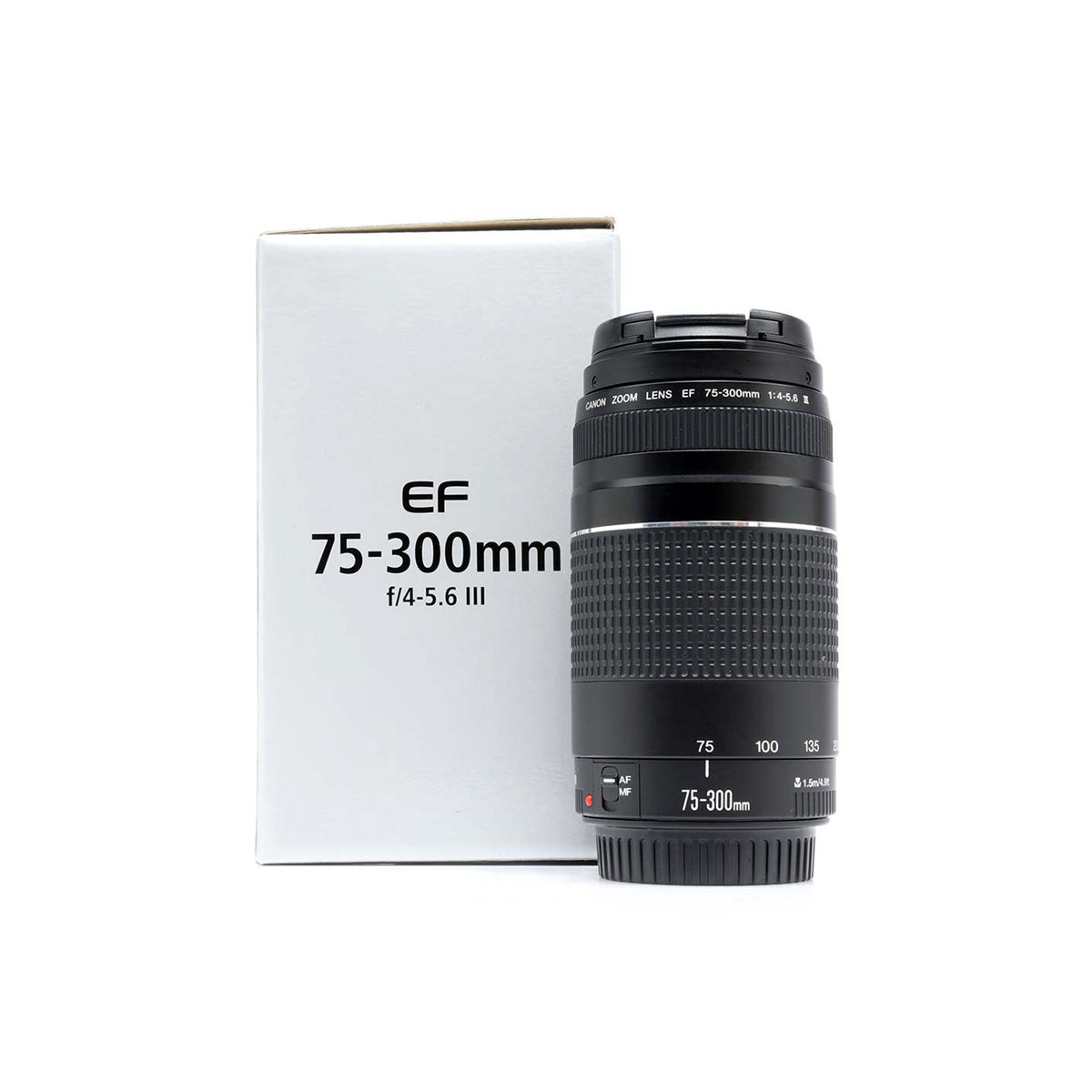
Because this is an older and commonly traded lens, condition matters more than cosmetic appearance. A few marks on the outer barrel may not affect photos, while internal haze or a faulty autofocus motor can matter greatly.
Before buying, check:
- Front and rear glass: Look for deep scratches, cracks, fungus, and heavy haze.
- Internal dust: A small amount of dust is common in older zoom lenses. Heavy dust can reduce contrast.
- Zoom movement: The ring should turn without grinding.
- Focus movement: Manual focus should feel controlled.
- Autofocus: Test near and far subjects at both 75mm and 300mm.
- Aperture control: Confirm that the camera changes aperture as the lens zooms.
- Mount: Check for bent parts, loose screws, or damaged electronic contacts.
- Filter thread: Confirm that a 58mm filter can attach without cross-threading.
- Sample images: Ask for full-size photos if the purchase is online.
- Return terms: A return period is valuable because optical faults may not be visible in a quick inspection.
Do not pay a premium for the basic EF 75-300mm III simply because it reaches 300mm. The cheaper price reflects its older design and missing features. A used Canon EF-S 55-250mm IS STM may be a better choice for an APS-C DSLR user who values stabilization and sharper everyday results, although it does not provide the same 300mm reach.

Canon EF 75-300mm III vs. Other Canon Telephoto Options
The right alternative depends on the camera body and the type of photography.
| Lens | Main advantage | Main limitation |
|---|---|---|
| EF 75-300mm f/4-5.6 III | Low cost and 300mm reach | No IS; basic autofocus |
| EF 75-300mm IS USM | Image stabilization and stronger autofocus design | Older, heavier, often costlier used |
| EF-S 55-250mm IS STM | Good stabilization and quiet STM focus on APS-C DSLRs | Does not fit full-frame EF DSLRs; reaches only 250mm |
| EF 70-300mm IS II USM | Faster autofocus and stronger overall performance | Usually costs more |
| RF 100-400mm IS USM | Native RF compatibility and modern stabilization | Requires an RF camera and a larger budget |
The EF 75-300mm III makes the most sense when the buyer already owns an EF or EF-S Canon DSLR and wants the lowest-cost route to a 300mm field of view.
For an APS-C DSLR user photographing family events or outdoor sports, the EF-S 55-250mm IS STM can be easier to use because stabilization helps with hand-held shooting. For a full-frame DSLR owner, the EF 75-300mm III remains one of the inexpensive native options, but the 70-300mm IS USM models are generally more capable.
Is the Canon EF 75-300mm f/4-5.6 III Worth Buying?
The lens is worth considering when price, size, and reach matter more than speed or advanced autofocus. It can produce pleasing results in daylight, especially when stopped down slightly and supported with good technique.
It is a weaker choice when you need reliable sharpness at 300mm, hand-held shooting in dim light, quiet autofocus for video, weather sealing, or strong subject tracking. The lack of image stabilization is the most important practical limitation.
Before buying, confirm three things:
- Your camera accepts Canon EF lenses or has a suitable EF-to-RF adapter.
- The used lens has working autofocus and clean optics.
- Your subjects are usually in enough light for a 300mm f/5.6 lens.
Frequently Asked Questions
Does the Canon EF 75-300mm f/4-5.6 III have image stabilization?
No. The standard EF 75-300mm f/4-5.6 III does not include Canon optical image stabilization. Use a faster shutter speed, a tripod, a monopod, or a camera body with sensor-based stabilization where supported.
Is this lens compatible with Canon Rebel cameras?
Yes. Canon Rebel DSLR cameras with EF-S mounts can generally use Canon EF lenses, including this 75-300mm model. It provides a narrower field of view on the Rebel’s APS-C sensor, similar to 120-480mm on a full-frame camera.
Can I use it on a Canon EOS R camera?
Yes, but not directly. You need a suitable EF-to-RF mount adapter. The adapter allows the EF lens to connect to the RF camera and may preserve electronic aperture and autofocus functions.
Is the Canon EF 75-300mm III good for wildlife?
It can work for wildlife in bright daylight, especially when the animal is large or reasonably close. Its 300mm reach is useful, but the f/5.6 aperture, lack of stabilization, and basic autofocus limit performance in low light or with fast, distant animals.
What filter size does this lens use?
The lens uses 58mm front filters. A 58mm circular polarizer or neutral-density filter can attach directly, provided the filter is made for the standard 58mm thread.
Final Recommendation
The Canon EF 75-300mm f/4-5.6 III is a simple, affordable telephoto zoom for Canon EF and EF-S DSLR users in the United States. Its strengths are low cost, light weight, and a useful 75-300mm range.
Buy it for bright outdoor photography when a basic 300mm lens is enough. Choose a stabilized or newer telephoto lens if you often shoot in low light, photograph fast action, or want more dependable sharpness and autofocus. Always verify the exact lens version and test a used copy before purchase.

