
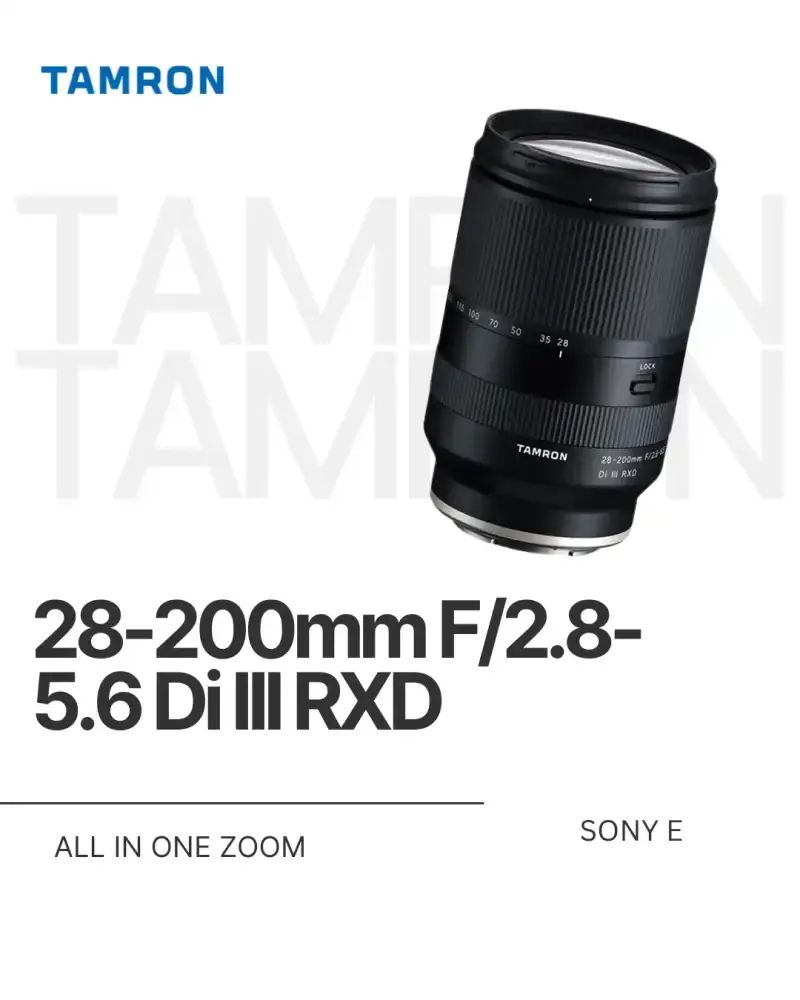
The Tamron 28-200mm F/2.8-5.6 Di III RXD is an all-in-one zoom lens for Sony E-mount full-frame mirrorless cameras. Its main appeal is range: it starts at 28mm for wide views and reaches 200mm for distant subjects. It also offers a bright f/2.8 maximum aperture at 28mm, which is useful for travel, family photos, street scenes, and casual portraits.
This lens is a strong fit for U.S. photographers who want one compact lens for trips, daily shooting, and outdoor events. Its main limits are the 28mm wide end, the slow f/5.6 aperture at 200mm, and the lack of built-in optical stabilization.
What Is the Tamron 28-200mm F/2.8-5.6 Di III RXD?
The Tamron 28-200mm F/2.8-5.6 Di III RXD, also called Model A071, is a superzoom lens made for Sony mirrorless cameras. “Di III” means it is designed for mirrorless cameras, while “RXD” refers to Tamron’s Rapid eXtra-silent stepping drive autofocus system.
The lens covers a wide range of common focal lengths:
- 28mm: landscapes, travel scenes, interiors, and group photos
- 35mm to 50mm: street photography and everyday scenes
- 85mm to 135mm: portraits and detail shots
- 200mm: wildlife at closer distances, sports sidelines, and distant subjects
The lens is designed for Sony E-mount full-frame cameras, such as the Sony a7, a9, and a1 families. It can also work on Sony APS-C cameras, but the smaller sensor creates a narrower field of view. On an APS-C body, 28mm looks similar to about 42mm on full frame, so it is no longer a very wide focal length.
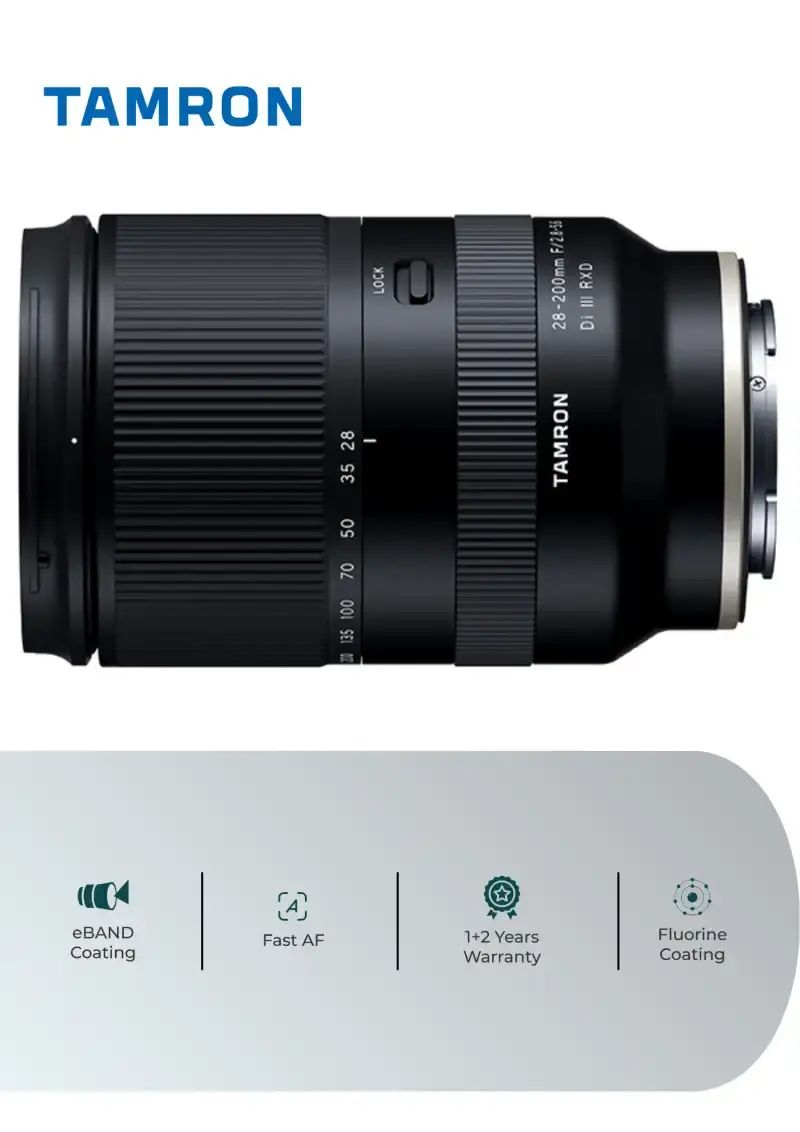
Tamron lists the lens with an 18-element, 14-group optical design. It uses BBAR coating to help reduce ghosting and flare. The lens also has moisture-resistant construction, but this does not make it waterproof.
Tamron 28-200mm Key Specifications
The table below summarizes the main published specifications. Always check the current Tamron USA page and your camera manual for firmware and regional details.
| Feature | Specification |
|---|---|
| Lens name | Tamron 28-200mm F/2.8-5.6 Di III RXD |
| Model | A071 |
| Mount | Sony E |
| Sensor format | Full frame |
| Focal length | 28-200mm |
| Maximum aperture | f/2.8 at 28mm to f/5.6 at 200mm |
| Minimum aperture | f/16 to f/32, depending on focal length |
| Optical design | 18 elements in 14 groups |
| Diaphragm | 7 rounded blades |
| Minimum focusing distance | 7.5 inches at 28mm; about 31.5 inches at 200mm |
| Maximum magnification | About 1:3.1 at 28mm |
| Filter size | 67mm |
| Length | About 4.6 inches |
| Weight | About 20.3 ounces |
| Autofocus motor | RXD stepping motor |
| Image stabilization | No lens-based VC |
| Weather protection | Moisture-resistant construction |
Published specifications may use rounded metric-to-imperial conversions. Product details can also change with firmware, regional packaging, or later manufacturer updates.
How the F/2.8-5.6 Aperture Affects Photos
The aperture changes as you zoom. At 28mm, the lens can open to f/2.8. At 200mm, the widest setting is f/5.6.
This affects three things:
- Light: The lens gathers less light at 200mm than at 28mm.
- Shutter speed: You may need a slower shutter speed or a higher ISO at the long end.
- background blur: The lens can blur backgrounds, but it will not match a fast 70-200mm f/2.8 lens at 200mm.
For bright outdoor work, f/5.6 at 200mm is often workable. For indoor sports, concerts, or dark wildlife scenes, it may be too slow. In those cases, a lens with a larger aperture may produce cleaner images and faster shutter speeds.
The 28mm f/2.8 setting is more useful than the aperture range on many older superzoom lenses. It gives you extra light for indoor travel scenes and evening street photos. Still, the aperture narrows quickly as you zoom.
Autofocus and Sony Compatibility
The RXD autofocus system is designed for quiet and responsive focusing on Sony E-mount cameras. It is useful for still photos and can also support video work when paired with a compatible Sony body.
Compatible camera features may include:
- Eye AF
- Face detection
- Real-time Tracking
- Continuous autofocus
- In-camera lens corrections
- Sony camera control through electronic communication
Performance depends on the camera body, firmware, subject, lighting, and focus settings. A newer Sony body may track fast subjects better than an older entry-level model.
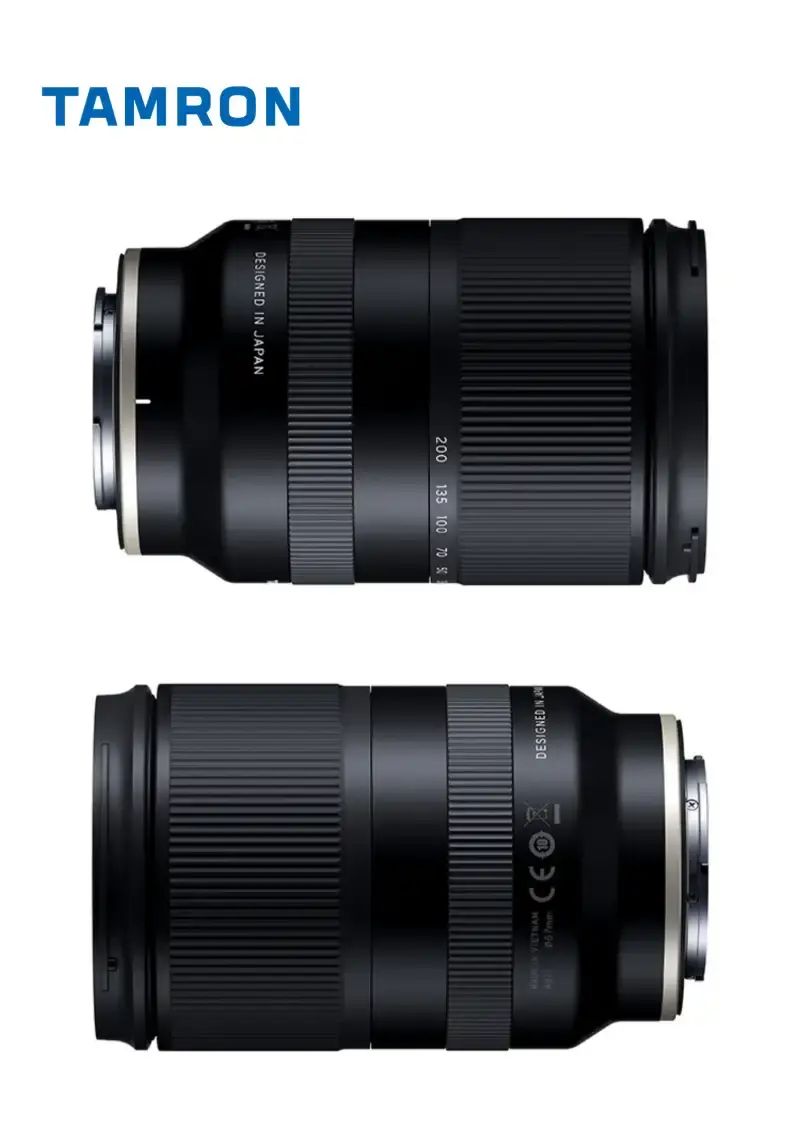
The lens does not have a physical focus-mode switch or a focus-distance scale. You usually change focus mode through the camera menu. This keeps the barrel simple, but it may feel less direct to photographers who prefer physical controls.
For video, the RXD motor is intended to operate quietly. However, no autofocus motor is completely silent in every setup. A camera-mounted microphone can still record operating sounds, and focus behavior can vary by camera settings.

Image Quality: What to Expect
The Tamron 28-200mm is designed to balance broad zoom coverage with a small size. That design brings trade-offs.
At the center of the frame, the lens can produce sharp images across much of its zoom range. Corners may be weaker at some focal lengths and apertures, especially at the wide end. Stopping down slightly can improve edge detail, although the best setting depends on the subject and camera.
Common optical behavior includes:
- Some barrel distortion at 28mm
- Pincushion distortion at longer focal lengths
- Vignetting at wide apertures
- Flare when a bright light source is near the frame
- Reduced fine detail at the extreme ends of the zoom range
Sony cameras may correct some lens issues automatically with in-camera profiles. RAW files may still show the original optical behavior until correction is applied in software.
This lens is best understood as a flexible travel tool rather than a specialist lens. It may not match a premium prime lens for corner detail or low-light work, but it can save time and weight when changing lenses is not practical.
Close-Focus Performance
The lens focuses unusually close at the 28mm end. Tamron lists a minimum focusing distance of about 7.5 inches, with a maximum magnification of approximately 1:3.1.
That makes it useful for:
- Food photos
- Flowers
- Small products
- Travel details
- Tabletop scenes
- Environmental close-ups
The close-focus advantage is strongest at 28mm. At 200mm, the minimum focus distance is much longer, so the lens is less useful for true telephoto close-ups.
At close range, depth of field becomes thin, especially at f/2.8. Use a single focus point or eye detection with care. If the camera focuses on the background, move the focus point or simplify the scene.
Does It Have Image Stabilization?
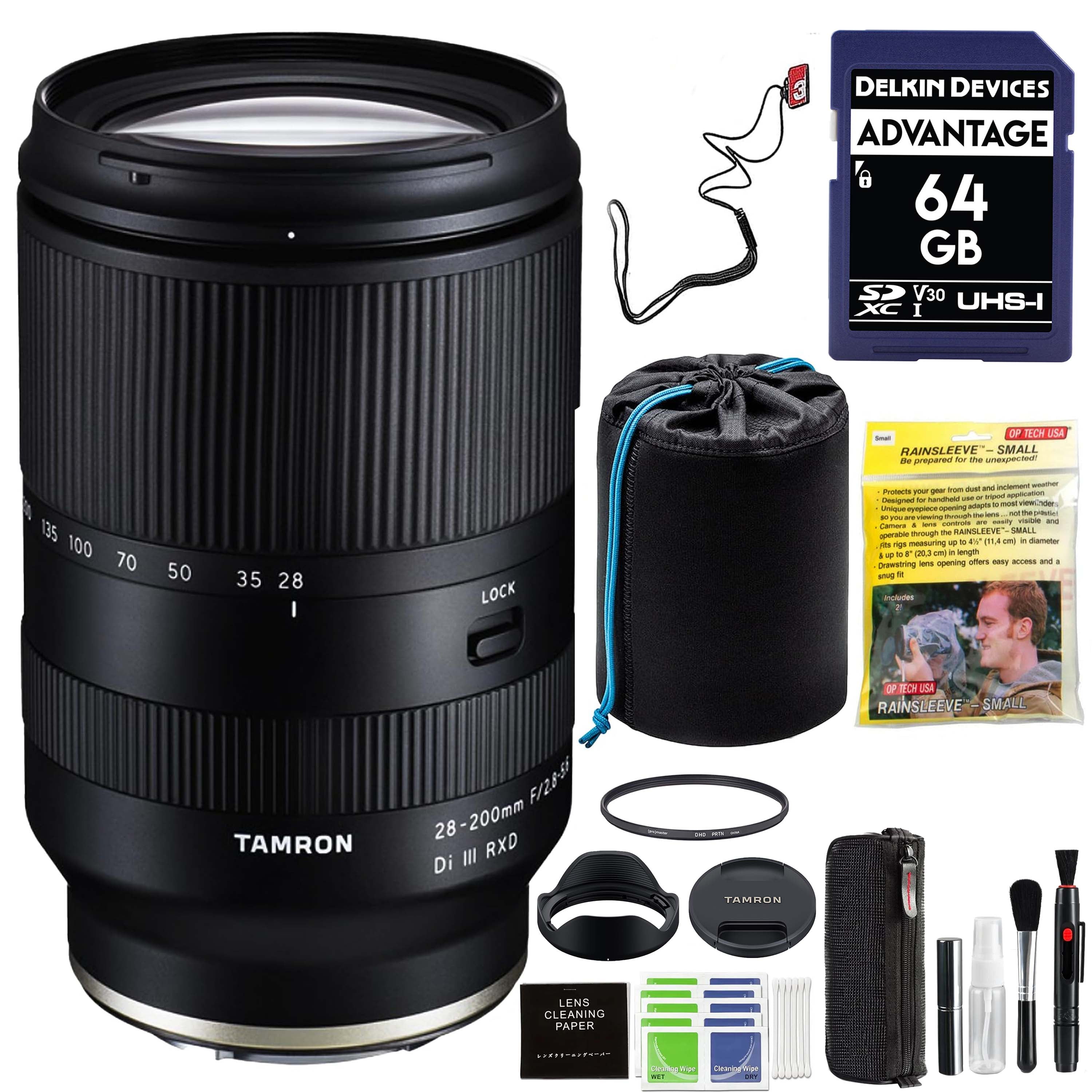
No. The Tamron 28-200mm does not include Tamron’s VC optical stabilization system.
This is not always a serious problem because many Sony full-frame cameras include sensor-shift stabilization. On a stabilized camera body, the camera may reduce the effect of hand movement for still photos. The exact benefit varies by camera model and shooting conditions.
On a Sony body without in-body stabilization, you need to rely on:
- A faster shutter speed
- A higher ISO
- A tripod or monopod
- A stable shooting position
- Lens support when recording video
Stabilization can reduce camera shake, but it cannot freeze a moving person, bird, or vehicle. If the subject moves, shutter speed still matters.
Who Should Buy This Lens?
The Tamron 28-200mm is a good match for photographers who value range and low weight.
It may suit you if you:
- Want one lens for a U.S. road trip or vacation
- Photograph family events in changing locations
- Shoot landscapes, portraits, and distant details
- Prefer not to change lenses outdoors
- Use a Sony full-frame mirrorless camera
- Want a brighter wide end than many basic superzooms provide
It may not suit you if you:
- Need a truly wide 24mm view
- Photograph indoor sports or concerts
- Need strong background blur at 200mm
- Require a physical AF/MF switch
- Depend on optical stabilization
- Need maximum corner sharpness for professional landscape work
The key decision is simple: choose this lens for flexibility, not for specialist performance at every focal length.
Tamron 28-200mm vs. Other Sony Lens Options
The best alternative depends on what you photograph most.
Tamron 28-200mm vs. Sony 24-240mm
The Sony FE 24-240mm offers a wider 24mm starting point and a longer 240mm reach. That can help with landscapes and distant subjects. The Tamron is generally the more compact option and offers the brighter f/2.8 aperture at 28mm.
Choose the Sony if 24mm and 240mm matter more than size and wide-end brightness. Choose the Tamron if you want a smaller travel lens with a brighter starting aperture.
Tamron 28-200mm vs. Tamron 28-300mm
The Tamron 28-300mm covers more telephoto range. The 28-200mm is the simpler choice when 200mm is enough and you want a shorter, lighter lens design.
A longer zoom does not automatically produce better results. Consider whether the extra reach is worth the added size, cost, or aperture trade-off.
Tamron 28-200mm vs. a Two-Lens Kit
A 24-70mm or 28-75mm lens combined with a 70-180mm lens can provide better low-light performance and image quality. The trade-off is weight, cost, and the need to change lenses.
A two-lens kit is better for planned professional work. The 28-200mm is better when convenience and mobility matter more.
| Your priority | More suitable option |
|---|---|
| One lens for travel | Tamron 28-200mm |
| Wider landscape views | Lens starting at 24mm |
| Indoor sports | Fast telephoto lens |
| Maximum reach | 240mm or 300mm zoom |
| Best low-light performance | Fast prime or constant-aperture zoom |
| Minimal lens changes | Tamron 28-200mm |

Practical Shooting Tips
Use the following settings as starting points, then adjust for your subject and light.
For travel photos
Use aperture priority at f/5.6 to f/8 in daylight. Keep ISO on Auto if light changes often. At 28mm, check the edges of the frame for leaning buildings and distortion.
For portraits
Zoom to 70mm to 135mm when you have room. Stand farther away and keep the subject separate from the background. At 200mm and f/5.6, background blur depends strongly on subject distance and background distance.
For wildlife
Use a fast shutter speed, often 1/1000 second or faster for birds in flight. Enable continuous autofocus and subject tracking if your camera supports it. Raise ISO when needed rather than allowing motion blur.
For close-ups
Use 28mm for the shortest focus distance. Move the focus point onto the main detail. Avoid pressing the front of the lens against a subject, even though the lens can focus close.
For video
Test autofocus before an important recording. Use an external microphone if focus motor noise matters. A tripod, monopod, or gimbal can help because the lens itself does not provide optical stabilization.
Common Problems and Their Causes
The image looks soft at 200mm
Possible causes include camera shake, subject movement, heat shimmer, high ISO noise, or atmospheric haze. Try a faster shutter speed, steady support, and a nearby test subject before judging the lens.
Autofocus hunts
Low contrast, poor light, reflections, and subjects with no clear detail can make any autofocus system hunt. Use a smaller focus area, add light, or focus on an edge with visible contrast.
The lens feels too narrow indoors
Twenty-eight millimeters is not as wide as 24mm or 20mm. Step back if possible, use a wider lens, or capture a panorama. Avoid forcing a group into a tight space.
Video footage shows camera shake
The lens has no built-in VC. Use a stabilized Sony body, electronic stabilization if appropriate, a tripod, or a gimbal. Remember that electronic stabilization may crop the image.
The lens does not work as expected
Check that the lens is fully locked onto the E mount. Clean the electronic contacts with appropriate care, confirm camera settings, and check for a firmware update from Tamron. Do not use liquids or abrasive tools on the contacts.

Frequently Asked Questions
Is the Tamron 28-200mm compatible with Sony full-frame cameras?
Yes. It is made for Sony E-mount full-frame mirrorless cameras. It can also mount on Sony APS-C E-mount cameras, where the field of view becomes narrower.
Is the Tamron 28-200mm good for travel?
Yes, especially when you want one lens for wide views, portraits, and distant subjects. Its 28mm starting point is less wide than 24mm, so some travelers may prefer a wider lens for architecture and cramped interiors.
Is f/5.6 at 200mm too slow?
It depends on the light and subject. It is often fine outdoors in daylight. It can be limiting for indoor sports, concerts, and wildlife at dawn or dusk.
Does the lens have weather sealing?
It has moisture-resistant construction, but it is not waterproof. Avoid heavy rain, water spray, sand, and rapid temperature changes unless your camera and lens are properly protected.
Can it photograph portraits?
Yes. The 70mm to 135mm range works well for many portraits. The lens can separate a subject from the background, but a fast prime or f/2.8 telephoto zoom will usually create more blur in similar conditions.
Final Recommendation
The Tamron 28-200mm F/2.8-5.6 Di III RXD is a practical all-in-one zoom for Sony full-frame mirrorless cameras. It offers a useful 28mm-to-200mm range, a bright f/2.8 wide end, close focusing, and a relatively compact design.
Its limits are just as clear: no lens-based stabilization, no 24mm view, and a slow f/5.6 aperture at 200mm. If you want one lens for travel, family use, outdoor photography, and general daily shooting, it is a well-balanced option. If low-light action, extreme wide-angle work, or maximum background blur is your priority, a specialist lens will be a better choice.
Before buying, confirm your camera uses Sony E mount, decide whether 28mm is wide enough, and check whether your camera body provides in-body stabilization.

