
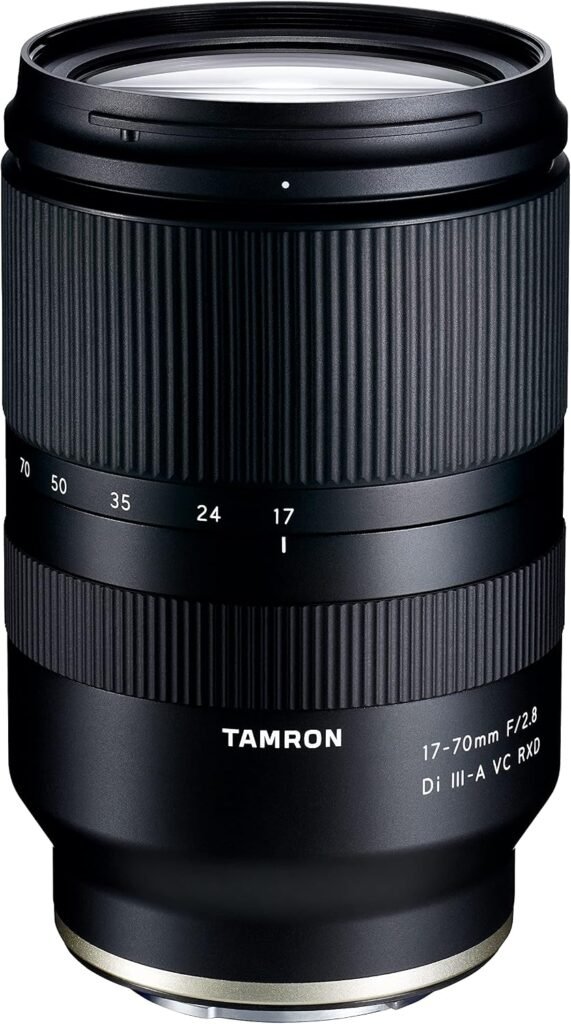
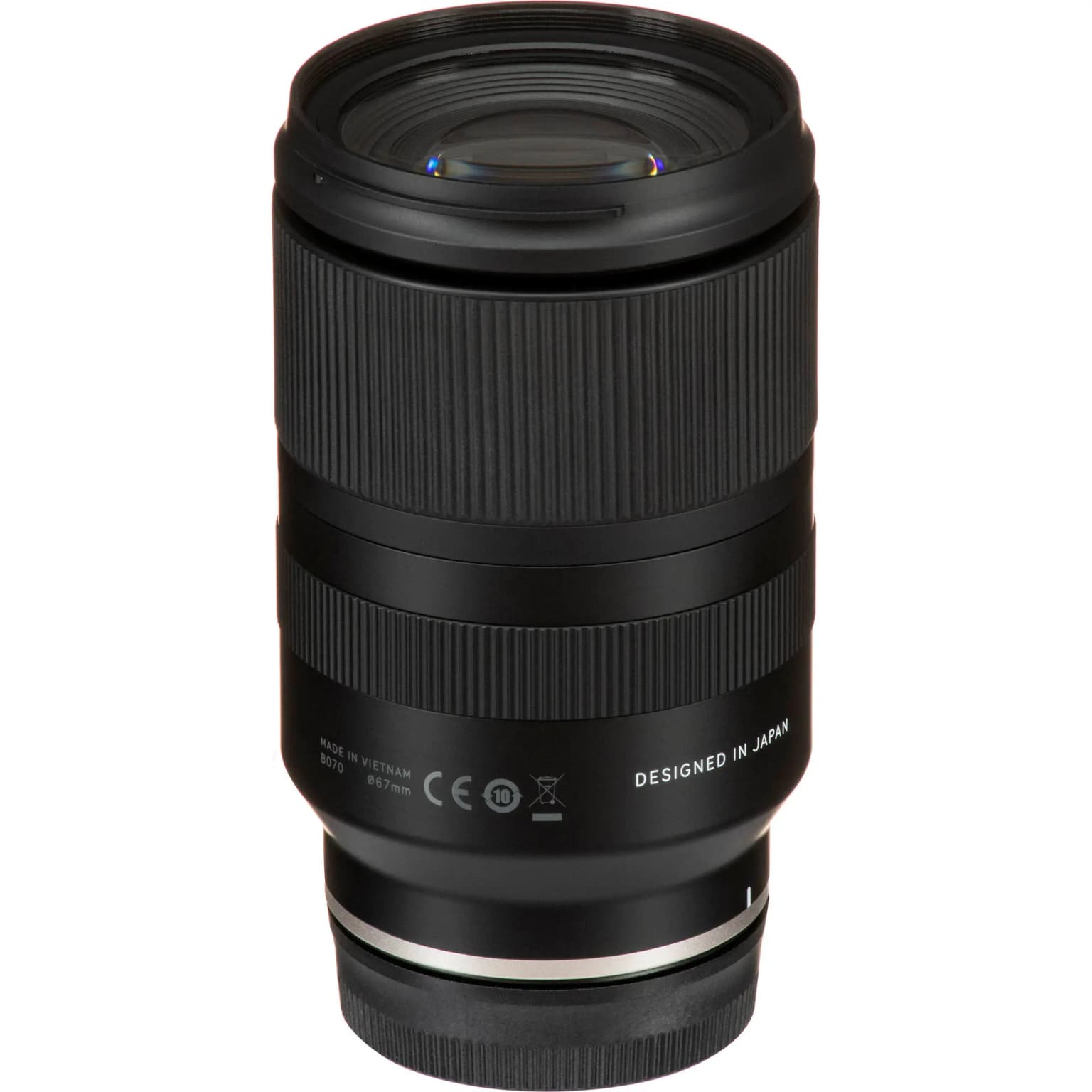
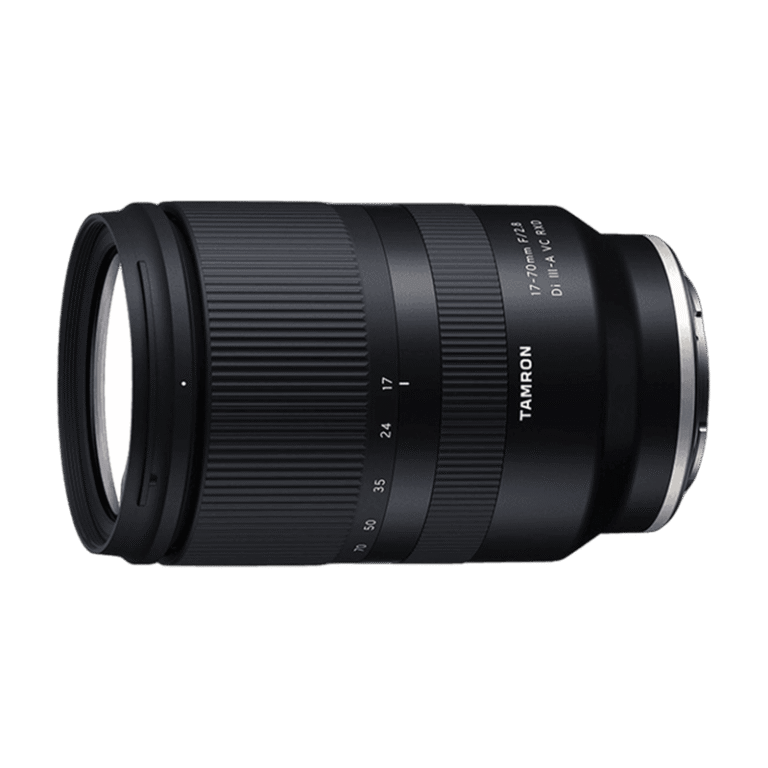
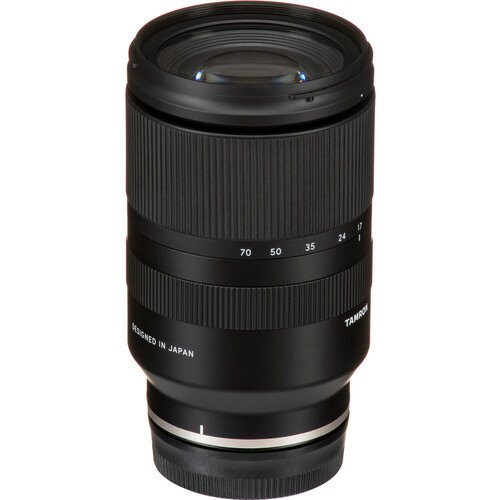
For photographers in the United States who use a Sony APS-C mirrorless camera, the Tamron 17-70mm F/2.8 Di III-A VC RXD is a versatile standard zoom for travel, portraits, family photos, events, and video. It combines a constant f/2.8 aperture, built-in optical stabilization, and a useful 17-70mm range in a lens that is made for Sony E-mount APS-C cameras.
Its full-frame equivalent view is about 25.5-105mm. That range covers wide scenes, normal snapshots, and short telephoto portraits without changing lenses. The main trade-off is size: this lens is more capable than a basic kit zoom, but it is also larger and heavier.
This guide explains the lens’s documented features, compatibility, image quality considerations, video behavior, limitations, and the type of Sony user who should consider it.
What is the Tamron 17-70mm F/2.8 Di III-A VC RXD?
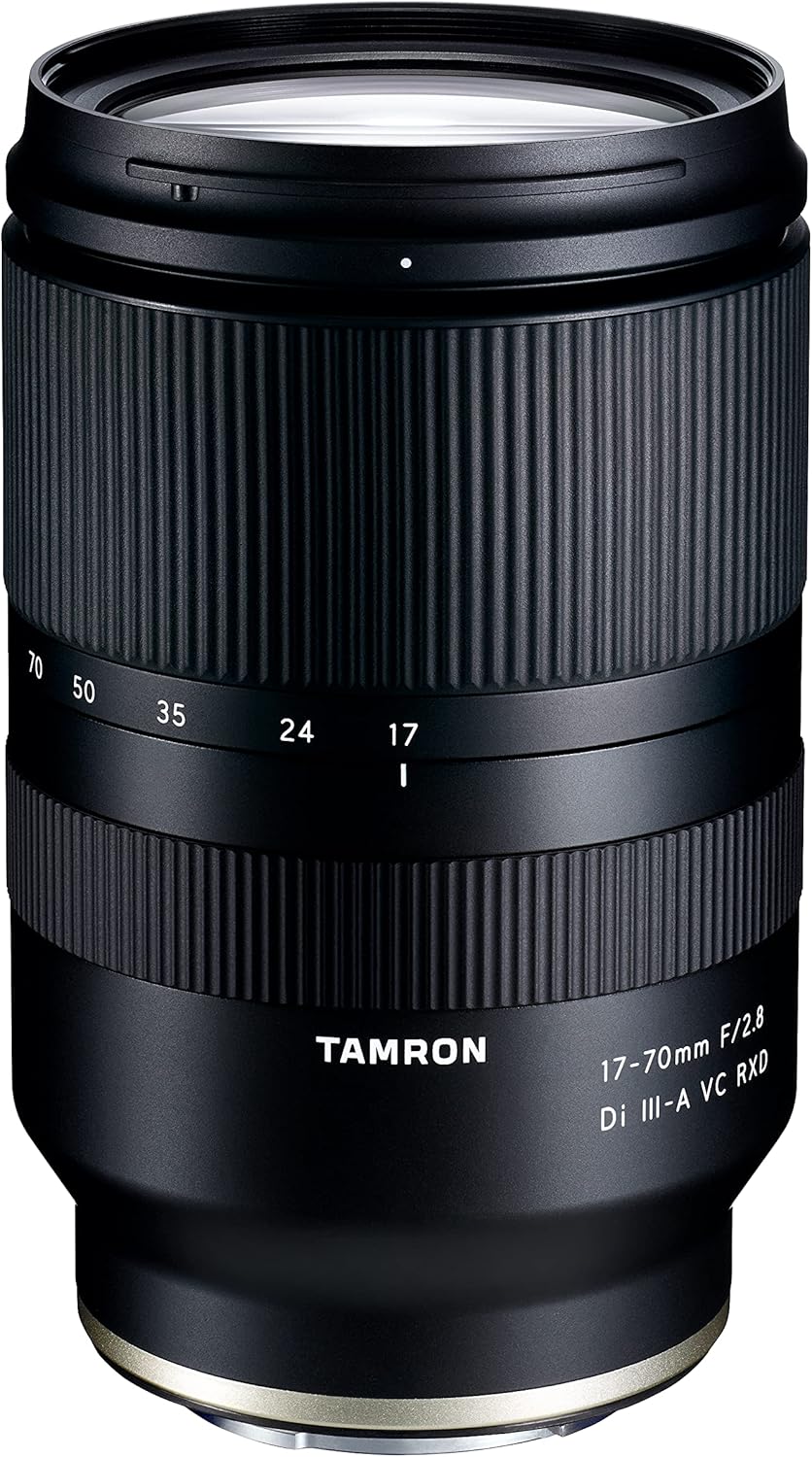
The Tamron 17-70mm F/2.8 Di III-A VC RXD is a constant-aperture zoom lens for Sony E-mount APS-C mirrorless cameras. Tamron identifies it as Model B070. “Di III-A” means it is designed for mirrorless cameras with APS-C sensors, while “VC” refers to Vibration Compensation, Tamron’s optical image stabilization system.
“RXD” stands for Rapid eXtra-silent Drive. This autofocus system uses a stepping motor and is designed for quiet, smooth focus changes. That makes the lens useful for both still photography and video.
The lens has these key specifications:
| Feature | Tamron 17-70mm F/2.8 Di III-A VC RXD |
|---|---|
| Mount | Sony E |
| Sensor format | APS-C |
| Full-frame equivalent range | About 25.5-105mm |
| Maximum aperture | Constant f/2.8 |
| Minimum aperture | f/22 |
| Stabilization | Tamron VC |
| Autofocus motor | RXD stepping motor |
| Minimum focus distance | 7.5 inches / 0.19 m at 17mm; 15.4 inches / 0.39 m at 70mm |
| Maximum magnification | About 1:4.8 at 17mm |
| Filter size | 67mm |
| Diaphragm blades | 9, rounded |
| Weight | About 19.2 ounces / 545g |
| Length | About 4.6 inches / 119.3mm |
| Weather resistance | Moisture-resistant construction with seals at key points |
Specifications can vary slightly by market documentation or production revision. Check Tamron’s current product page and the lens manual before purchase.
What does 17-70mm mean on a Sony APS-C camera?
Sony APS-C cameras use a sensor smaller than a full-frame sensor. As a result, the lens produces a narrower field of view than it would on a full-frame body.
To estimate the full-frame equivalent, multiply the focal length by 1.5:
- 17mm × 1.5 = 25.5mm
- 70mm × 1.5 = 105mm
The lens therefore starts at a moderately wide view and ends at a short telephoto view. It does not provide an ultra-wide angle for dramatic architecture or very tight indoor spaces, but it offers more reach than a typical 16-50mm kit lens.
Why the constant f/2.8 aperture matters
The lens stays at f/2.8 throughout the zoom range. A kit zoom may become slower as you zoom in, often reaching f/5.6 at the long end.
A constant f/2.8 aperture gives you:
- More light for indoor and evening photos
- Faster shutter speeds in dim conditions
- More control over background blur
- Consistent exposure while zooming during video
- A brighter view through the electronic viewfinder
The f/2.8 aperture does not remove the need for good technique. In low light, subject movement can still cause blur. Stabilization helps with camera movement, but it cannot freeze a moving person.

Compatibility with Sony E-mount APS-C cameras
The Tamron 17-70mm is made for Sony E-mount APS-C cameras. It is compatible with many Sony Alpha models, including cameras such as the a6100, a6400, a6600, a6700, ZV-E10, and similar E-mount APS-C bodies.
Compatibility can depend on camera firmware and feature support. Before buying, confirm the current compatibility list from Tamron and update both the camera and lens firmware when required.
Using the lens on a full-frame Sony camera
You can physically mount the lens on a full-frame Sony E-mount camera, but the lens is designed to cover an APS-C sensor. A full-frame body will normally need to use its APS-C or Super 35 crop mode.
In crop mode, the camera uses a smaller central area of the sensor. This avoids the dark corners that may appear when an APS-C lens is used across the full-frame image area.
This setup can be useful as a temporary solution, but it does not give the same image area or resolution as a full-frame lens used in full-frame mode. If you own a full-frame Sony camera and want full use of its sensor, consider a lens designed for full-frame coverage instead.
Camera features that may vary
The lens supports important Sony camera functions, but exact behavior depends on the camera model. Features may include:
- Phase-detection autofocus
- Eye autofocus
- Real-time tracking
- In-camera lens corrections
- Focus control during video
- Camera-controlled aperture
Older cameras may not support every newer autofocus or video feature. A current firmware check is a sensible step if autofocus performance seems unusual.

Image quality and everyday performance
The Tamron 17-70mm is designed as a practical all-purpose zoom rather than a specialist lens. Its value comes from the combination of range, aperture, stabilization, and close-focus ability.
The 17mm end works well for:
- Travel scenes
- Street photography
- Groups
- Landscapes
- Indoor family photos
- Environmental portraits
The 70mm end is useful for:
- Head-and-shoulder portraits
- Details
- Stage or event photos
- Compressed background views
- Candid photos from a short distance
Sharpness and aperture use
At f/2.8, the lens can produce useful detail across the frame, especially when the subject is near the center. Stopping down to f/4 or f/5.6 may improve edge detail and overall consistency in scenes where maximum sharpness matters.
The best aperture depends on the subject:
- Use f/2.8 for low light, subject separation, or faster shutter speeds.
- Use f/4 to f/5.6 for a balance of sharpness and background separation.
- Use f/8 for many landscapes and scenes that need more depth of field.
- Avoid very small apertures such as f/16 or f/22 unless needed, because diffraction can reduce fine detail.
These are general photographic guidelines, not guarantees for every scene. Results also depend on focus accuracy, shutter speed, camera sensor, atmospheric conditions, and editing.
Distortion, vignetting, and corrections
Wide-angle zooms often show some barrel distortion at the short end and pincushion distortion at the telephoto end. Modern Sony cameras and editing programs may correct some lens behavior through built-in profiles.
In-camera corrections can affect the image preview and the final JPEG. RAW files may retain uncorrected optical behavior until software applies a profile.
If you photograph architecture, products, or straight lines, inspect the corners and edges at 17mm. For casual travel, people, and general use, the available corrections may be sufficient.
Background blur
The f/2.8 aperture can create background blur, especially at 70mm, when the subject is close and the background is far away. However, this is an APS-C zoom, not a dedicated full-frame portrait lens with a very wide aperture.
For stronger separation:
- Zoom toward 70mm.
- Move closer to the subject.
- Keep the background as far away as practical.
- Use f/2.8.
- Focus carefully on the subject’s eye when photographing people.

Vibration Compensation for stills and video
The Tamron 17-70mm includes optical Vibration Compensation, or VC. The system shifts optical elements to counter small movements from the photographer’s hands.
VC is most useful when:
- The subject is still
- You are shooting at slow shutter speeds
- You are working in dim light
- You are using the telephoto end
- You are recording handheld video
Stabilization does not stop subject movement. A person walking, a child running, or a moving vehicle can remain blurred even when the camera stays steady.
Sony cameras with their own in-body stabilization may use camera and lens stabilization together, depending on the model and operating mode. Read the Sony camera manual for the specific stabilization behavior.
A simple shutter-speed example
Suppose you photograph a still subject at 70mm. A shutter speed around 1/100 second may be a reasonable starting point for reducing hand movement, although the best setting depends on the photographer and camera.
With VC, you may be able to use a slower shutter speed for a still subject. That does not mean every photo will be sharp at the slowest possible setting. Review test shots at 100% magnification before relying on a slow shutter speed for an important image.
For video, stabilization can make handheld footage smoother. It may also create a floating or shifting effect during certain movements. Test VC before recording a full event.
Autofocus and video use
The RXD autofocus motor is designed for fast and quiet operation. It supports the needs of many Sony users who want one lens for both photos and video.
The lens is well suited to:
- Family videos
- Travel clips
- Interviews
- Product demonstrations
- Walk-and-talk footage
- General social media production
Autofocus results depend on the camera body, focus mode, subject contrast, lighting, and firmware. No lens can guarantee perfect tracking in every scene.
Practical video strengths
The constant f/2.8 aperture helps keep exposure consistent as you zoom. This is useful when the camera is set to manual exposure or when you want to avoid a sudden change in brightness during a zoom.
The 17-70mm range is also useful for a solo creator. At 17mm, the lens can frame a presenter at arm’s length or in a small room. At 70mm, it can create a tighter talking-head view or isolate a detail.
Video limitations
The lens is not a dedicated cinema zoom. Consider these limits:
- Focus breathing may still be visible during focus changes.
- Zooming while recording may not look perfectly smooth by hand.
- The lens is relatively large for a small APS-C body.
- Stabilization behavior varies by Sony camera.
- Motor sound can be recorded if the camera microphone is close and the environment is quiet.
For professional sound, use an external microphone and test the camera-lens combination before an important shoot.

Close focusing and macro-like work
The Tamron 17-70mm can focus as close as about 0.19 meters, or 7.5 inches, at 17mm. Its maximum magnification is about 1:4.8, which is useful for close-up work but does not make it a true 1:1 macro lens.
It can photograph:
- Food
- Crafts
- Flowers
- Small products
- Travel details
- Desk objects
At the wide end, close focusing can create a strong sense of depth. Objects near the front of the frame may look much larger than the background.
For small products or flat documents, check the edges for distortion. A longer focal length may give a more natural perspective, even if the minimum focus distance is greater.
Size, handling, and accessories
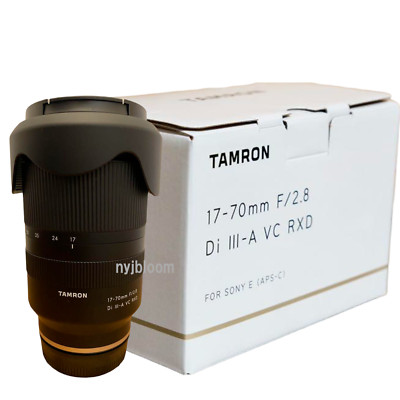
At roughly 545g, the Tamron 17-70mm is not a lightweight travel lens. Its size reflects the constant f/2.8 aperture, stabilization hardware, and broad zoom range.
The weight may feel balanced on cameras such as the Sony a6600 or a6700. On a smaller body such as the a6100 or ZV-E10, the lens may feel front-heavy. A grip, cage, or hand strap can improve comfort during long sessions.
The lens uses a 67mm front filter thread. If you plan to use a circular polarizer or variable neutral-density filter, buy the correct 67mm size. A step-up ring can also let you use larger filters that you already own.
Useful accessories
Consider these items based on your work:
- 67mm UV or clear filter: only if you want a front-element protection filter; use a quality model.
- 67mm circular polarizer: useful for reflections and blue skies, but it reduces light.
- 67mm variable ND filter: useful for video in bright outdoor light.
- Lens hood: helps reduce stray light and protects the front element.
- Camera strap or small shoulder bag: helpful because the lens is larger than a basic kit zoom.
- Extra battery: important for travel and video use.
Avoid stacking several thick filters. They can cause vignetting at the 17mm setting.

Main advantages and limitations
The Tamron 17-70mm makes the most sense when you want a single lens that handles many common subjects.
Main advantages
- Constant f/2.8 aperture
- Useful 25.5-105mm full-frame equivalent range
- Optical stabilization
- Quiet RXD autofocus
- Close focusing for detail shots
- Moisture-resistant design
- Sony E-mount camera integration
- One-lens convenience for travel and daily photography
Main limitations
- Larger and heavier than a basic kit zoom
- Not ultra-wide on APS-C
- Not a true macro lens
- Background blur is more limited than with a fast prime lens
- Full-frame Sony users must use crop mode
- Stabilization does not freeze moving subjects
- Autofocus and camera features vary by Sony body
- Optical corrections may be needed for demanding architectural work
The central decision is simple: choose this lens if versatility and a constant f/2.8 aperture matter more than low weight.

Tamron 17-70mm vs. a Sony kit lens
A typical Sony APS-C kit zoom is smaller and lighter. It may also start at a wider 16mm focal length, which can help in tight spaces.
The Tamron 17-70mm offers several practical improvements:
| Need | Tamron 17-70mm | Basic kit zoom |
|---|---|---|
| Low-light ability | Constant f/2.8 | Usually slower at longer focal lengths |
| Reach | 70mm | Often ends near 50mm |
| Stabilization | Optical VC | Depends on lens and camera |
| Size | Larger | Usually smaller |
| Portrait reach | Stronger | More limited |
| Travel weight | Heavier | Easier to carry |
| Cost | Usually higher | Often included with the camera |
The Tamron is a meaningful upgrade for users who regularly outgrow the kit lens. It may not be worth the added size for people who mainly shoot outdoors in bright light and value a small camera bag.
Tamron 17-70mm vs. a fast prime lens
A fast prime lens may offer a wider aperture, smaller size, or stronger background blur. A 35mm or 50mm equivalent prime can also be easier to carry.
The Tamron wins on flexibility. You can change framing without moving your feet or changing lenses. A prime can win on low-light performance, subject separation, and simplicity.
A common two-lens setup is the Tamron 17-70mm plus a small fast prime for portraits, night scenes, or indoor work. Whether that makes sense depends on your budget and shooting style.
Common mistakes to avoid
Assuming VC freezes action
VC corrects camera movement. It does not correct subject movement. Use a faster shutter speed when your subject is moving.
Treating 70mm as a long telephoto
On APS-C, 70mm gives a 105mm equivalent view. That is useful for portraits and nearby events, but it is not a replacement for a 200mm or 300mm telephoto lens.
Ignoring camera balance
The lens may feel heavy on a small Sony body. Hold the lens with your left hand and support the camera with your right hand. A comfortable grip reduces fatigue.
Using full-frame mode with an APS-C lens
If dark corners appear on a full-frame Sony camera, switch to APS-C crop mode or use a full-frame lens.
Expecting macro results
A 1:4.8 maximum magnification is useful for close-up images, but it does not provide the detail and filling power of a dedicated macro lens.
Skipping firmware checks
If autofocus or camera communication seems unreliable, check the lens firmware, camera firmware, and Tamron’s compatibility information before assuming the lens is defective.
Is the Tamron 17-70mm F/2.8 worth buying?
The Tamron 17-70mm is a strong fit for Sony APS-C users who want one lens for travel, family photography, portraits, events, and video. Its most important advantage is the combination of a constant f/2.8 aperture and a 17-70mm range.
It is less suitable if your top priority is the smallest possible kit, ultra-wide coverage, extreme background blur, or serious wildlife reach.
Before buying, check three points:
- Confirm that your camera is a Sony E-mount APS-C model or that you are willing to use crop mode on a full-frame body.
- Decide whether the roughly 545g weight fits your carrying style.
- Compare the current U.S. price with the cost of a kit zoom plus one fast prime.
For many Sony APS-C photographers, the lens serves as a practical “do most things” zoom. It does not replace every specialized lens, but it can reduce the need to carry several lenses.
Frequently asked questions
Is the Tamron 17-70mm compatible with the Sony a6400?
Yes. It is designed for Sony E-mount APS-C cameras, and the Sony a6400 is one of the camera types it is intended to support. Confirm current firmware requirements before use.
Does the Tamron 17-70mm have image stabilization?
Yes. It includes Tamron VC optical stabilization. The effect is most useful for camera movement with still subjects. It cannot prevent blur caused by a moving subject.
Can I use this lens on a Sony full-frame camera?
Yes, it can mount on a full-frame Sony E-mount body, but it is designed for APS-C coverage. Use the camera’s APS-C or Super 35 crop mode to avoid dark corners.
Is the Tamron 17-70mm good for portraits?
Yes. The 70mm end gives an approximately 105mm full-frame equivalent view, which works well for head-and-shoulder portraits. The f/2.8 aperture can also help separate the subject from the background.
Is this a macro lens?
No. It offers useful close focusing and about 1:4.8 maximum magnification, but it is not a true 1:1 macro lens.
Does the lens work well for video?
It can be a good video lens because of its constant f/2.8 aperture, quiet RXD autofocus, wide-to-telephoto range, and stabilization. Test focus breathing, microphone pickup, and stabilization behavior with your specific Sony camera.

Final assessment
The Tamron 17-70mm F/2.8 Di III-A VC RXD is a versatile standard zoom for Sony APS-C cameras in the United States and other markets. Its constant f/2.8 aperture, optical stabilization, close-focus ability, and 25.5-105mm equivalent range give it broad practical value.
Its main compromise is portability. This is a capable lens, but it is larger and heavier than a basic kit zoom. If you accept that trade-off, it can become a dependable everyday lens for stills and video.
Check Tamron’s current U.S. specifications, warranty terms, firmware information, and authorized dealer availability before purchasing.

