The Canon EF-S 55-250mm IS STM is the best Canon EF-S zoom lens for most telephoto users.
You may own a Canon APS-C camera and still rely on the small kit lens. That works for family shots, but it feels limited at the zoo, sports field, trail, or school event. A Canon EF-S zoom lens can solve that gap without the cost or size of a professional full-frame lens. I compared five popular Canon options for reach, daily use, wide views, focus speed, image quality, and value. The right pick depends on whether you need telephoto reach, a simple walkaround lens, or an ultra-wide view.
See the differences between my top picks at a glance.
Canon EF-S 55-250mm IS II Lens

The Canon EF-S 55-250mm f/4-5.6 IS II gives APS-C camera owners a useful step up from a standard kit lens. Its 55mm starting point works well for portraits and nearby subjects, while 250mm reaches much farther across a field or open park. Canon’s optical Image Stabilizer helps reduce blur from camera shake when you shoot still subjects at slower shutter speeds. This lens uses a variable f/4-5.6 aperture, so its maximum light intake changes as you zoom.
I see this model as a practical budget choice for outdoor photography. It can handle family events, travel, wildlife at close range, and casual sports in good light. The 1.6x crop factor on compatible Canon APS-C cameras gives the long end a field of view similar to about 400mm on a full-frame camera, though the actual focal length remains 250mm. It is not the newest design, but it offers the reach many beginners need at a reasonable cost.
Pros:
- Strong 55-250mm range for outdoor subjects
- Optical Image Stabilizer helps reduce hand-shake blur
- Useful portrait range at the lower zoom settings
- Relatively compact compared with professional telephoto lenses
- Good fit for Canon APS-C DSLR cameras
- Often available at an attractive used or renewed price
Cons:
- Autofocus is not as quiet or refined as the STM version
- Variable f/4-5.6 aperture is not ideal for dark venues
- Older design may show more wear when bought used
What Amazon Buyers Are Saying
Common buyer feedback tends to focus on the useful reach and low weight. Many owners like the way it brings distant subjects closer without carrying a large professional lens. Buyers also often value the built-in stabilization for casual handheld shots. As with many older lenses sold through marketplace listings, condition and packaging can vary, so I would check the seller, product condition, and return terms before ordering.
My Recommendation
I recommend this lens for beginners who want affordable telephoto reach and mainly shoot outdoors. It is worth considering when the price is clearly lower than the newer STM model. I would not choose it first for video, quiet indoor work, or fast action in poor light.
| Category | Rating |
|---|---|
| Reach and framing | 4.5/5 |
| Image stabilization | 4/5 |
| Autofocus | 3.5/5 |
| Outdoor value | 4.5/5 |
| Overall Rating | 4.2/5 |
Canon EF-S 55-250mm IS STM Lens
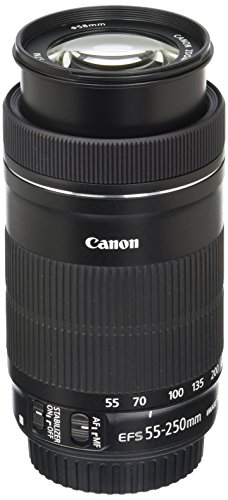
The Canon EF-S 55-250mm f/4-5.6 IS STM is my top pick for most people who want a Canon EF-S telephoto zoom. It covers the same useful range as the IS II version, but its STM focus motor gives a smoother and quieter focus action. Canon also designed this lens with a seven-blade aperture, ED glass elements, and a close focus distance of about 2.79 feet. Those features make it more flexible for portraits, detail shots, and simple video work.
The lens remains light enough for travel and long walks. Its Image Stabilizer helps when I shoot still subjects by hand, although stabilization cannot freeze a moving person or animal. The f/4-5.6 aperture works best in daylight, near windows, or with a camera that handles higher ISO settings well. For users who want one affordable long lens for parks, vacations, children’s sports, and outdoor portraits, this is the strongest all-around option in the group.
Pros:
- Excellent 55-250mm range for Canon APS-C cameras
- Quiet STM autofocus suits stills and basic video
- Image Stabilizer supports steadier handheld shooting
- Close focus distance adds useful subject detail options
- Seven-blade aperture can produce pleasing background blur
- ED glass elements help support clear image performance
- Good balance of price, size, reach, and features
Cons:
- Slow f/4-5.6 aperture limits low-light performance
- Not designed for Canon full-frame DSLR bodies
- Cannot match a professional lens for fast sports or dark venues
What Amazon Buyers Are Saying
Buyer reviews commonly praise this lens for its reach, low weight, and sharp results in good light. Many owners describe it as a strong upgrade from a basic 18-55mm kit lens. The quiet focus motor also receives attention from people who record casual video. The most common concern is not a serious fault but the slow aperture, since users often notice that indoor shots need higher ISO, a slower shutter speed, or extra light.
My Recommendation
This is the best Canon EF-S zoom lens in this comparison for telephoto use. I would buy it over the older IS II model when the price difference is reasonable. It offers the most complete mix of reach, stabilization, focus behavior, and value. My overall rating is 4.7 out of 5.
| Category | Rating |
|---|---|
| Reach and framing | 4.5/5 |
| Image stabilization | 4.5/5 |
| Autofocus and video use | 4.5/5 |
| Value | 4.5/5 |
| Overall Rating | 4.7/5 |
Canon EF-S 18-55mm IS II Lens

The Canon EF-S 18-55mm f/3.5-5.6 IS II is the most basic option here, but basic does not mean useless. Its 18mm setting gives a fairly wide view for rooms, travel scenes, and group photos. The 55mm end works for portraits and everyday subjects. Built-in optical stabilization helps reduce blur caused by small hand movements when the subject stays still.
This lens makes the most sense as an affordable replacement, spare, or first lens for a Canon APS-C DSLR. It is small and easy to carry, so I would use it for walks, family photos, and simple travel work. It does not offer the reach of the 55-250mm models or the extra-wide view of the 10-18mm lens. Still, its standard zoom range covers many common photo tasks at a low entry price.
Pros:
- Useful everyday 18-55mm focal range
- Compact size makes it easy to carry
- Optical stabilization supports handheld still photography
- Simple zoom design suits beginners
- Good choice for family photos and travel snapshots
- Usually costs less than advanced Canon zoom lenses
Cons:
- Limited telephoto reach beyond 55mm
- Variable f/3.5-5.6 aperture is modest in low light
- Older focus design is less suited to quiet video
- May feel basic to users upgrading from a newer kit lens
What Amazon Buyers Are Saying
Amazon buyers often like this model because it restores a standard lens to an older Canon camera at a low cost. Reviews commonly mention its light weight and useful everyday range. Some buyers expect more dramatic image quality or better low-light results, then find that the lens performs best in daylight. I would read the listing closely because white-box and replacement-lens packaging may differ from a complete retail kit.
My Recommendation
I recommend this lens for a new Canon DSLR owner who needs an inexpensive standard zoom. It is also useful as a backup lens. However, I would not buy it for sports, wildlife, serious portraits, or video-first work. It earns 3.9 out of 5 for its role as a simple everyday lens.
| Category | Rating |
|---|---|
| Everyday range | 4/5 |
| Portability | 4.5/5 |
| Low-light ability | 3/5 |
| Beginner value | 4/5 |
| Overall Rating | 3.9/5 |
Canon EF-S 55-250mm IS II International

This Canon EF-S 55-250mm f/4-5.6 IS II listing offers the same core lens type as the standard IS II model, but it is identified as an international version with no warranty. The 55-250mm range remains useful for distant subjects, outdoor portraits, and casual wildlife photography. Optical Image Stabilizer support can help when the camera moves slightly during a handheld shot. The lens fits Canon APS-C DSLR cameras that accept EF-S lenses.
The main question here is not image coverage. It is seller support and product risk. A low price may appeal to shoppers who already understand the warranty limits and plan to inspect the lens upon arrival. I would test zoom movement, focus, stabilization, and image quality during the return period. If the price is close to a supported local version, the warranty-free listing becomes harder to justify.
Pros:
- Long 55-250mm telephoto range
- Optical stabilization for handheld still subjects
- Useful for outdoor travel, portraits, and field sports
- Can provide strong value when priced well below other listings
- Works with compatible Canon APS-C EF-S DSLR bodies
- Easy way to add reach to an 18-55mm kit lens
Cons:
- Listing states that it comes without a warranty
- International model may have less convenient support
- Older autofocus motor is not the best choice for video
- Variable aperture is not suited to dark indoor events
What Amazon Buyers Are Saying
Buyer experiences with this type of listing often center on value, reach, and the importance of checking condition. Many shoppers seek the lens because it costs less than newer telephoto options. The most important caution is the stated warranty status, not a hidden performance claim. Since marketplace stock can change, I suggest checking the seller rating, exact condition, return window, and included accessories before purchase.
My Recommendation
I recommend this version only when the savings are meaningful and you accept the no-warranty status. It can be a good budget tool for outdoor shooting, but the STM version is a better long-term buy if the prices are close. I rate this listing 3.8 out of 5 because the lens range is useful, while support is limited.
| Category | Rating |
|---|---|
| Telephoto reach | 4.5/5 |
| Stabilization | 4/5 |
| Buyer protection | 3/5 |
| Budget value | 4/5 |
| Overall Rating | 3.8/5 |
Canon EF-S 10-18mm IS STM Lens

The Canon EF-S 10-18mm f/4.5-5.6 IS STM serves a very different purpose from the telephoto lenses above. Its 10mm setting captures a broad scene, which helps with landscapes, architecture, rooms, real estate, and travel views. The 18mm end gives a little more natural framing when an ultra-wide view feels too dramatic. Canon includes optical stabilization, a seven-blade aperture, ED glass, and aspherical elements in this design.
This is the best choice in the group for photographers who struggle to fit a large building or small room into one frame. STM focus keeps operation quiet, which helps for simple video recording. Ultra-wide lenses need careful technique because people near the edges can look stretched. I also avoid placing important faces too close to the corners. This lens will not replace a telephoto zoom, but it can add a creative view that a standard kit lens cannot match.
Pros:
- Very wide 10mm perspective for landscapes and interiors
- 18mm end offers more flexible wide framing
- Optical stabilization helps with static low-light scenes
- STM autofocus supports quiet operation
- ED and aspherical elements support clear wide-angle images
- Light and useful for travel photography
- Strong option for APS-C Canon DSLR video and stills
Cons:
- Does not provide telephoto reach
- Variable f/4.5-5.6 aperture is not especially bright
- Edge stretching can appear with close subjects
- Requires care with straight lines and people near the frame edge
What Amazon Buyers Are Saying
Amazon buyers often value the wide view most. They commonly use this lens for landscapes, city scenes, rooms, travel, and video. A repeated learning point is that ultra-wide framing takes practice, especially when a subject stands near an edge. Buyers who expected a general-purpose zoom may feel limited, while those who needed a wide lens often find its perspective very useful.
My Recommendation
I recommend this lens to Canon APS-C users who need a true wide-angle option. It is not the best Canon EF-S zoom lens for wildlife or sports, but it is the most useful specialist lens here for buildings, rooms, and broad landscapes. I rate it 4.5 out of 5 for its intended purpose.
| Category | Rating |
|---|---|
| Wide-angle coverage | 5/5 |
| Stabilization | 4/5 |
| Autofocus and video | 4.5/5 |
| Travel value | 4.5/5 |
| Overall Rating | 4.5/5 |
How to Choose the Best Canon EF-S Zoom Lens
Choosing the best Canon EF-S zoom lens starts with your camera body and your main subjects. These lenses are made for Canon APS-C DSLR cameras with an EF-S mount. They are not the same as EF lenses, and an EF-S lens should not be treated as a full-frame solution. Before you order, match the lens to your camera, shooting style, light, and budget. A clear match matters more than a high feature count.
1. Match the Focal Length to Your Subjects
Focal length controls how much of the scene you see and how close distant subjects appear. The 18-55mm range works well for daily photos, travel, family groups, and simple portraits. It gives you a useful middle ground, but it cannot bring far subjects close.
The 55-250mm range suits outdoor portraits, wildlife at modest distances, school sports, and stage events. At 250mm, you can fill more of the frame with a distant subject. On a Canon APS-C camera, the crop view makes the lens feel even more useful for reach. Still, you need good light and a fast enough shutter speed for moving subjects.
The 10-18mm lens handles the opposite need. It fits more into the frame. That helps with rooms, buildings, landscapes, and city streets. If you often stand back but still cannot fit the scene, an ultra-wide zoom may solve the problem better than a longer lens.
2. Check Stabilization, Focus Motor, and Aperture
Image Stabilizer technology can reduce blur from your hand movement. It helps most when the subject stays still. It does not stop a running child, flying bird, or fast player from moving through the frame. For action, you still need a fast shutter speed and enough light.
STM stands for Stepping Motor. In these Canon lenses, it supports smoother and quieter focus than older motor designs. That makes the EF-S 55-250mm IS STM and EF-S 10-18mm IS STM better choices for basic video. For still photos, both older and newer lenses can work well, but the STM models offer a more refined user experience.
Aperture also deserves careful attention. The lenses in this list use variable maximum apertures. That means the lens lets in less light as you zoom toward its long end. In bright daylight, this may not matter. In a gym, theater, or dim room, it can force you to raise ISO or lower shutter speed. If low-light work matters most, a bright prime lens or a more advanced zoom may suit you better.
3. Compare Compatibility, Condition, and Total Value
Confirm that your camera accepts EF-S lenses before buying. Canon APS-C DSLRs often use this mount, but not every Canon camera uses the same lens system. Mirrorless Canon users may need the correct adapter, and full-frame users should not assume an EF-S lens will give a normal full-frame image.
Used and international listings can offer good savings. They also need more care. Look for clear notes about dust, fungus, scratches, focus problems, missing caps, and warranty coverage. Test the zoom ring, focus ring, Image Stabilizer, and autofocus as soon as the lens arrives. Keep the box and packing until you know the lens works properly.
Finally, compare the complete cost, not only the sale price. A lens with better focus, support, and return terms may offer more value than a cheaper listing with no warranty. For most buyers, the EF-S 55-250mm IS STM provides the best balance. For daily use, the 18-55mm remains simple and practical. For wide scenes, the 10-18mm earns its place as a specialist lens.
Final Verdict: Which Should You Buy?
The Canon EF-S 55-250mm IS STM is the best Canon EF-S zoom lens here for most telephoto buyers. It combines useful reach, stabilization, quiet STM focus, and strong value.
Choose the 10-18mm for wide scenes or the 18-55mm for daily use. Match the lens to your camera and confirm the seller details before ordering.
FAQs Of best canon efs zoom lens
What is the best Canon EF-S zoom lens overall?
The Canon EF-S 55-250mm IS STM is the best overall choice for telephoto use. It offers long reach, stabilization, quiet focus, and good value.
Are Canon EF-S lenses compatible with full-frame cameras?
EF-S lenses are designed for Canon APS-C cameras. Do not assume they will work normally on a full-frame Canon camera. Check your camera manual first.
Is the Canon 55-250mm lens good for wildlife?
It works well for casual wildlife photography in daylight. It may feel short for very distant animals, and its variable aperture is less useful in dim light.
Which Canon EF-S lens is best for landscapes and rooms?
The Canon EF-S 10-18mm IS STM is the best option in this group. Its wide 10mm setting fits more of a scene into one frame.
Is the 55-250mm IS STM better than the IS II version?
Usually, yes. The IS STM model offers a quieter, smoother focus motor and a more refined design. The IS II can still be a good bargain when priced much lower.