
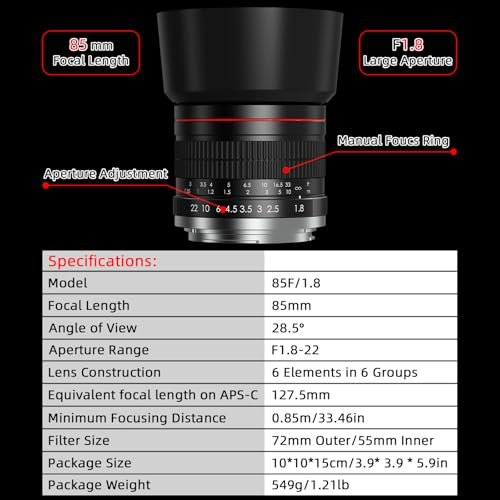
The EF 85mm f1.8 Portrait Lens MF for Canon EOS Rebel offers affordable, bright portrait reach.
Many Canon EOS Rebel owners want soft background blur without spending a fortune on a professional lens. An 85mm lens can help create flattering portraits, headshots, event photos, and detail shots. These manual-focus EF lenses also offer a wide f/1.8 aperture, but they demand careful focusing. I compared three affordable options with Canon’s premium EF 85mm f/1.2L USM to show which lens best fits your camera, skill level, and budget.
See the differences between my top picks at a glance.
| Lens | Focus | Aperture | Best For | Price Check |
|---|---|---|---|---|
| EF 85mm f/1.8 MF, B00VZYR2LA | Manual | f/1.8 | Budget portraits | View on Amazon |
| 85mm f/1.8 EF/EF-S, B098DJ21PM | Manual | f/1.8 | Rebel users learning manual focus | View on Amazon |
| 85mm f/1.8 EF, B0CL255NSY | Manual | f/1.8 | Simple EF portrait setup | View on Amazon |
| Canon EF 85mm f/1.2L USM | Autofocus | f/1.2 | Premium portrait work | View on Amazon |
EF 85mm f/1.8 MF for Canon Rebel

This first lens targets Canon DSLR owners who want an 85mm portrait view at a lower cost. It uses manual focus, so you turn the focus ring instead of relying on the camera’s autofocus system. The f/1.8 maximum aperture lets in a good amount of light and can create a soft background when you place the subject away from it. On a full-frame Canon DSLR, 85mm gives a classic portrait angle.
On an EOS Rebel with an APS-C sensor, the view looks tighter than 85mm because of the crop factor. In practice, it gives a field of view close to a 136mm lens on full frame. That reach works well for headshots and outdoor portraits, but you need more room between yourself and the subject. The EF mount fits compatible Canon DSLR bodies, including many Rebel models listed by the seller. I would still confirm your exact camera before ordering.
Pros:
- Wide f/1.8 aperture for portraits and low-light scenes
- Classic 85mm focal length on full-frame Canon DSLRs
- Tighter portrait framing on APS-C EOS Rebel cameras
- Manual focus gives direct control over the focus point
- Useful option for photographers on a limited budget
- Compact prime-lens design can be easier to carry than a zoom
Cons:
- Manual focus can be slow for moving people
- It may take practice to achieve sharp eyes at f/1.8
- Electronic camera control features may not be available
What Amazon Buyers Are Saying
Buyer feedback for low-cost manual-focus 85mm lenses often centers on value, portrait compression, and the bright aperture. Many shoppers like the look they can get without paying for a branded autofocus lens. Users who take time to learn focus distance and use a steady technique tend to get the most from this type of lens.
The main concern in this category is not usually the focal length. It is the manual-focus process. Some buyers expect autofocus or automatic aperture control and feel disappointed when they discover the lens needs more hands-on work. I recommend reading the current listing details and recent buyer comments before purchase, since fit, finish, and packaging can vary between sellers.
My Recommendation
I recommend this lens for still portraits, creative practice, and controlled sessions. It can be a smart first manual lens for an EOS Rebel user who wants an f/1.8 portrait look at a modest price. I would not choose it for fast children, sports, weddings, or any scene where the subject moves often.
| Category | Rating |
|---|---|
| Portrait potential | 4/5 |
| Manual-focus control | 3.5/5 |
| Ease of use | 3/5 |
| Value | 4/5 |
| Overall Rating | 3.7/5 |
85mm f/1.8 EF/EF-S Manual Lens

This second option follows the same core idea: an 85mm portrait lens with a bright f/1.8 maximum aperture and manual focus. Its product listing names a wide range of Canon EOS Rebel and other EOS DSLR models. That broad compatibility list may appeal to photographers who use more than one Canon body. Still, a long camera list should not replace checking the exact mount and body connection before checkout.
The EF and EF-S terms can cause confusion. Canon EF lenses generally work on Canon DSLR bodies that accept EF or EF-S lenses, while an EF-S lens cannot mount on a full-frame EF DSLR. This listing describes an EF/EF-S mount lens, but the exact design matters. The lens does not turn into an autofocus lens simply because the camera supports autofocus. It remains a manual-focus tool, so use the viewfinder, magnified live view, and careful focus technique.
Pros:
- Bright f/1.8 setting suits portraits and dim indoor light
- 85mm perspective helps separate the subject from the background
- Broad listed compatibility with many Canon DSLR models
- Manual operation can help users learn focus control
- Good fit for posed portraits and studio-style work
- Prime focal length encourages deliberate composition
Cons:
- No autofocus assistance for quick candid photos
- Users must verify mount details for their specific camera
- Manual exposure or aperture limits may reduce convenience
What Amazon Buyers Are Saying
Feedback on budget 85mm manual lenses commonly praises the focal length and the low entry cost. Buyers often enjoy the strong background separation that an 85mm lens can produce when used near its wide aperture. Some also like the learning value because the lens makes them slow down and think about subject distance, focus, and composition.
Complaints tend to come from buyers who wanted a simple point-and-shoot experience. Manual focus requires a different pace, and a sharp portrait needs the focus plane to land on the eye. Review patterns can also mention differences in build feel or focus-ring smoothness. I suggest checking the current Amazon page for updated images, seller details, and recent comments before making a final decision.
My Recommendation
This lens is worth considering if you want a low-cost way to try an 85mm portrait setup on a compatible Canon DSLR. I see it as a better fit for patient photographers than for busy portrait sessions. If you already enjoy manual lenses, this option may offer useful creative control. If you need reliable autofocus, choose an autofocus Canon or third-party lens instead.
| Category | Rating |
|---|---|
| Optical appeal for portraits | 4/5 |
| Compatibility clarity | 3.5/5 |
| Ease for beginners | 3/5 |
| Budget value | 4/5 |
| Overall Rating | 3.7/5 |
85mm f/1.8 EF Manual Lens for Canon
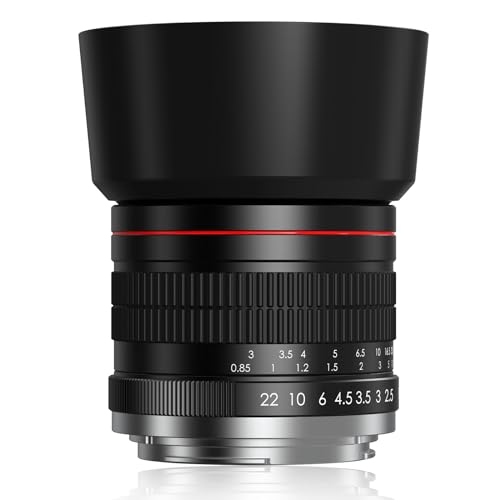
This third lens is another manual-focus 85mm option for Canon EOS DSLR cameras. Its listing focuses on EF compatibility and names several current and older Canon bodies, including Rebel models. The 85mm focal length remains useful for portraits because it gives a natural working distance on full frame and a tighter view on APS-C. The f/1.8 aperture can also help you keep shutter speeds higher in low light.
The main trade-off stays the same: you must focus by hand. That can work very well for a seated subject, a planned headshot, or a creative image with a fixed focus point. It becomes less practical when a child moves toward the camera or when you need many sharp frames in a row. For the best results, I would use a single focus target, check the eye at high magnification, and take several frames.
Pros:
- Classic portrait focal length for Canon DSLR bodies
- f/1.8 aperture supports background blur and low-light work
- Manual focus ring offers direct creative control
- Useful for posed portraits, flowers, and still subjects
- Can complement a standard kit zoom with a tighter view
- Affordable way to explore prime-lens photography
Cons:
- Manual focus is not ideal for fast action
- Users must confirm camera and mount compatibility
- Wide-aperture focus errors can appear clearly in portraits
What Amazon Buyers Are Saying
Shoppers who understand the manual-focus design often value this kind of lens for its low cost and portrait reach. Buyers commonly look for a soft background, a bright aperture, and a simple prime lens that feels different from a kit zoom. Those are reasonable goals for this lens class, especially when you shoot in a calm setting and control the distance to your subject.
The most important caution comes from expectations. Some buyers may compare a low-cost manual lens with an autofocus Canon lens and find the workflow slower. Others may need time to judge sharpness at f/1.8. I recommend treating current buyer reviews as a guide to real-world handling, while also checking the latest product specifications and return terms.
My Recommendation
I would choose this lens for a photographer who wants a simple, affordable portrait prime and accepts manual operation. It has a clear purpose, but it is not a universal replacement for an autofocus zoom. With good light, a steady subject, and careful focus, it can produce enjoyable portraits. For everyday family photography, I would keep an autofocus lens available as well.
| Category | Rating |
|---|---|
| Portrait usefulness | 4/5 |
| Focus control | 3.5/5 |
| Learning curve | 3/5 |
| Value for money | 4/5 |
| Overall Rating | 3.7/5 |
Canon EF 85mm f/1.2L USM Lens

The Canon EF 85mm f/1.2L USM belongs to a different class from the affordable manual lenses above. It uses Canon’s EF mount and includes autofocus through a USM drive system. Its f/1.2 maximum aperture is wider than f/1.8, which can help in low light and create a very shallow depth of field. The lens was designed for Canon SLR cameras, so it is a premium alternative for compatible EOS DSLR users.
This lens can deliver a distinctive portrait look, but it also demands skill. At f/1.2, the sharp focus area becomes very thin, so small changes in subject movement or camera position matter. The lens is also a more serious investment than a budget MF lens. On an APS-C Rebel, the 85mm view becomes tighter, much like using a longer portrait lens, so indoor photographers may need extra space.
Pros:
- Very wide f/1.2 aperture for portrait work and low light
- Autofocus offers a faster workflow than manual-focus alternatives
- Canon EF compatibility suits many Canon DSLR systems
- Strong subject isolation at close portrait distances
- Premium optical design aimed at demanding portrait users
- USM focusing supports a more practical shooting process
Cons:
- Costs much more than the manual-focus f/1.8 options
- Shallow depth of field makes accurate focus challenging
- The 85mm view can feel tight indoors on an APS-C Rebel
- Older professional DSLR lenses may be heavy for casual users
What Amazon Buyers Are Saying
Feedback for Canon’s 85mm f/1.2L line often focuses on its portrait rendering, very wide aperture, and professional build. Buyers who want a special look tend to value the strong subject separation and the ability to shoot at wider apertures. Autofocus also makes it more practical than a fully manual lens for sessions with some subject movement.
Common concerns include cost, size, and the narrow focus depth at f/1.2. Buyers may also compare the lens with newer designs and wonder whether the extra light is worth the price. I would inspect the exact listing condition, seller history, and warranty details, especially when buying an older or used Canon EF lens.
My Recommendation
This is the strongest choice for a photographer who wants premium Canon portrait performance and accepts the price and learning curve. It is not the best value for someone who simply wants to test an 85mm focal length. For a working portrait shooter with a compatible Canon DSLR, the autofocus and f/1.2 aperture make it much more capable than the budget MF lenses. I rate it highly, but only for the right user.
| Category | Rating |
|---|---|
| Portrait image potential | 4.8/5 |
| Autofocus performance | 4.5/5 |
| Ease of use | 4/5 |
| Value for budget buyers | 3/5 |
| Overall Rating | 4.3/5 |
How to Choose EF 85mm f1.8 Portrait Lens MF For Canon Eos Rebel
Choosing the right EF 85mm f1.8 Portrait Lens MF For Canon Eos Rebel means looking beyond the focal length. You should match the lens to your camera mount, shooting style, focus skill, and available space. A cheap lens can offer great value when it suits your needs. It can also frustrate you when you expect autofocus or automatic camera control.
1. Confirm the Canon Mount and Camera Fit
Start with your camera model. Many Canon EOS Rebel cameras use the EF or EF-S mount. An EF lens can fit many Canon DSLR bodies, while EF-S designs target Canon APS-C DSLR cameras. Check the product page for your exact Rebel model before you buy.
Also check whether you use a DSLR or a newer mirrorless Canon camera. An EF lens does not mount directly to an RF-mount EOS R camera. You need the correct Canon EF-EOS R adapter for that system. An adapter can preserve much of the lens function, but compatibility depends on the lens and adapter combination.
2. Decide If Manual Focus Fits Your Subjects
Manual focus works best when your subject stays still. It suits headshots, seated portraits, self-portraits, flowers, products, and creative images. You can focus on the eye, stop the subject from moving, and take several frames.
Manual focus becomes harder with children, pets, sports, and events. The issue becomes more serious at f/1.8 because the sharp zone can be narrow at close distance. Use live-view magnification when possible. You can also stop down to f/2.8 or f/4 for more focus room, though that changes the amount of background blur and the light reaching the sensor.
3. Compare Aperture, Working Distance, and Value
An f/1.8 lens gives you a bright maximum aperture and a strong portrait option. Yet you may not always need to shoot wide open. A smaller aperture can make both eyes sharp and improve the keeper rate. Look for a focus ring that turns smoothly and a body that feels secure on your camera.
Think about working distance too. On a full-frame body, 85mm gives a familiar portrait view. On an APS-C Rebel, it looks tighter. That can flatter faces, but it may feel too long in a small room. If you often shoot indoors, measure your space before buying.
Finally, compare the total value. A manual-focus lens may cost less, but it gives up speed and convenience. The Canon EF 85mm f/1.2L costs more, yet autofocus and the wider aperture may matter for professional work. For learning and posed portraits, a budget EF 85mm f1.8 Portrait Lens MF For Canon Eos Rebel can be the more sensible choice.
Final Verdict: Which Should You Buy?
For the best overall portrait performance, I would choose the Canon EF 85mm f/1.2L USM. For low-cost learning and posed portraits, the B00VZYR2LA manual-focus f/1.8 lens offers the strongest value.
The EF 85mm f1.8 Portrait Lens MF For Canon Eos Rebel works best when you accept manual focus and plan your shots. Confirm the mount, check current Amazon details, and choose based on your subjects.
FAQs Of EF 85mm f1.8 Portrait Lens MF For Canon Eos Rebel
Will an 85mm EF lens fit a Canon EOS Rebel?
Most Canon EOS Rebel DSLR cameras accept compatible EF lenses. Check your exact camera model and the current product listing before ordering.
Is the EF 85mm f1.8 Portrait Lens manual focus?
The budget lenses reviewed here use manual focus. You turn the focus ring by hand and should not expect normal autofocus operation.
Is 85mm good for portraits on an APS-C Canon Rebel?
Yes. It gives a tight portrait view similar to about 136mm on full frame. It works well for headshots but needs more space indoors.
Can I use an EF 85mm lens on a Canon EOS R camera?
Not directly. Canon EOS R cameras use the RF mount, so you need a compatible EF-EOS R adapter for an EF lens.
What is better for moving subjects, f/1.8 MF or Canon f/1.2L USM?
The Canon f/1.2L USM is the better choice because it offers autofocus. A manual-focus f/1.8 lens suits still or carefully posed subjects.

