
Introduction
Photographers across the United States use different camera formats, from full-frame DSLRs and mirrorless cameras to APS-C, Micro Four Thirds, and smartphones. Because the same lens can show a different amount of a scene on each format, comparing focal lengths by the printed number alone can be misleading.
Our focal length equivalent calculator solves this problem. Enter the lens focal length and your camera’s crop factor to estimate its 35mm full-frame equivalent focal length:
Equivalent focal length = actual focal length × crop factor
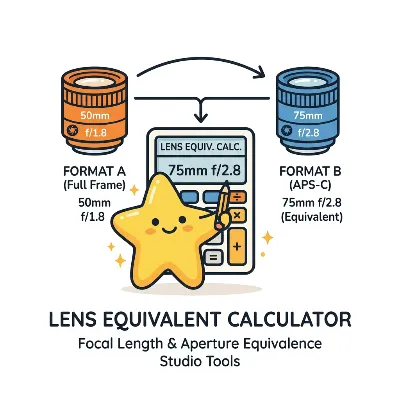
For example, a 50mm lens on a camera with a 1.5× crop factor gives a field of view similar to a 75mm lens on a full-frame camera.

What Is a Focal Length Equivalent?
A focal length equivalent compares the field of view of a lens and camera combination with a 35mm full-frame system. It does not change the lens’s true focal length.
A 50mm lens remains a 50mm lens on every camera. The sensor changes how much of the image circle the camera records. A smaller sensor captures a narrower section of the scene, making the lens appear more zoomed in.
This is often called the crop factor or 35mm equivalent focal length.
Actual focal length vs. equivalent focal length
| Term | Meaning | Example |
|---|---|---|
| Actual focal length | The physical focal length marked on the lens | 50mm |
| Crop factor | The sensor-size comparison used for field of view | 1.5× |
| Equivalent focal length | The full-frame focal length with a similar field of view | 75mm |
The equivalent value helps you compare lenses across camera systems. It does not predict every visual effect.
For example, a 50mm f/1.8 lens on an APS-C camera has the field of view of about a 75mm lens on full frame. Its depth of field and light-gathering behavior still relate to the real 50mm f/1.8 lens.
How to Use a Focal Length Equivalent Calculator
Use the calculator in four simple steps.
-
Enter the lens’s actual focal length.
Use the number printed on the lens, such as 24mm, 35mm, 50mm, or 200mm. -
Select the camera sensor format or crop factor.
Choose full frame, APS-C, Micro Four Thirds, or another listed format. If the calculator asks for a crop factor, enter the correct value. -
Calculate the result.
The tool multiplies the actual focal length by the crop factor. -
Use the result to compare field of view.
Match the result with a full-frame lens, a composition goal, or a familiar viewing angle.
The basic formula
Full-frame equivalent = actual focal length × crop factor
Example: APS-C camera
Suppose you own a 35mm lens and use a camera with a 1.5× crop factor:
35mm × 1.5 = 52.5mm
The lens gives a field of view close to a 52.5mm lens on full frame. Many photographers would describe this as approximately a 50mm-equivalent view.
Reverse calculation
You can also use the formula to find the actual lens needed for a target equivalent:
Actual focal length = desired equivalent focal length ÷ crop factor
For a 50mm-equivalent view on a 1.5× crop camera:
50mm ÷ 1.5 = 33.3mm
A 33mm or 35mm lens would be a practical match.

Common Crop Factors by Camera Format
Crop factors vary by sensor dimensions and by manufacturer. The values below are common approximations, not universal rules.
| Camera format | Common crop factor | 24mm lens equivalent | 50mm lens equivalent |
|---|---|---|---|
| Full frame | 1.0× | 24mm | 50mm |
| Canon APS-C | 1.6× | 38.4mm | 80mm |
| Nikon, Sony, Fujifilm APS-C | 1.5× | 36mm | 75mm |
| Micro Four Thirds | 2.0× | 48mm | 100mm |
| 1-inch type | About 2.7× | About 65mm | About 135mm |
| Medium format digital | Often below 1.0× | Varies | Varies |
The exact result depends on the sensor’s dimensions and the reference used by the calculator. Some systems also apply a different crop value when recording video because the camera uses only part of the sensor.
Why APS-C crop factors differ
Most APS-C cameras use a crop factor near 1.5×. Canon APS-C cameras commonly use about 1.6× because their sensors are slightly smaller than many competing APS-C sensors.
That small difference matters when you compare wide lenses or build a multi-lens kit. For everyday photography, rounding to the nearest whole millimeter is usually reasonable.
Finding an unknown crop factor
If you know the sensor’s width and height, calculate its diagonal:
Sensor diagonal = √(width² + height²)
Then compare it with the 35mm full-frame diagonal, which is about 43.3mm:
Crop factor = 43.3 ÷ sensor diagonal
This method is an estimate. A camera may crop the sensor during video, use a different image area, or record in a nonstandard aspect ratio.
Focal Length Equivalent Examples
The following examples show how the calculator changes lens comparisons.
Example 1: 24mm lens on Micro Four Thirds
24mm × 2.0 = 48mm
A 24mm lens on a Micro Four Thirds camera gives a view close to a 48mm lens on full frame. It will not look ultra-wide in the same way a 24mm full-frame lens does.
Example 2: 85mm lens on APS-C
Using a 1.5× crop factor:
85mm × 1.5 = 127.5mm
The lens gives a field of view close to 128mm on full frame. This can be useful for portraits, sports, and distant subjects when you want a tighter view.
Example 3: 200mm lens on a 1.6× crop camera
200mm × 1.6 = 320mm
The field of view resembles a 320mm lens on full frame. The camera does not create extra optical magnification, but the smaller sensor frames the subject more tightly.
Example 4: Choosing a lens for a 35mm-equivalent view
You want a 35mm-equivalent lens on a Micro Four Thirds camera:
35mm ÷ 2.0 = 17.5mm
A 17mm or 18mm lens will provide a close practical match.
Quick comparison table
| Desired full-frame view | Actual focal length on 1.5× APS-C | Actual focal length on 2× Micro Four Thirds |
|---|---|---|
| 24mm ultra-wide | 16mm | 12mm |
| 35mm wide | About 23mm | About 17mm |
| 50mm standard | About 33mm | 25mm |
| 85mm portrait | About 57mm | About 43mm |
| 200mm telephoto | About 133mm | 100mm |
These are field-of-view matches. They are not identical lens designs, and they do not produce exactly the same depth of field, background blur, or perspective.
What the Calculator Does—and Does Not—Tell You
The calculator estimates field of view, which is the most useful reason to compare equivalent focal lengths. It does not fully predict how an image will look.
It helps compare framing
A 35mm-equivalent value can help you decide whether a lens is suitable for:
- Landscapes
- Street photography
- Travel
- Portraits
- Sports
- Wildlife
- Indoor scenes
- Video production
A lower equivalent number shows more of the scene. A higher number gives a narrower view.
It does not change perspective
Perspective depends mainly on your camera position, not the lens number alone. If you use a wide lens and move close to a person, the person’s features may look more exaggerated. If you use a telephoto lens and move back to keep the same framing, the background may appear more compressed.
The calculator cannot predict this change. To compare perspective, keep the camera position the same.
It does not make a lens faster
A 50mm f/1.8 lens remains f/1.8 on an APS-C camera. The crop factor does not turn it into an f/2.7 lens for exposure.
For depth of field comparisons, some photographers use an approximate full-frame-equivalent aperture:
Equivalent aperture for depth of field = actual aperture × crop factor
A 50mm f/1.8 lens on a 1.5× crop camera can give depth of field similar to about 75mm at f/2.7 on full frame when framing and camera position are comparable. This is an approximation, not an exposure setting.
It does not improve optical detail
A crop sensor may frame a distant subject more tightly, but it does not automatically provide the same detail as a longer lens on a full-frame camera. Resolution, lens sharpness, focus accuracy, atmospheric haze, and processing also matter.
Choosing a Lens by Equivalent Focal Length
Use the equivalent value as a starting point, then consider your subject, working distance, and camera system.
| Photography goal | Common full-frame field-of-view range | Practical guidance |
|---|---|---|
| Ultra-wide landscapes or interiors | 14–24mm | Useful when you need a broad view |
| Travel and environmental scenes | 24–35mm | Shows a subject with its surroundings |
| Street and documentary work | 28–50mm | Balances context and natural framing |
| General-purpose photography | 35–60mm | Flexible for daily use |
| Head-and-shoulders portraits | 75–105mm | Often gives comfortable working distance |
| Sports and wildlife | 200mm and longer | Helps fill the frame from farther away |
| Birds and distant details | 400mm and longer | Usually requires careful support and focus |
These ranges are guidelines, not strict categories. A photographer’s distance from the subject often matters more than the label attached to a focal length.
For portraits
A 50mm-equivalent lens can work well for full-body or environmental portraits. An 85mm- to 105mm-equivalent view often gives more working distance for head-and-shoulders portraits.
On a 1.5× APS-C camera, a 56mm lens produces about an 84mm-equivalent view. On Micro Four Thirds, a 42.5mm lens produces about an 85mm-equivalent view.
For landscapes and travel
A 24mm- to 35mm-equivalent lens can show architecture, streets, and landscapes while keeping a natural sense of space. Very wide lenses can include more, but they may make nearby objects look large and distant objects look small.
For wildlife and sports
A higher equivalent focal length can make it easier to fill the frame from a safe or practical distance. It does not remove the need for fast autofocus, adequate shutter speed, good light, and stable technique.
Important Limits and Common Mistakes
Mistake 1: Treating equivalent focal length as the actual focal length
A 35mm lens on a 1.5× crop camera does not become a 52.5mm lens. It still has the optical properties of a 35mm lens. The number only describes its approximate field of view compared with full frame.
Mistake 2: Applying crop factor to exposure
Do not multiply the aperture to set exposure. A 35mm f/1.8 lens remains f/1.8 for exposure on every compatible camera.
Mistake 3: Forgetting the camera’s video crop
Some cameras use the full sensor for still photos but crop the image for 4K or other video modes. Calculate the crop factor for the active recording area when video framing matters.
Mistake 4: Ignoring aspect ratio
A camera may use a 3:2, 4:3, 16:9, or another image shape. Horizontal, vertical, and diagonal fields of view will not be identical. A diagonal equivalent is useful for broad comparison, but horizontal framing may be more relevant for video or architecture.
Mistake 5: Confusing digital zoom with optical reach
Digital zoom crops the image after capture or during processing. It may reduce the recorded detail and does not work like a longer optical focal length.
Mistake 6: Assuming smartphones use one crop factor
Smartphones often combine several cameras with different sensors and lenses. Their published focal lengths may already be stated as 35mm equivalents. Check the manufacturer’s specifications before applying another crop factor.
Mistake 7: Comparing lenses without checking the mount
Equivalent focal length does not confirm compatibility. Check the lens mount, sensor coverage, autofocus support, flange distance, and any adapter limits before buying or renting a lens.
How to Get the Most Accurate Calculator Result
For a reliable result, confirm these details first:
- Camera model and sensor format
- Still-photo or video mode
- Actual lens focal length
- Crop factor used by the calculator
- Image aspect ratio
- Whether the lens is native, adapted, or designed for a smaller sensor
A lens made for an APS-C sensor may not cover a full-frame sensor without dark corners. A full-frame lens can usually cover a smaller sensor, but the camera may apply an automatic crop or record a smaller image area.
For zoom lenses, calculate both ends of the range. A 16–80mm lens on a 1.5× camera gives approximately:
16mm × 1.5 = 24mm
80mm × 1.5 = 120mm
Its field of view is therefore similar to a 24–120mm full-frame zoom.
Frequently Asked Questions
Is a focal length equivalent the same as a crop factor?
No. The crop factor describes the sensor-size relationship. The equivalent focal length is the lens’s actual focal length multiplied by that factor.
What is the full-frame equivalent of a 50mm lens?
It depends on the camera. It is 50mm on full frame, about 75mm on a 1.5× APS-C camera, about 80mm on a 1.6× Canon APS-C camera, and about 100mm on Micro Four Thirds.
Does crop factor affect image quality?
Crop factor alone does not determine image quality. Sensor size, pixel design, lens quality, lighting, focus, camera settings, and image processing all affect the result.
Does crop factor affect low-light performance?
The sensor format can affect noise, dynamic range, and depth of field at the same framing, but crop factor by itself is not a complete measure of low-light performance. Compare the whole camera system rather than relying on one number.
Should I use actual or equivalent focal length when buying a lens?
Use both. Use the actual focal length to confirm the lens and camera system. Use the equivalent focal length to predict the field of view and compare it with lenses on other formats.
Key Takeaways
- Use actual focal length × crop factor to estimate a 35mm full-frame equivalent.
- A 50mm lens on a 1.5× camera gives a field of view similar to 75mm on full frame.
- The calculation describes framing, not a change in the lens’s physical focal length.
- Crop factor does not directly change exposure.
- Check sensor format, video crop, aspect ratio, and smartphone specifications before calculating.
- Use the equivalent value as a guide, then consider working distance, perspective, depth of field, and lens compatibility.
Conclusion
A focal length equivalent calculator makes lens comparisons much easier across camera systems used in the United States. Enter the true focal length, select the correct crop factor, and use the result to estimate your full-frame field of view.
The best lens is not defined by one number. Choose the focal length that gives you the framing, working distance, background control, and flexibility your subject requires.

