
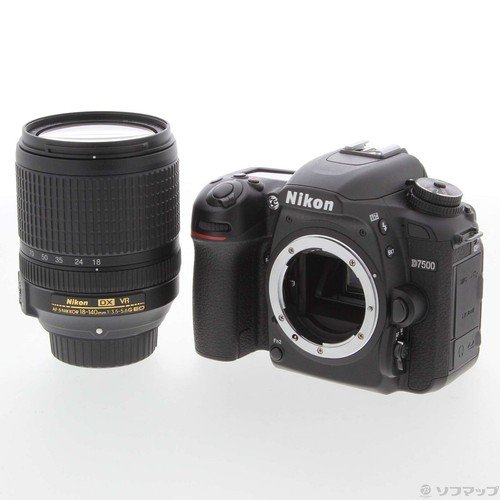
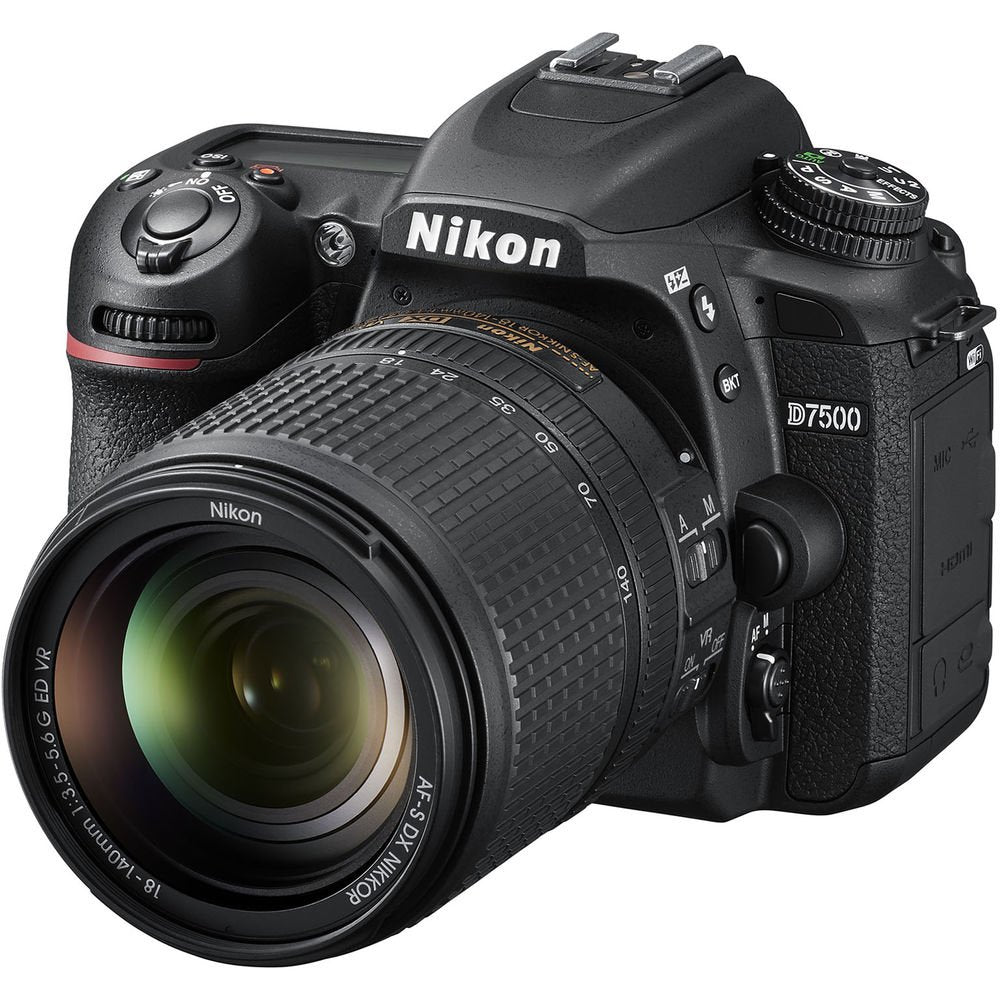
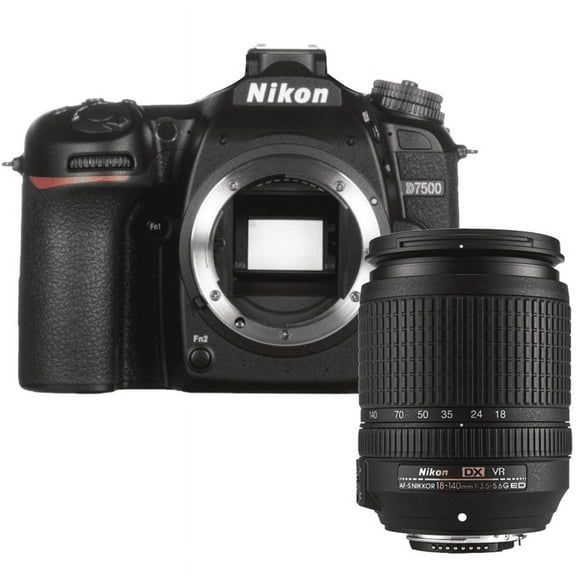
For photographers in the United States, the Nikon D7500 with the AF-S DX NIKKOR 18-140mm f/3.5-5.6G ED VR lens is a flexible DSLR kit for travel, family events, portraits, sports, wildlife, and everyday photos. Its 20.9-megapixel DX sensor, fast burst rate, strong high-ISO range, and broad zoom lens make it more capable than a basic entry-level camera.
The kit is not the best fit for every buyer. The D7500 uses an older DSLR design, has one SD card slot, and does not offer the latest mirrorless autofocus or video features. Still, it remains a useful option for photographers who want an optical viewfinder, long battery life, physical controls, and a single lens that covers many common shooting needs.
Key Takeaways
- The Nikon D7500 uses a 20.9MP DX-format CMOS sensor.
- The included 18-140mm lens gives a full-frame equivalent view of about 27-210mm.
- The camera can shoot at up to 8 frames per second with continuous autofocus.
- The lens includes Nikon VR optical image stabilization.
- The D7500 records 4K UHD video, but with a crop and some limits compared with newer mirrorless cameras.
- It has one SD card slot, not two.
- The kit suits travel, portraits, family use, outdoor photography, and general-purpose shooting.
- Buyers should check the camera’s condition, shutter count, battery health, lens fungus, and autofocus performance when purchasing used.
What Is the Nikon D7500?
The Nikon D7500 is a mid-range Nikon DSLR with a DX-format sensor. Nikon introduced it in 2017 as a successor to the D7200. It sits above beginner models such as the D3500 and D5600 in Nikon’s DSLR range.
A DX sensor is smaller than a full-frame sensor. Nikon’s DX format applies a 1.5x crop factor to the lens view. This means the included 18-140mm lens gives a field of view similar to a 27-210mm lens on a full-frame camera.
That range is useful because it starts wide enough for groups and landscapes and reaches far enough for portraits, travel details, and outdoor subjects. It does not provide the same reach as a dedicated telephoto lens, but it is much easier to carry.
The D7500 also has a traditional optical viewfinder. You see the scene through the lens with a mirror and prism rather than through an electronic display. Many photographers prefer this view for its natural motion and low display lag.
Who Should Consider This Camera?
The D7500 and 18-140mm lens may suit:
- Enthusiasts moving up from a basic DSLR
- Travelers who want one general-purpose lens
- Parents photographing sports and school events
- Portrait photographers who want strong background separation at longer focal lengths
- Outdoor photographers who value battery life and physical controls
- Students learning exposure, focus, and lens choice
It may not suit buyers who need a small body, silent shooting, advanced subject recognition, or the newest video tools. A modern mirrorless camera may be a better choice for those needs.
Nikon D7500 Specifications at a Glance
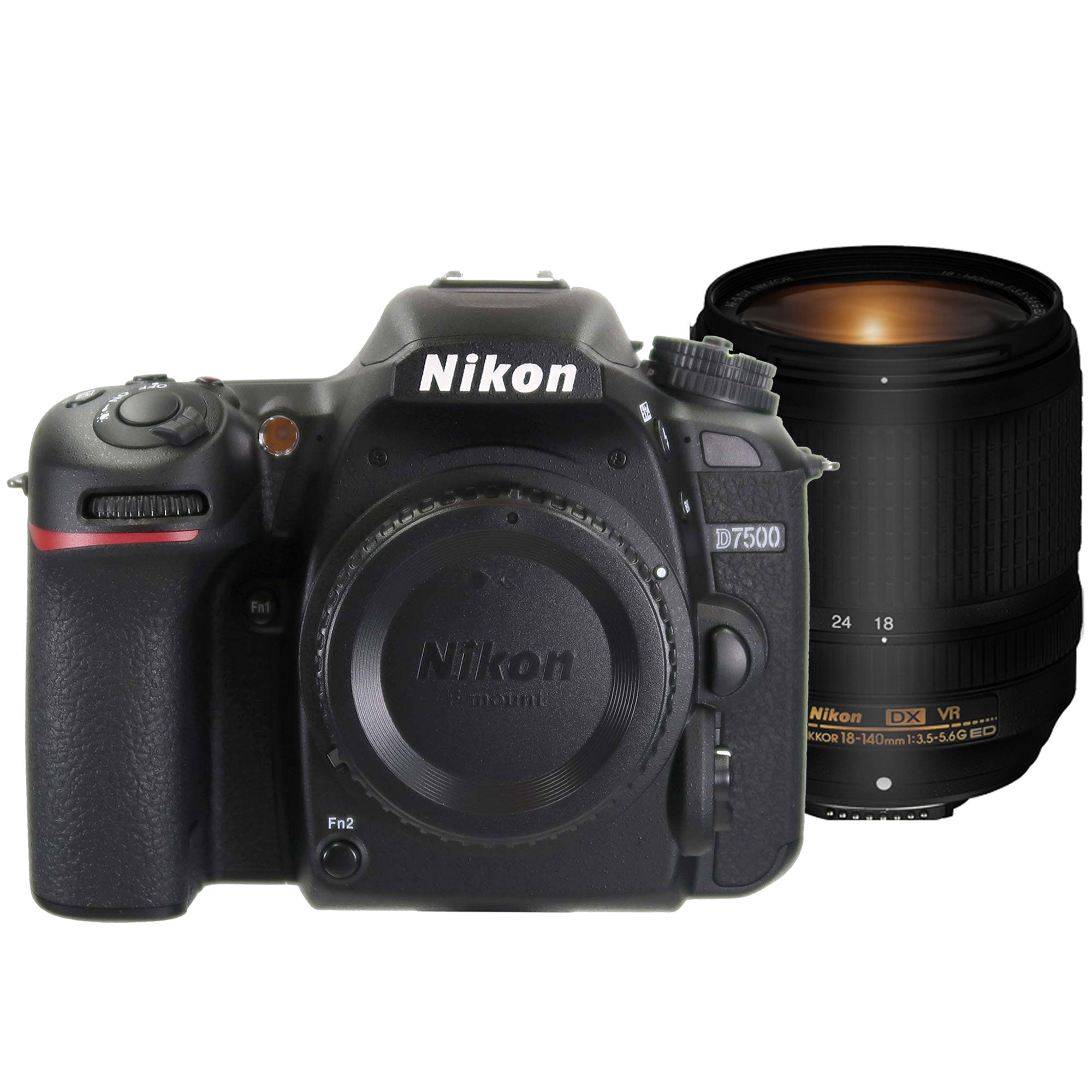
The table below lists the main documented specifications of the Nikon D7500 body and the 18-140mm kit lens.
| Feature | Nikon D7500 with 18-140mm lens |
|---|---|
| Camera type | Digital single-lens reflex camera |
| Sensor | 20.9MP DX-format CMOS |
| Image processor | EXPEED 5 |
| Lens mount | Nikon F mount |
| Included lens | AF-S DX NIKKOR 18-140mm f/3.5-5.6G ED VR |
| Full-frame equivalent view | About 27-210mm |
| ISO range | ISO 100-51,200; expanded range available |
| Continuous shooting | Up to 8 frames per second |
| Autofocus system | 51-point AF system |
| Viewfinder | Optical pentaprism viewfinder |
| Rear screen | 3.2-inch tilting touchscreen LCD |
| Video | 4K UHD and Full HD recording |
| Memory card | One SD card slot |
| Image stabilization | VR in the included lens |
| Wireless features | Wi-Fi and Bluetooth through SnapBridge features |
| Battery | EN-EL15a type battery supplied for the model |
| Body weight | About 640 grams with battery and memory card |
Specifications can vary by shooting mode, firmware, battery type, and regional package. Nikon’s user manual remains the best source for exact menu behavior and recording limits.
Resolution and Image Files
The D7500 produces 20.9MP still images. Its maximum image size is approximately 5,568 by 3,712 pixels. That gives enough detail for common prints, online publishing, cropping, and photo books.
The camera supports Nikon’s NEF RAW format and JPEG files. RAW files preserve more editing information, especially in highlights and shadows. JPEG files are smaller and ready to share with little or no editing.
A 20.9MP sensor is not the highest-resolution option today. However, resolution is only one part of image quality. Lens quality, focus accuracy, light, shutter speed, and editing technique also affect the final image.
ISO Performance
The standard ISO range runs from 100 to 51,200. Nikon also lists expanded settings above and below the standard range.
Higher ISO settings help when light is low. For example, a photographer can raise ISO at an indoor basketball game to keep the shutter speed fast enough to reduce motion blur.
The trade-off is noise. Fine detail and color quality usually decline as ISO rises. The D7500’s larger DX sensor and modern-for-its-generation processor give it a useful advantage over many older entry-level Nikon models, but no camera produces clean, noise-free images at every ISO setting.

AF-S DX NIKKOR 18-140mm Lens: What Can It Do?
The AF-S DX NIKKOR 18-140mm f/3.5-5.6G ED VR is an all-purpose zoom lens. Its focal length range is its main strength.
At 18mm, the lens is useful for:
- Landscapes
- Buildings
- Small rooms
- Group photos
- Travel scenes
- Environmental portraits
At 50-85mm, it works well for:
- Standard everyday photos
- Street scenes
- Head-and-shoulder portraits
- Food and detail shots
At 100-140mm, it can help with:
- Tighter portraits
- Outdoor events
- Distant details
- Some wildlife and sports from nearby positions
The lens has a variable maximum aperture. It opens to f/3.5 at the wide end and f/5.6 at 140mm. This means less light reaches the sensor as you zoom in.
What Does VR Mean?
VR means Vibration Reduction. It is Nikon’s optical image stabilization system. The lens shifts an internal optical element to reduce the effect of small hand movements.
VR can help with camera shake when photographing still subjects at slower shutter speeds. It does not freeze a moving person, animal, or vehicle. For moving subjects, you still need a fast shutter speed.
For example, VR may help when photographing a stationary building at dusk. It will not stop a child from appearing blurred while running indoors.
Main Lens Limitation
The 18-140mm lens is convenient, but it is not especially bright at the long end. Its f/5.6 maximum aperture can make indoor sports and dim events harder to photograph.
A faster lens, such as a 50mm f/1.8 or 85mm f/1.8, can let in more light and create stronger background blur. A dedicated telephoto lens can also provide more reach for wildlife or field sports.

Autofocus, Burst Shooting, and Real-World Use
The D7500 uses a 51-point autofocus system through its optical viewfinder. It supports single-point AF, dynamic-area AF, group-area AF, and 3D-tracking modes.
The best mode depends on the subject:
- Single-point AF: Good for portraits, landscapes, and still subjects.
- Dynamic-area AF: Useful when the subject moves slightly away from the selected point.
- Group-area AF: Helpful for subjects that are difficult to track against a busy background.
- 3D-tracking: Designed to follow a subject’s movement and color information.
The camera can shoot at up to 8 frames per second. That speed is useful for sports, wildlife, action, and changing expressions at events.
Burst speed alone does not guarantee sharp action photos. Focus mode, shutter speed, subject contrast, lighting, and the photographer’s timing all matter. A useful starting point for running subjects is a shutter speed around 1/500 second, although faster movement may need 1/1000 second or more.
The D7500 also offers a quiet continuous mode at a lower speed. This can help when photographing in places where a loud shutter is distracting, though it is not fully silent electronic shooting.
Video Features and Limitations
The Nikon D7500 records 4K UHD video. It can also record Full HD footage at a range of frame rates. The camera includes a microphone input for better sound than the built-in microphone can provide.
Its tilting touchscreen can help with low-angle and waist-level recording. The screen is useful for still photography as well, especially when composing from a low position.
The main video limitation is the 4K crop. The camera uses a smaller area of the sensor for 4K recording, which makes the lens view narrower. An 18mm lens appears less wide in 4K than it does for still photos.
The D7500 is also an older DSLR design. Newer mirrorless cameras often provide better face and eye detection during video, more advanced subject tracking, and more flexible monitoring tools.
Choose the D7500 for video if you mainly need occasional clips, travel footage, or basic 4K recording. Choose a newer camera if video is a main purpose.
Handling, Screen, and Connectivity
The D7500 has a substantial DSLR body with a deep grip and many direct controls. Its larger size can feel more stable with the 18-140mm lens attached.
The optical pentaprism viewfinder gives a bright view of the subject. It also avoids the electronic refresh delay that can occur with some older electronic viewfinders.
The 3.2-inch rear touchscreen tilts up and down. It does not fully articulate to the side. This matters for creators who need to monitor themselves while recording from in front of the camera.
Nikon’s SnapBridge system provides Bluetooth and Wi-Fi functions for compatible smartphones. These features can support image transfer, remote control, and location data workflows. Phone compatibility and app behavior can change, so buyers should confirm current support before relying on wireless functions.
The camera uses one SD card slot. This is a practical limitation for paid event work because there is no in-camera second-card backup. Photographers who need instant redundancy should consider a camera with two card slots.
Battery Life and Outdoor Use
The D7500 uses a rechargeable EN-EL15-series battery. Nikon rated the camera for a high number of still images under specified test conditions. Actual battery life changes with live view use, flash, Wi-Fi, video, cold weather, autofocus behavior, and screen brightness.
For a full day outdoors, carry at least one spare battery and a second memory card. Keep batteries warm in cold conditions, and avoid storing loose batteries where metal objects can short their contacts.
The body includes dust and weather sealing intended to help protect it in challenging conditions. Sealing is not the same as waterproofing. Do not expose the camera to heavy rain, spray, sand, or water without suitable protection.
If the camera becomes damp, turn it off, remove the battery if safe, and allow it to dry fully before use. Do not use a hair dryer or strong heat source.

Buying a Used Nikon D7500 in the United States
Because the D7500 is an older DSLR, many US buyers will encounter used or refurbished examples. Condition matters more than the model name alone.
Check these points before buying:
- Shutter count: A lower count can be useful, but it does not prove that the camera is in perfect condition.
- Sensor: Inspect for scratches, heavy dust, or marks that remain after careful cleaning.
- Lens glass: Look for haze, fungus, deep scratches, and separation.
- Autofocus: Test autofocus at both 18mm and 140mm.
- Zoom ring: Make sure the ring turns smoothly without grinding or sticking.
- VR switch: Confirm that vibration reduction can be turned on and off.
- Screen and controls: Test the touchscreen, command dials, buttons, card door, and battery door.
- Ports: Check the USB, microphone, headphone, and HDMI ports if you need them.
- Battery: Ask whether the battery is genuine Nikon and whether it holds a charge.
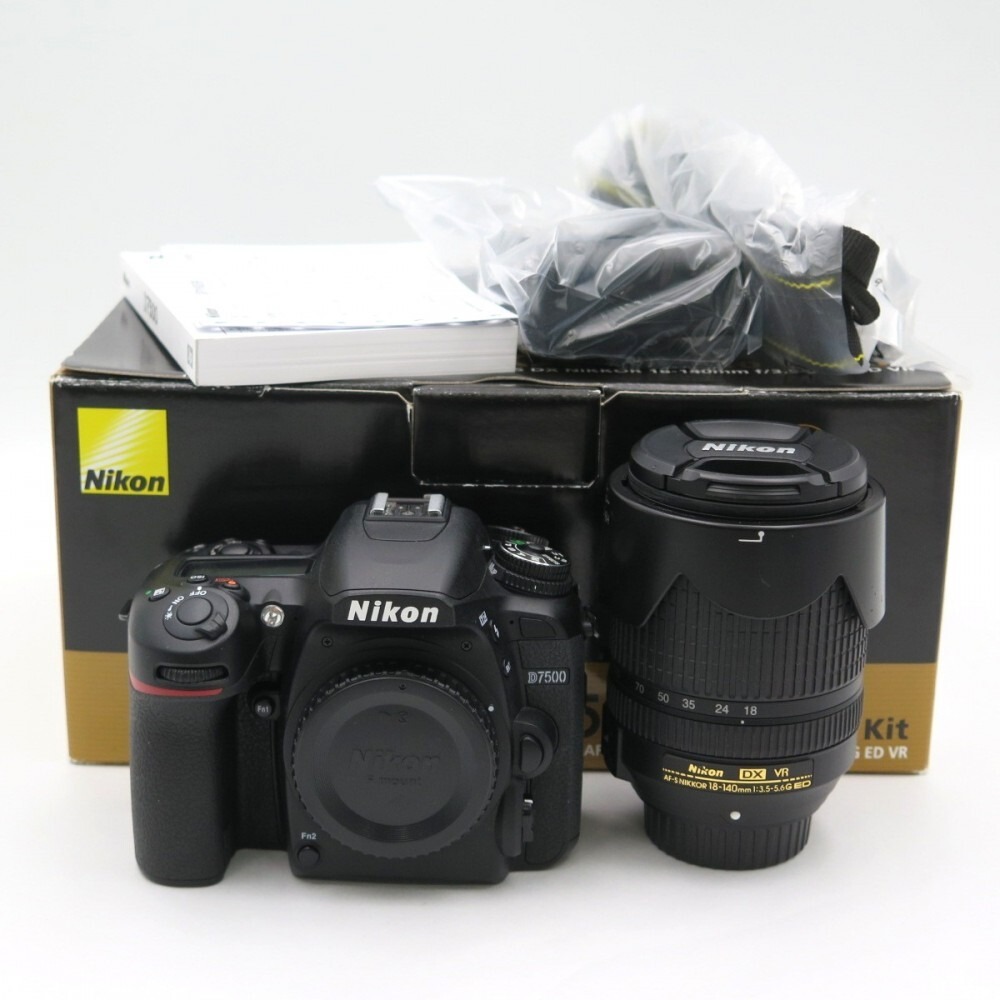
- Included items: Confirm the charger, battery, body cap, lens cap, strap, and manuals.
Ask for sample photographs if you are buying online. A photo of a plain wall at a small aperture can reveal sensor dust. A close photo of the lens at an angle can reveal scratches or haze.
Avoid paying a premium for a kit only because the seller calls it “like new.” Use the exact condition of the body, lens, battery, and accessories to judge value.

Nikon D7500 vs. Other Nikon Options
The D7500 is best understood as a capable older enthusiast DSLR rather than a beginner camera or modern mirrorless body.
| Camera type | Main advantage over the D7500 | Main trade-off |
|---|---|---|
| Nikon D3500 | Lower weight and simpler controls | Slower performance and fewer advanced features |
| Nikon D5600 | Fully articulating screen and simpler design | Less robust controls and lower action capability |
| Nikon D500 | Stronger professional action features and autofocus | Larger, heavier, and usually more expensive used |
| Nikon Z50 | Smaller mirrorless body and newer live-view autofocus | Requires Z-mount lenses or an adapter for F-mount lenses |
| Nikon Z50II-class mirrorless body | Newer subject detection and video features | Higher cost and different battery and lens system |
The right choice depends on the buyer’s current lenses. A photographer who already owns Nikon F-mount DX lenses may find the D7500 more practical. A new buyer who wants a long upgrade path may prefer Nikon Z mount.
The 18-140mm lens is an F-mount DX lens. It can be used on some Nikon Z cameras with the FTZ or FTZ II adapter, but the adapter adds size and cost. It also keeps the user in the older F-mount lens system.

Common Mistakes to Avoid
Expecting the 18-140mm Lens to Replace Every Lens
The kit lens covers many situations, but it cannot provide the reach of a long telephoto lens or the low-light ability of a fast prime lens.
Using Too Slow a Shutter Speed
VR can reduce camera shake, but it cannot freeze movement. Raise the shutter speed for people, pets, sports, and wildlife.
Leaving the Camera in Auto ISO Without Limits
Auto ISO is useful, but set a maximum ISO and minimum shutter speed when you need predictable results. This is especially helpful indoors.
Confusing Crop Factor With Extra Magnification
The 1.5x DX crop changes the angle of view. It does not create extra optical detail. A distant subject may look tighter in the frame, but the lens has not gained real magnification.
Ignoring the Single Card Slot
The D7500 cannot create an in-camera backup on a second card. Copy important files to a computer or storage device as soon as practical.
Treating Weather Sealing as Waterproofing
Use a rain cover or sealed bag in bad weather. Dry the camera before storing it in a closed case.

Is the Nikon D7500 With 18-140mm Lens Worth It?
The Nikon D7500 with the AF-S DX NIKKOR 18-140mm lens is worth considering when the price reflects its age and condition. It offers strong still-image performance, a useful zoom range, fast burst shooting, a bright optical viewfinder, and long battery life.
It is a particularly sensible choice for photographers who prefer DSLRs, already own Nikon F-mount lenses, or want a durable camera for travel and outdoor work without carrying several lenses.
A newer mirrorless camera is the better choice when you need advanced eye autofocus, a fully articulated screen, silent electronic shooting, smaller size, or modern video tools. The single card slot also makes the D7500 less suitable for photographers who require immediate backup during paid assignments.
Before buying, compare the complete kit cost with a newer mirrorless body and lens. Include the cost of batteries, memory cards, adapters, and future lenses. The cheapest camera body is not always the least expensive system over time.

Frequently Asked Questions
Is the Nikon D7500 a full-frame camera?
No. The D7500 is a DX-format camera with a smaller sensor than a full-frame model. Nikon’s 1.5x crop factor makes the 18-140mm lens appear similar to a 27-210mm lens on full frame.
Is the 18-140mm lens good for portraits?
Yes, it can produce pleasing portraits, especially from about 50mm to 140mm. For stronger background blur and better low-light performance, a faster prime lens such as a 50mm f/1.8 or 85mm f/1.8 may be better.
Can the D7500 shoot 4K video?
Yes. It records 4K UHD video, but the 4K mode uses a crop. This makes the lens view narrower than it is for still photography.
Does the D7500 have image stabilization?
The camera body does not provide sensor-shift stabilization. The included 18-140mm lens has Nikon VR optical stabilization.
Can I use this lens on a Nikon Z camera?
The lens may be used on compatible Nikon Z cameras with an FTZ-series mount adapter. It remains a DX F-mount lens, so the camera may use a cropped DX image area.
Is the Nikon D7500 good for beginners?
It can be good for beginners who want to learn manual exposure and advanced controls. Its larger body and deeper menu system may feel more complex than an entry-level DSLR or simple mirrorless camera.
Final Recommendation
The Nikon D7500 20.9MP DSLR Camera with the AF-S DX NIKKOR 18-140mm f/3.5-5.6G ED VR lens is a versatile still-photo kit for US photographers who value DSLR handling and a broad all-purpose zoom. Its strongest points are image quality, action speed, battery life, controls, and lens range.
Its main limits are age, one card slot, a non-articulating screen, 4K crop, and less advanced autofocus than current mirrorless cameras. Check the condition and total system cost before buying. If those limits fit your needs, this Nikon kit can remain a practical and capable camera for travel, family photos, portraits, and outdoor work.
Sources and Verification Notes
The technical details in this article are based on Nikon’s documented product information and the Nikon D7500 reference manual:

