
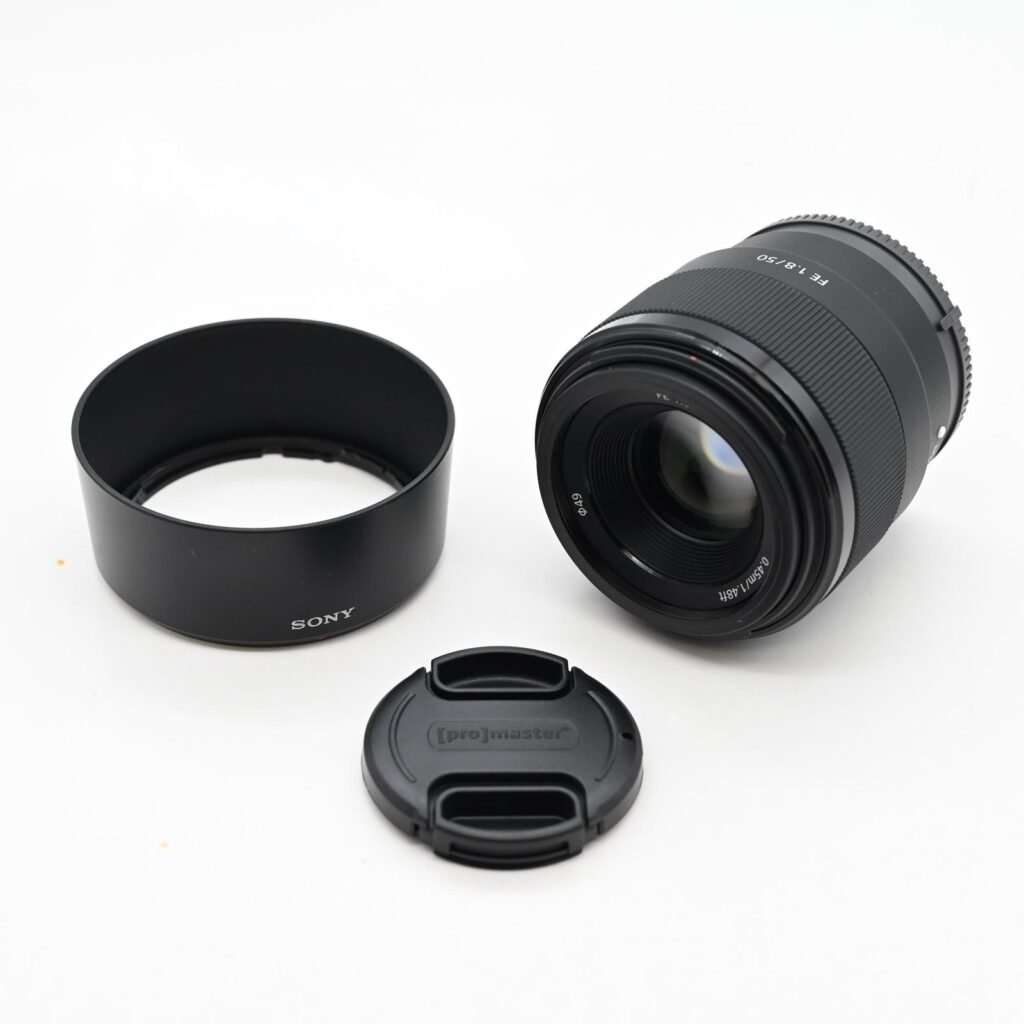
The Sony FE 50mm F1.8 (SEL50F18F) is a low-cost full-frame E-mount lens for Sony Alpha cameras. It offers a bright f/1.8 aperture, a small body, and a natural view that suits portraits, street photos, family shots, and everyday use. Its main limits are basic autofocus performance, no optical stabilization, and softer corners at f/1.8.
For photographers in the United States who want an affordable prime lens for a Sony full-frame camera, the SEL50F18F remains a practical entry point. It is less convincing for fast action, video, or demanding wide-open work.
Model note: Sony’s official model number is SEL50F18F. Some listings incorrectly add a “2” and call it “SEL50F18F2.” The lens reviewed here is the black Sony FE 50mm F1.8.
Quick Verdict
The Sony FE 50mm F1.8 is best for buyers who want a simple, bright prime lens without spending much. It produces attractive background blur and can perform well in low light, especially when stopped down slightly.
Its slow, audible autofocus and modest edge performance prevent it from being a complete all-purpose lens. If you mostly take portraits, still life, travel, or casual photos, it offers good value. If you shoot sports, weddings, video, or moving subjects, a newer Sony or third-party lens may be worth the extra cost.
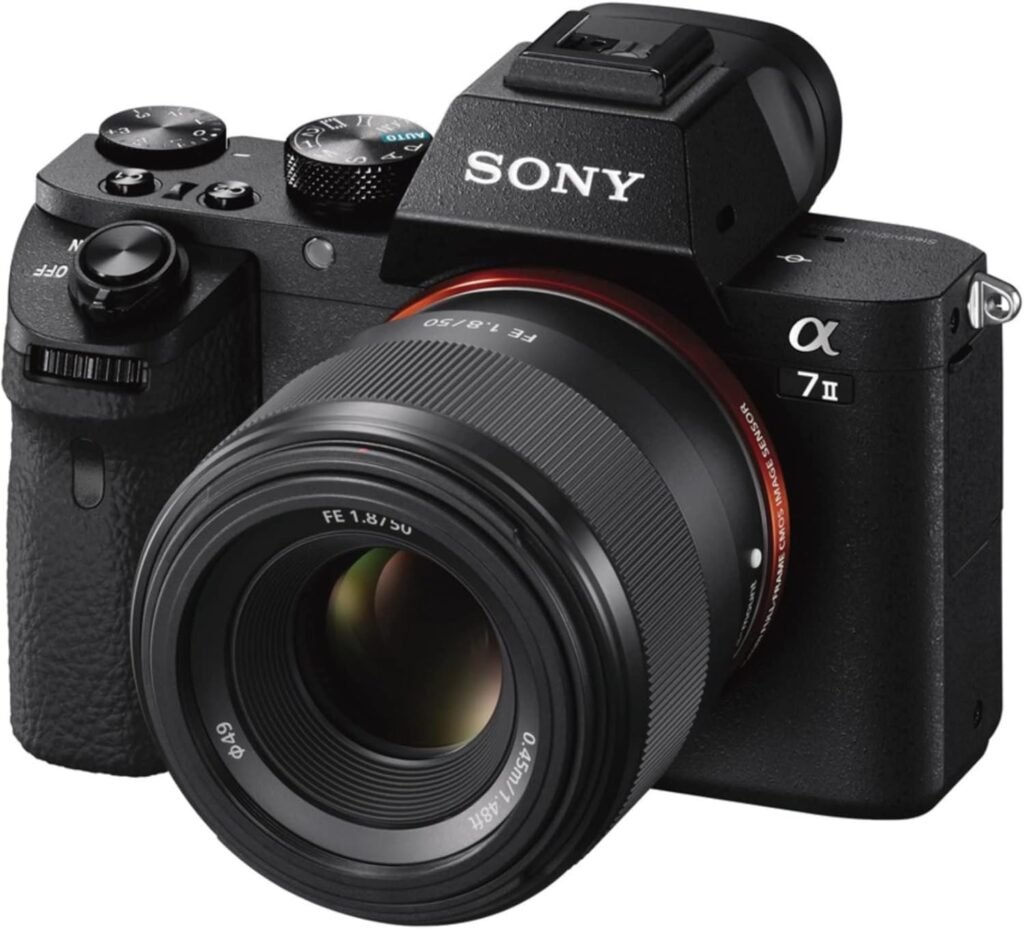
Sony FE 50mm F1.8 Specifications
The SEL50F18F is designed for Sony cameras with the FE full-frame E-mount. It also works on Sony APS-C E-mount cameras, where the view becomes similar to a 75mm lens because of the crop factor.
| Feature | Sony FE 50mm F1.8 SEL50F18F |
|---|---|
| Lens type | Standard prime lens |
| Mount | Sony E-mount |
| Format coverage | Full frame and APS-C |
| Focal length | 50mm |
| Maximum aperture | f/1.8 |
| Minimum aperture | f/22 |
| Optical design | 6 elements in 5 groups |
| Aperture blades | 7, circular design |
| Minimum focus distance | 0.45 m / 1.48 ft |
| Maximum magnification | 0.14x |
| Filter size | 49mm |
| Image stabilization | No optical stabilization |
| Weight | About 186 g / 6.6 oz |
| Size | About 68.6mm wide and 59.5mm long |
| Included items | Front and rear caps, hood |
These are manufacturer specifications. They describe the lens design but do not guarantee a certain sharpness level, autofocus speed, or bokeh result in every camera body.
What does “FE” mean?
“FE” means the lens covers Sony’s full-frame E-mount sensor. You can use it on cameras such as the Sony Alpha 7, Alpha 9, and Alpha 1 families.
The lens also fits APS-C Sony cameras, including many Alpha 6000-series bodies. On those cameras, the 50mm focal length gives a narrower view. The result is close to a 75mm equivalent field of view, which can work well for portraits but may feel tight indoors.
What does f/1.8 offer?
The f/1.8 maximum aperture lets in more light than a typical kit zoom set near 50mm. This can help you:
- Use faster shutter speeds indoors.
- Keep ISO lower in dim light.
- Create more background blur.
- Separate a subject from a simple background.
The aperture does not remove the need for good technique. At f/1.8, depth of field is narrow. A small focus error can place the eyes or main subject outside the sharp area.

Image Quality Review
The Sony FE 50mm F1.8 can deliver sharp central detail, but its performance changes across the frame and across the aperture range.
At f/1.8, the center can look useful for portraits and everyday photos. The outer areas are usually less crisp, and corners may show visible light falloff. Stopping down to around f/2.8 or f/4 generally improves contrast and edge detail.
Sharpness
The lens is most useful when you match the aperture to the subject.
- f/1.8: Brightest setting, with softer corners and more visible optical flaws.
- f/2 to f/2.8: Better overall balance for portraits and low-light work.
- f/4 to f/8: Stronger edge detail and more even results.
- f/11 to f/22: More depth of field, but diffraction may reduce fine detail at the smallest settings.
For a portrait, the softer edges at f/1.8 are often not a serious problem. The subject usually sits near the center, and the background blur can make the image feel less busy.
For landscapes, architecture, and copy work, stopping down is more important. Place the main detail near the center at wide apertures, or use f/4 to f/8 when you need more even sharpness.
Bokeh and background blur
The seven-blade circular aperture can produce smooth background blur when the subject is close and the background is far away. The effect is strongest at f/1.8.
The lens does not create the same level of creamy separation as a 50mm f/1.2 or 85mm f/1.4 lens. Background blur depends on more than the aperture. Subject distance, background distance, focal length, and sensor size all matter.
A simple example:
- Move close to the subject.
- Keep the background well behind the subject.
- Use f/1.8 or f/2.
- Focus carefully on the nearest eye for a portrait.
Busy lights and fine branches may look less smooth than they would with a more expensive optical design. This is normal for a compact, budget-oriented 50mm lens.
Distortion, vignetting, and color fringing
The lens may show visible vignetting at f/1.8. Vignetting means the corners look darker than the center. Many Sony cameras and RAW programs can correct this with a lens profile.
Longitudinal chromatic aberration can appear around high-contrast edges when the aperture is wide open. You may see purple or green color fringes in front of or behind the focus plane. Stopping down can reduce the effect, but it may not remove it in every scene.
These issues are most noticeable in:
- Bright backlit scenes.
- Dark subjects against a bright sky.
- High-contrast branches and wires.
- Images with plain white or gray backgrounds.
They are less distracting in ordinary portraits and casual photos.

Autofocus and Manual Focus
Autofocus is the main weakness of the Sony FE 50mm F1.8. The lens uses a basic DC autofocus motor rather than the faster, quieter linear motors found in many newer Sony lenses.
Autofocus can be accurate in good light, but it may feel slow when the lens must move through a large focus range. The motor can also make audible noise. That matters for video because the sound may be recorded by an on-camera microphone.
Autofocus performance in still photos
For portraits, travel, and static subjects, the lens can work well when light levels are reasonable. Sony’s camera body supplies much of the focusing intelligence, including face and eye detection on compatible models.
For action, the lens is less dependable. The focusing motor may not keep up as well with:
- Children running toward the camera.
- Sports.
- Pets in motion.
- Events with rapid subject changes.
- Continuous video autofocus.
The exact result depends on the camera body, firmware, focus settings, subject speed, and available light. The lens is not unusable for movement, but it is not a strong choice when autofocus speed is a top priority.
Autofocus noise for video
The DC motor can produce a noticeable mechanical sound during focusing. You can reduce the problem by:
- Using an external microphone.
- Recording with manual focus.
- Using a slower, controlled focus transition.
- Keeping the microphone away from the lens.
- Choosing a lens with a quieter linear or stepping motor.
If silent autofocus is essential, the Sony FE 50mm F2.5 G, Sony FE 40mm F2.5 G, or a suitable third-party lens may be a better fit.
Manual focus
The lens has a focus ring and a focus-mode switch. Manual focusing is electronic rather than fully mechanical. The camera interprets ring movement and moves the focus group.
This allows useful camera features such as focus magnification and focus peaking. The ring is adequate for still photos, but filmmakers who want a long, repeatable focus throw may prefer a lens designed for video work.
Build Quality and Handling
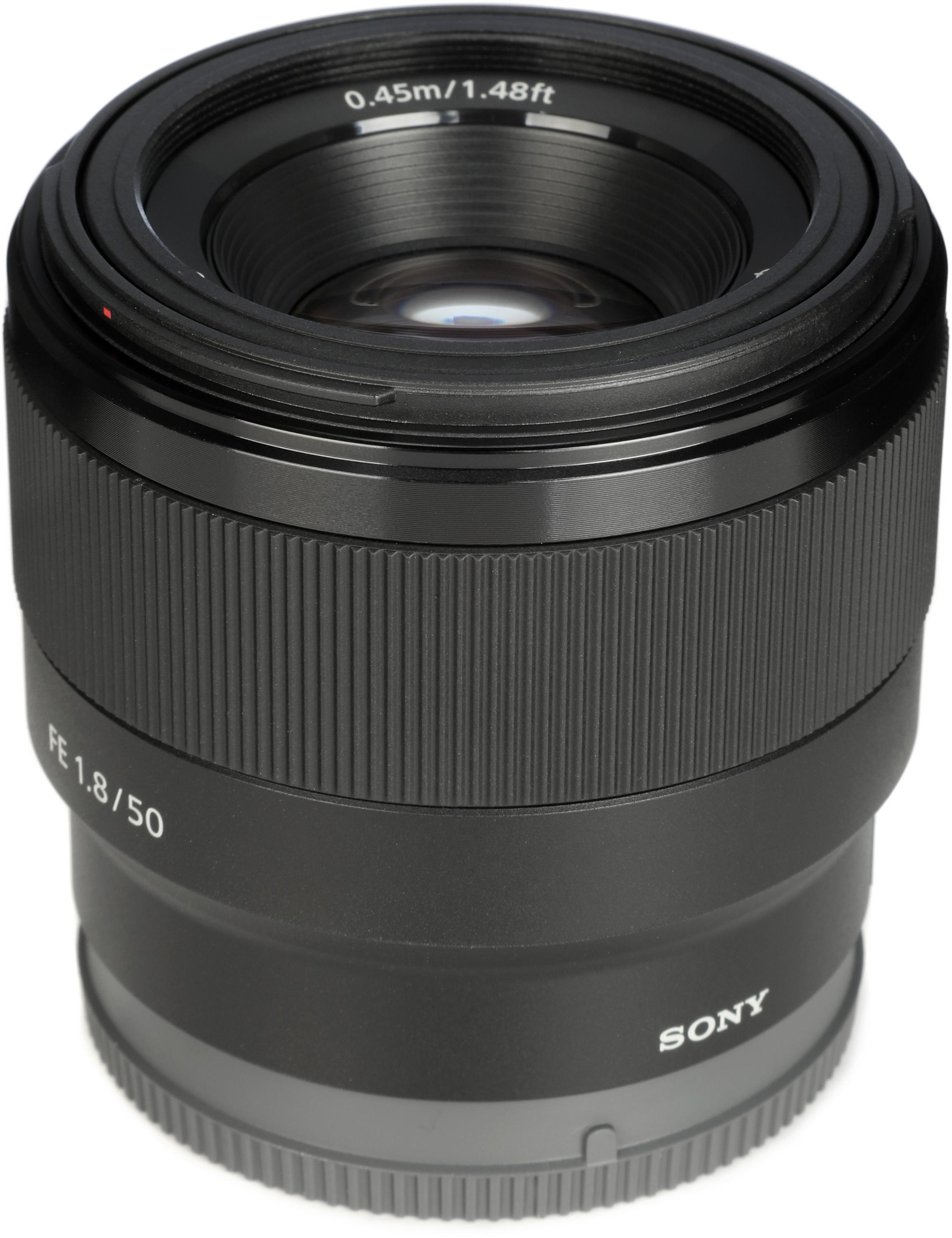
The SEL50F18F has a lightweight plastic barrel and a metal mount. Its low weight makes it easy to carry on a full-frame Sony camera for long periods.
The compact design is useful for:
- Walkaround photography.
- Travel.
- Street photography.
- Family events.
- Small camera bags.
- Gimbal setups where low weight matters.
The trade-off is that it does not feel as substantial as Sony’s G Master lenses or premium metal-bodied primes. The lens also lacks the extra controls found on newer models, such as an aperture ring or a customizable focus-hold button.
Is the lens weather sealed?
Sony does not position this lens as a fully weather-sealed professional lens. Treat it with care around rain, spray, dust, and sand. A camera body may have weather resistance, but that does not make the complete camera-and-lens combination waterproof.
Use a rain cover in wet conditions. Avoid changing lenses in dusty or damp areas. If moisture enters the lens or camera, turn the equipment off and allow it to dry before use.
Filter size and accessories
The lens uses 49mm filters. A clear protection filter, polarizer, or neutral-density filter must match that size.
A polarizing filter can reduce reflections from glass and foliage, but it also cuts light. A neutral-density filter can help maintain a wide aperture in bright outdoor light, especially for video.
Use the supplied hood when practical. It can help block stray light and protect the front element from minor bumps.

Using the Sony 50mm F1.8 for Portraits
The lens is a good low-cost portrait option on a full-frame Sony camera. Its 50mm view shows more of the surroundings than an 85mm lens, so it works well for environmental portraits and casual indoor photos.
For a head-and-shoulders portrait, move close enough to fill the frame but avoid placing the face at the extreme edge when using f/1.8. Wide-aperture perspective can make a nose or other feature look more prominent if the camera is too close.
Try these settings as a starting point:
- Aperture: f/1.8 to f/2.8.
- Shutter speed: at least 1/125 second for a still person.
- Focus: single-point, face detection, or eye autofocus.
- ISO: use Auto ISO if the light changes.
- File type: RAW if you plan to edit exposure and color.
On an APS-C Sony camera, the 75mm-equivalent view is often flattering for portraits. It gives more working distance than the full-frame view, though the smaller sensor also gives deeper apparent depth of field at the same framing and aperture.
Using It for Street, Travel, and Everyday Photos
The 50mm focal length is a flexible middle ground. It is wider than a short telephoto and tighter than a phone’s ultra-wide camera. It can frame people, food, signs, details, and small scenes without major distortion.
It may feel too narrow in a small room. In that situation, a 35mm lens is easier to use. Outdoors, the 50mm view often feels natural and helps isolate a subject from a crowded background.
The small size is one of this lens’s strongest practical features. It adds little weight to a full-frame body and can make a large camera easier to carry all day.

Low-Light Performance and Image Stabilization
The f/1.8 aperture helps in low light, but the lens has no built-in optical image stabilization. A stabilized Sony camera can still provide stabilization for some still-photo situations, but stabilization does not freeze a moving person or animal.
The difference is useful to understand:
- Stabilization can reduce camera shake.
- A faster shutter speed can reduce subject movement.
- A wider aperture can help the camera use a faster shutter speed.
- Higher ISO may still be necessary in very dark scenes.
For a static subject, stabilization and careful technique may allow a slower shutter speed. For a moving subject, use a faster shutter speed and accept that ISO may rise.
Do not assume the f/1.8 setting will always produce a clean image. Wide-open images can show more vignetting, lower edge sharpness, and color fringing. For many indoor portraits, f/2 or f/2.8 offers a better balance.
Sony FE 50mm F1.8 Compared With Alternatives
The best alternative depends on whether you value price, autofocus, size, low-light ability, or image quality.
| Lens type | Main advantage | Main trade-off |
|---|---|---|
| Sony FE 50mm F1.8 | Low price and bright aperture | Basic, noisy autofocus |
| Sony FE 50mm F1.4 GM | Very wide aperture and premium image quality | Much higher price and weight |
| Sony Sonnar T* FE 55mm F1.8 ZA | Strong image quality and compact design | Older design and higher cost than the 50mm f/1.8 |
| Sony FE 40mm F2.5 G | Small body, quiet AF, useful controls | Slower aperture and wider focal length |
| Sony FE 50mm F2.5 G | Quiet AF and premium handling | Less low-light ability and less blur |
| A 35mm f/1.8 lens | Wider indoor and street view | Less subject isolation |
| An 85mm f/1.8 lens | Stronger portrait compression | Tighter framing indoors |
Should you buy the 50mm f/1.8 or a 35mm f/1.8?
Choose the 50mm if you want more subject separation and often photograph people or details. Choose a 35mm if you work indoors, photograph groups, or want more of the scene in the frame.
Should you buy the 50mm f/1.8 or an 85mm f/1.8?
The 85mm is usually better for dedicated portraits because it gives more working distance and stronger background separation. The 50mm is more flexible for travel, family photos, and environmental portraits.
Should you buy the 50mm f/1.8 or the 50mm f/1.4 GM?
The 50mm f/1.4 GM is aimed at photographers who need premium optical performance, faster autofocus, stronger subject separation, and advanced handling. The SEL50F18F makes more sense when price, size, and basic everyday use matter more than professional performance.

Common Problems and Practical Fixes
The photo looks soft
First, check shutter speed and focus. Camera shake and subject movement can look like poor lens sharpness.
Then test the lens in good light at f/4 or f/5.6. Use a static subject, single autofocus, and a tripod if available. If the center is still consistently soft, inspect the front and rear elements and test on another camera body.
Autofocus hunts or moves slowly
Low light, low contrast, and a subject with no clear detail can make any autofocus system struggle. Use a focus point over a high-contrast area, add light, or switch to manual focus.
If the lens remains unusually slow in bright light, check the camera body’s focus mode and firmware. A newer lens may be the better solution for fast action.
The corners are dark
Dark corners are common at f/1.8. Stop down to f/2.8 or f/4 and enable the camera’s lens correction settings. RAW files may require correction in your editing software.
The background looks harsh
Move the subject farther from a busy background. Use a longer subject-to-background distance and avoid small bright points behind the subject. The lens can blur a background, but it cannot make every background smooth.
Video contains focusing noise
Use an external microphone, manual focus, or a quieter lens. The lens’s autofocus motor is a known design limitation for video work.
The camera says there is no lens
Remove and remount the lens. Check that the contacts are clean and that the lens locks fully into place. Do not use liquid or abrasive material on the electronic contacts. If the issue continues, test the lens on a compatible Sony body or contact Sony support.

Who Should Buy the Sony FE 50mm F1.8?
The Sony FE 50mm F1.8 is a sensible choice for:
- Sony full-frame users buying their first prime lens.
- Portrait beginners on a limited budget.
- Travelers who want a small, bright lens.
- Photographers upgrading from a basic kit zoom.
- APS-C users who want a compact portrait lens.
- Still photographers who can accept slower autofocus.
It is less suitable for:
- Professional event photographers who need dependable tracking.
- Videographers who need quiet autofocus.
- Sports photographers.
- Users who demand strong corner sharpness at f/1.8.
- Photographers who work in heavy rain or dust.
- Buyers who want a premium focus ring, aperture ring, or custom controls.
Key Takeaways
- The official model is Sony SEL50F18F, not SEL50F18F2.
- It is a full-frame Sony E-mount 50mm prime lens.
- The f/1.8 aperture helps with low light and background blur.
- Center sharpness is useful, while corners improve when stopped down.
- Autofocus is slower and louder than newer Sony lenses.
- There is no built-in optical stabilization.
- It works as a 75mm-equivalent lens on Sony APS-C cameras.
- It offers good value for portraits, travel, and everyday still photography.
- Video shooters and action photographers should consider a newer alternative.
Frequently Asked Questions
Is the Sony FE 50mm F1.8 good for beginners?
Yes. It is simple, light, and affordable. The 50mm focal length also teaches useful skills such as subject distance, composition, and depth-of-field control. Beginners should understand that f/1.8 requires careful focusing.
Is the Sony FE 50mm F1.8 compatible with Sony a6000-series cameras?
Yes. It fits Sony APS-C E-mount cameras, including the a6000 family. The field of view becomes similar to a 75mm lens, making it useful for portraits but less useful in tight indoor spaces.
Does the Sony 50mm F1.8 have image stabilization?
No. The lens does not include optical stabilization. A compatible Sony camera may provide in-body stabilization, but the result depends on the camera model.
Is the Sony FE 50mm F1.8 weather sealed?
It should not be treated as a fully weather-sealed lens. Protect it from rain, dust, sand, and moisture, especially when mounted on a camera that has weather resistance.
Can this lens be used for video?
Yes, but with limits. The autofocus motor can be audible and may not provide the smooth, quiet focus changes that many video users want. Manual focus or an external microphone can help.
Is the Sony FE 50mm F1.8 worth buying?
It is worth considering when the price is low and your priority is a small, bright lens for still photography. It is less compelling when fast autofocus, quiet operation, edge-to-edge sharpness, or weather protection matters more than cost.
Final Recommendation
The Sony FE 50mm F1.8 SEL50F18F is a useful budget prime, not a premium all-purpose lens. Its strongest qualities are the bright f/1.8 aperture, light weight, compact size, and natural perspective. Its weaknesses are the basic autofocus motor, lack of optical stabilization, and reduced corner performance at maximum aperture.
Buy it for affordable portraits, travel, family photos, and everyday still images. Choose another lens if you need fast subject tracking, quiet video autofocus, professional weather protection, or consistently strong sharpness across the frame at f/1.8.
For current compatibility and specifications, confirm the product details on Sony’s official SEL50F18F product page and the documentation for your specific Sony camera body.

