
For photographers in the United States, the Tamron 70-180mm F/2.8 Di III VC VXD G2 is a fast telephoto zoom made for Sony E-mount full-frame cameras. It covers portraits, weddings, indoor sports, events, and travel while keeping a constant f/2.8 aperture. The G2 version adds optical stabilization, faster close focus, and updated autofocus over the first-generation lens.
It is a strong option for Sony users who want a lighter and less costly alternative to a 70-200mm f/2.8 lens. However, its 180mm reach is shorter than 200mm, and it does not offer the same level of reach as a 100-400mm or 200-600mm lens.

What Is the Tamron 70-180mm F/2.8 Di III VC VXD G2?
The Tamron 70-180mm F/2.8 Di III VC VXD G2 is a full-frame telephoto zoom lens for Sony E mount. Its model number is commonly listed as A065.
The lens is designed for Sony mirrorless cameras with a full-frame sensor, such as:
- Sony Alpha 7 IV
- Sony Alpha 7R V
- Sony Alpha 7S III
- Sony Alpha 9 III
- Sony Alpha 1
- Sony Alpha 7C and 7C II
- Sony Alpha 7CR
It also works on Sony APS-C cameras, including models in the Alpha 6000 series. On an APS-C body, the field of view is similar to approximately 105-270mm on a full-frame camera because of Sony’s 1.5× crop factor.
The lens uses Tamron’s VXD autofocus motor, which means Voice-coil eXtreme-torque Drive. It also has VC, or Vibration Compensation, for optical image stabilization.
Key specifications
| Feature | Tamron 70-180mm F/2.8 Di III VC VXD G2 |
|---|---|
| Lens mount | Sony E |
| Format | Full frame |
| Focal length | 70-180mm |
| Maximum aperture | f/2.8 |
| Minimum aperture | f/22 |
| Optical design | 20 elements in 15 groups |
| Minimum focus distance | 0.3 m at 70mm; 0.85 m at 180mm |
| Maximum magnification | 1:2.6 at 70mm; 1:4.7 at 180mm |
| Diaphragm blades | 9, rounded |
| Filter size | 67mm |
| Maximum diameter | About 83mm |
| Length | About 157mm |
| Weight | About 855g |
| Stabilization | Tamron VC |
| Autofocus motor | VXD linear motor |
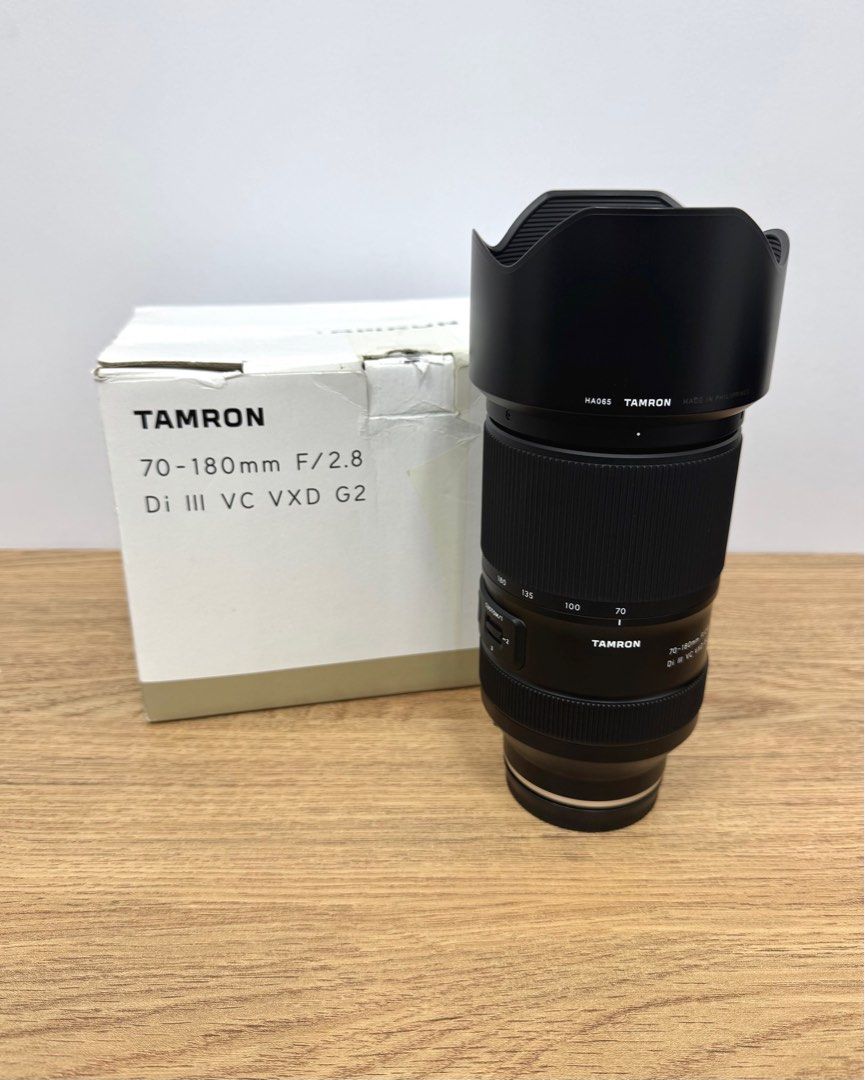
| Included accessories | Front cap, rear cap, lens hood |
Specifications may vary slightly by market listing or production documentation. Always confirm the final details with Tamron USA before purchase.
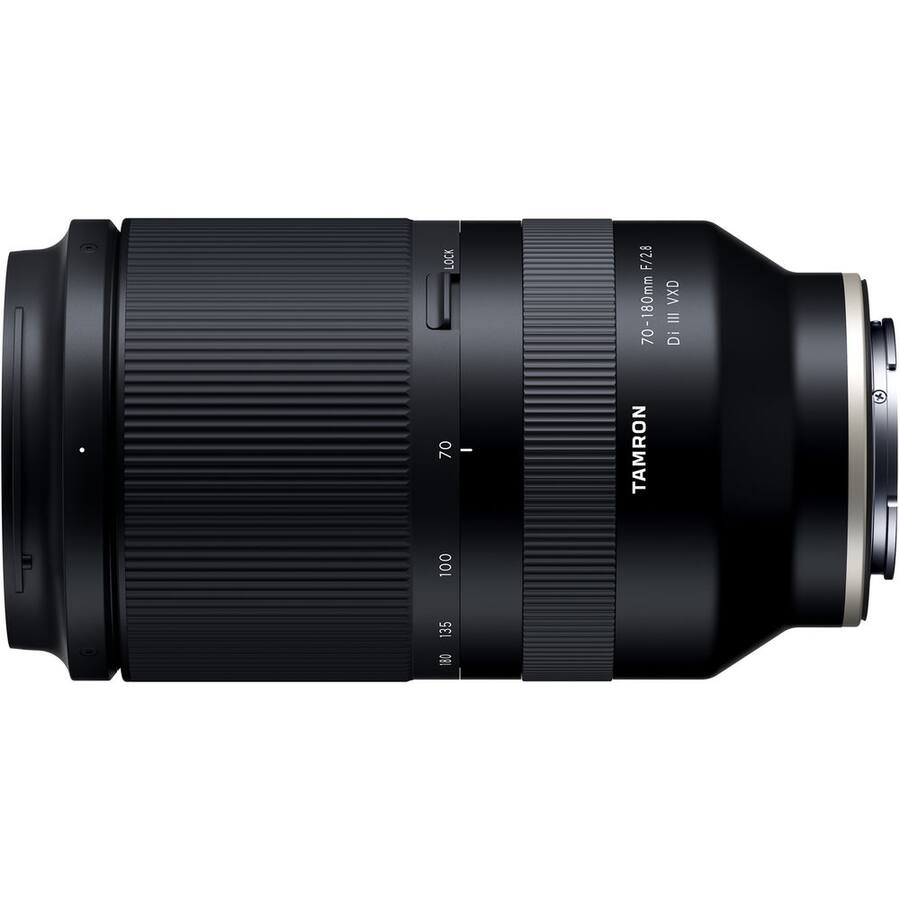
Why the Constant f/2.8 Aperture Matters
The constant f/2.8 aperture lets the lens gather more light than a typical 70-300mm zoom. It also keeps exposure settings more consistent as you zoom from 70mm to 180mm.
This helps in several ways:
- Indoor photos: You can use a faster shutter speed in gyms, halls, and event spaces.
- Portraits: f/2.8 can create soft background blur.
- Sports: More light can help support faster shutter speeds.
- Video: Exposure does not change while you zoom.
- Low-light work: The wide aperture can reduce the need for very high ISO settings.
The f/2.8 setting does not guarantee a blurry background. Background blur also depends on subject distance, background distance, focal length, and sensor size. At 180mm, a subject placed well away from the background will usually look more separated than at 70mm.
The lens can stop down to f/22. Smaller apertures can increase depth of field, but diffraction may reduce fine detail at very small settings. For many full-frame cameras, f/8 to f/11 offers a useful balance of depth and sharpness when more of the scene must remain clear.
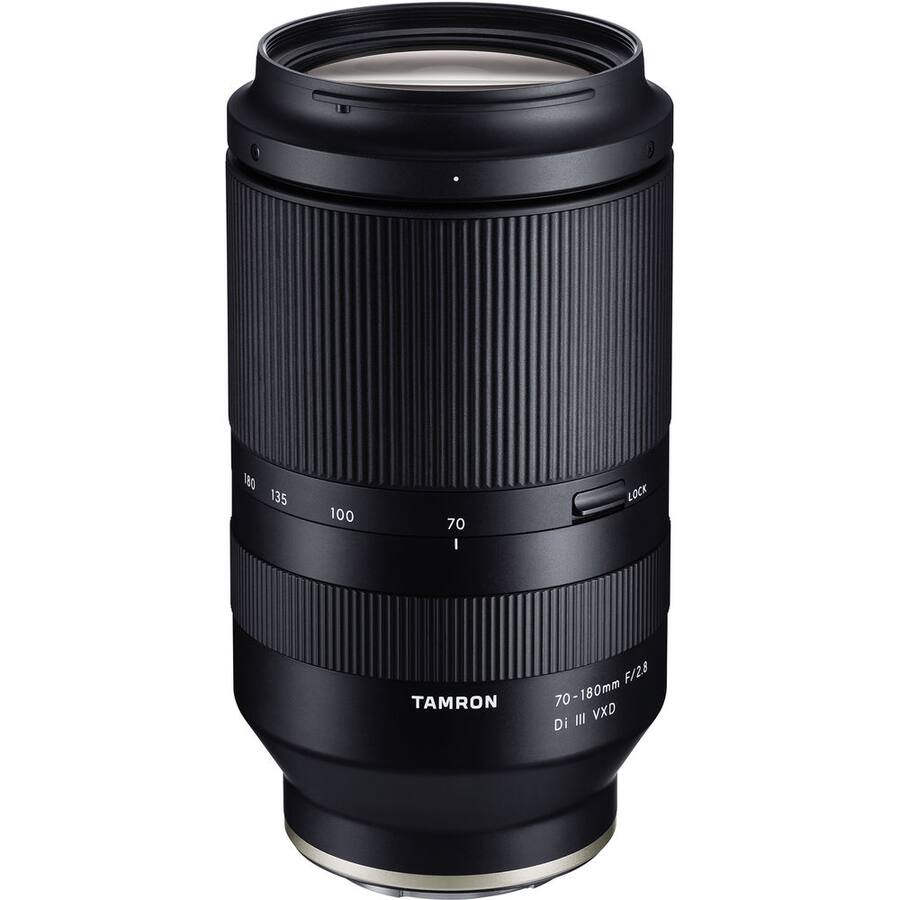
VXD Autofocus and Sony E-Mount Performance
The VXD motor is designed to provide fast and quiet autofocus. It is useful for portraits, moving subjects, weddings, and general event work.
The lens supports autofocus functions available through compatible Sony camera bodies. These may include:
- Eye AF
- Animal Eye AF
- Real-time Tracking
- Face detection
- Continuous autofocus
- In-camera lens corrections
Actual performance depends on the camera body, firmware, subject contrast, light level, focus mode, and Sony camera settings. A lens cannot make every older camera perform like a newer body.
For video, the VXD system is designed to keep focus noise low. Still, the camera’s microphone position, recording level, and focus settings affect the final audio. Videographers who need near-silent sound may still prefer an external microphone.
Firmware and compatibility
Tamron provides firmware updates for supported lenses. The G2 lens includes a USB-C connection for use with the Tamron Lens Utility system. Depending on the supported function and software version, the utility may help with lens updates or focus-related settings.
Before updating:
- Check the exact lens model.
- Use Tamron’s official support page for the United States.
- Read the listed camera and operating-system requirements.
- Charge the camera or use a stable setup.
- Do not disconnect the lens or cable during an update.
Firmware support can change. Confirm the current instructions before starting.
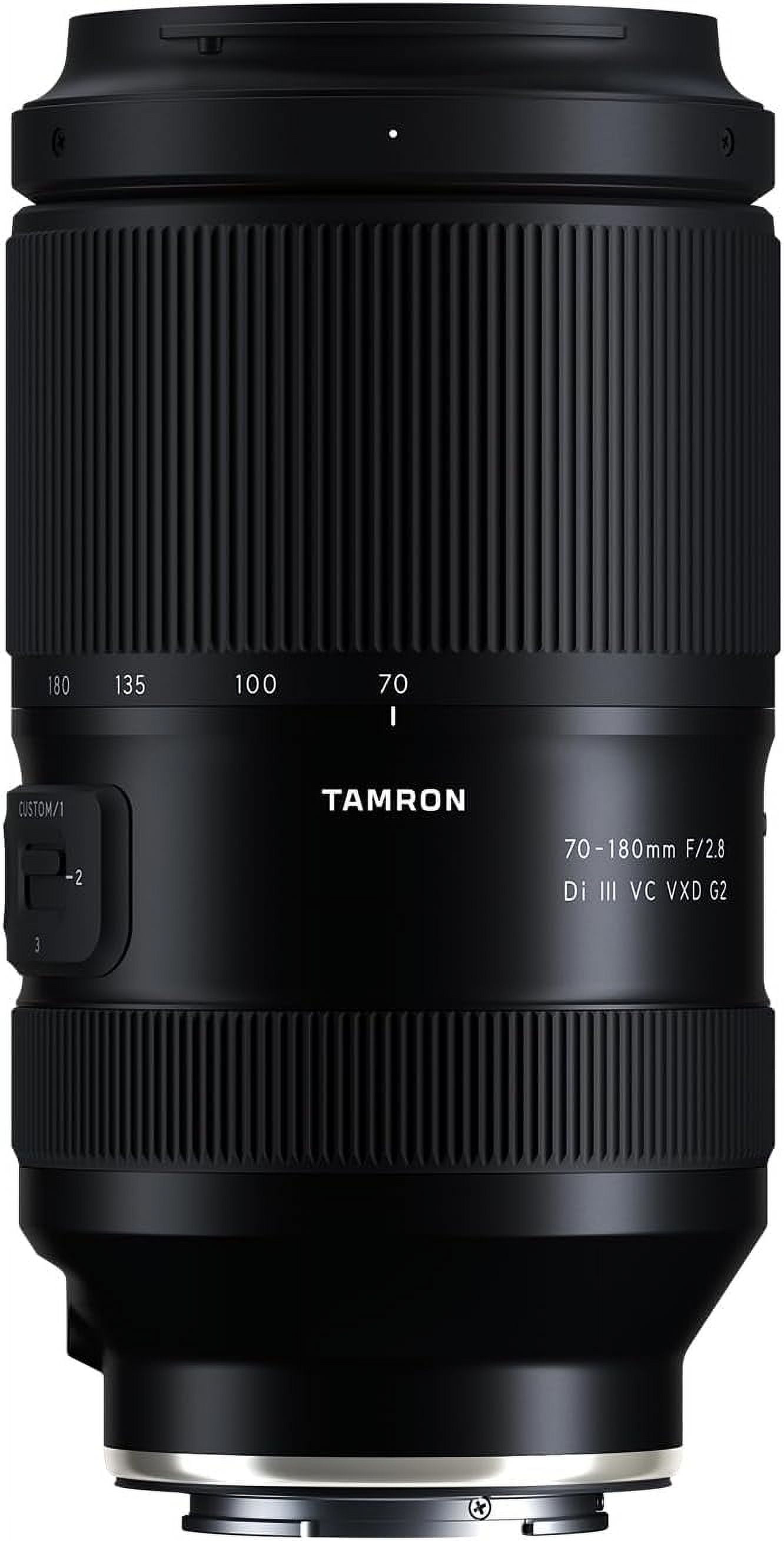
Tamron 70-180mm G2 Image Stabilization
The G2 version includes Tamron VC optical stabilization. VC shifts lens elements to reduce the effect of small camera movements.
This can help when photographing static subjects at slower shutter speeds. It is useful for:
- Indoor portraits
- Travel scenes
- Landscapes at dusk
- Museum and architectural photos
- Handheld video
- Events in low light
VC does not freeze a moving subject. If a person moves, the shutter speed must still be fast enough to stop that motion. For sports or active children, a shutter speed such as 1/500 second may be more useful than relying on stabilization alone.
Some Sony cameras also provide in-body image stabilization. The camera and lens may work together, but the result depends on the camera model and firmware. Check the Sony body manual for the correct stabilization setting.
A simple shutter-speed example
Suppose you photograph a still subject at 180mm. Without stabilization, camera shake may become visible at a slower shutter speed. VC may allow a slower handheld speed, but the exact benefit depends on your technique and the subject.
This is only a guide:
- Static subject: stabilization can help.
- Walking subject: use a faster shutter speed.
- Running subject: use a much faster shutter speed.
- Moving vehicle or aircraft: stabilization alone is not enough.

Close-Focus Performance
One of the most useful G2 improvements is its close-focus ability at the 70mm end.
At 70mm, the lens can focus as close as about 0.3 meters, or roughly 11.8 inches, from the sensor plane. Its maximum magnification is about 1:2.6. This is not true 1:1 macro, but it can fill the frame with flowers, food, small products, and details.
The close-focus distance becomes longer at 180mm. At the long end, the minimum focus distance is about 0.85 meters, or roughly 33.5 inches, with a maximum magnification near 1:4.7.
This creates an important practical trade-off:
- Use 70mm for larger close-up subjects and stronger magnification.
- Use 180mm for working farther away and creating a tighter view.
- Use a dedicated macro lens for true 1:1 reproduction.
At very close distances, depth of field becomes thin at f/2.8. Stopping down can make more of the subject sharp, but it may require more light or a slower shutter speed.

Handling, Size, and Build
The lens weighs about 855 grams, or about 1.9 pounds. That is lighter than many traditional 70-200mm f/2.8 DSLR lenses, though it is still a substantial lens for a small Sony body.
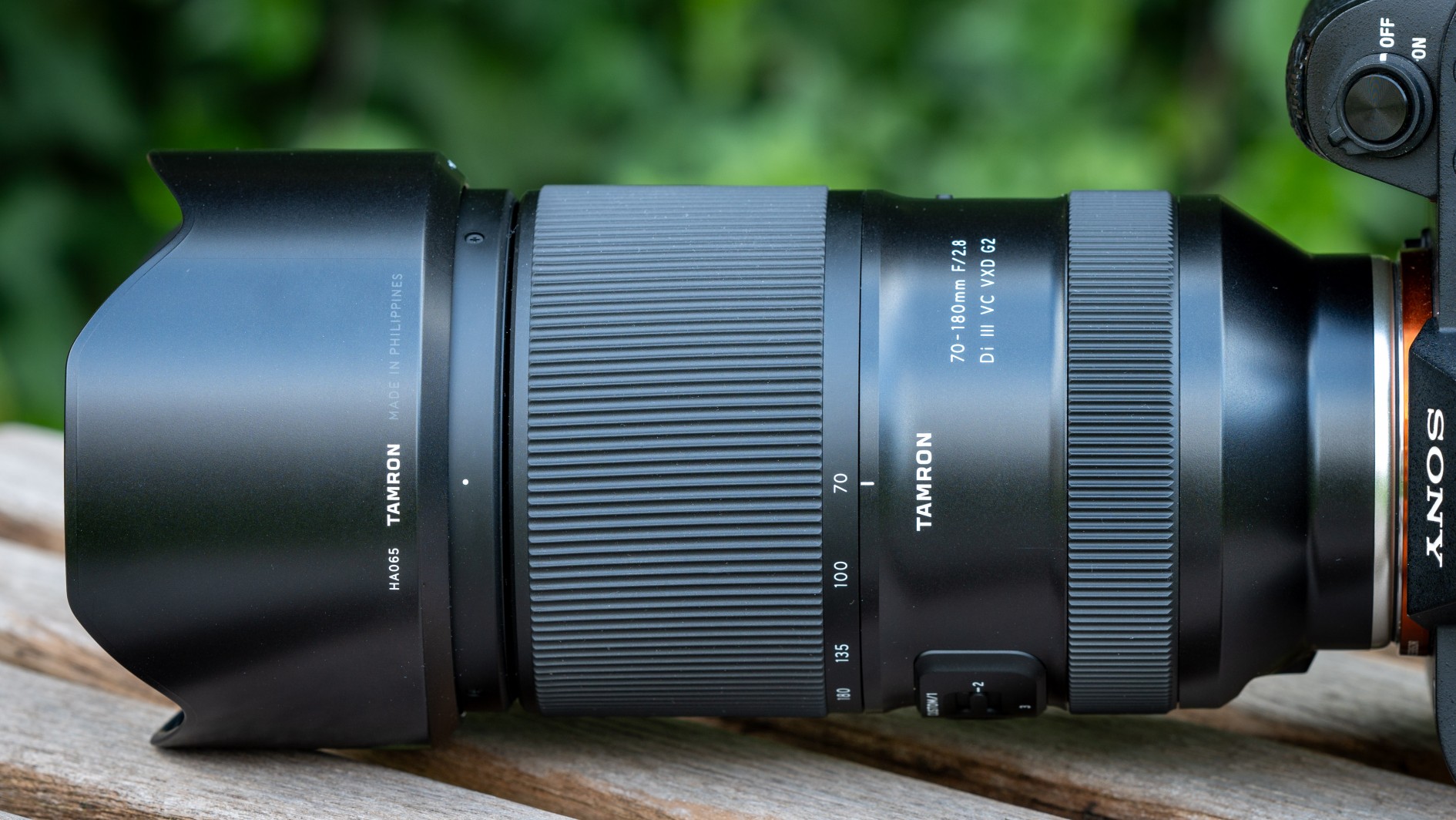
The lens has a compact internal zoom design. Its length stays nearly the same while zooming, which can help with balance and handling. It also uses a 67mm filter thread, a size shared by several Tamron lenses.
A tripod collar is not included as standard. Most users can handhold the lens, but a collar may help when the lens is mounted on a tripod or monopod for long sessions.
Weather resistance
Tamron describes the lens as having moisture-resistant construction and protective features around key areas. This does not make it waterproof.
Use extra care in:
- Heavy rain
- Salt spray
- Blowing dust
- Sand
- Rapid temperature changes
- Very cold conditions
Wipe the lens dry after use in wet conditions. Keep water away from the camera mount and USB-C port. Weather sealing works best when the lens is attached to a compatible camera body and all covers are closed correctly.
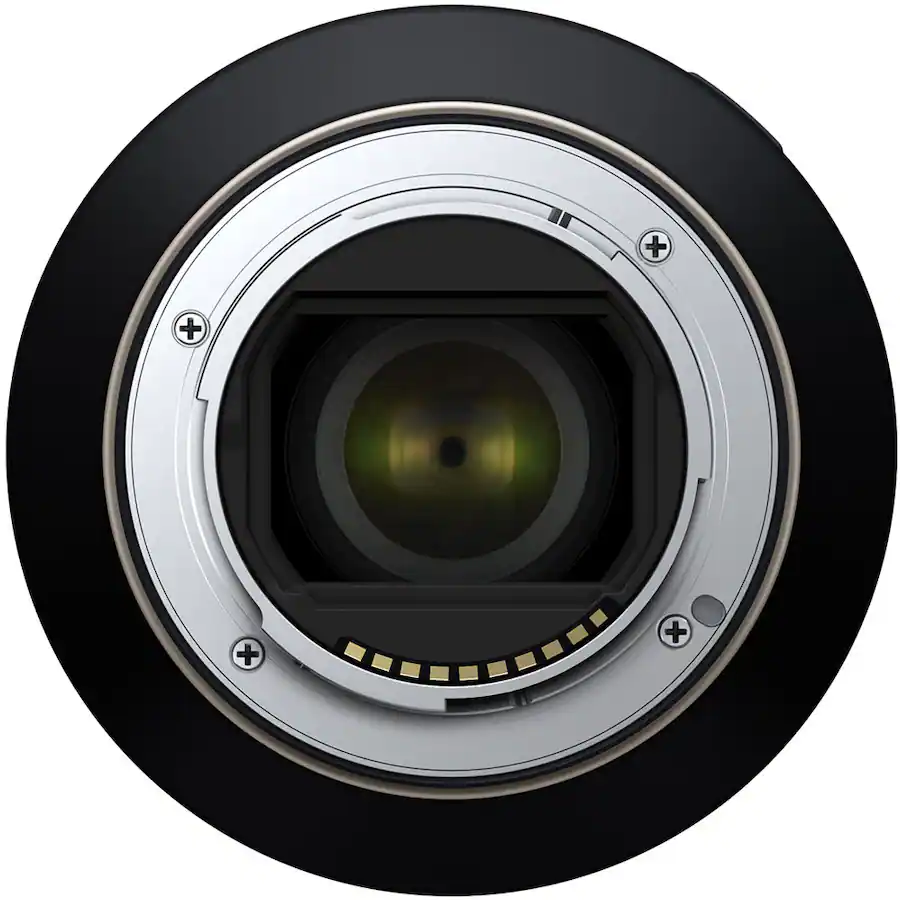
Image Quality: What Buyers Can Reasonably Expect
The lens is built for high-resolution full-frame Sony cameras and uses special optical elements to reduce common problems such as chromatic aberration and distortion.
Expected strengths include:
- High central sharpness across much of the zoom range
- Strong low-light ability from the f/2.8 aperture
- Useful subject separation
- Good close-focus ability at 70mm
- Controlled color fringing in many scenes
- Practical sharpness for portraits and events
Image quality can change with focal length, aperture, focus distance, and the position of the subject in the frame. Wide-open images may show some corner falloff or reduced corner sharpness. Stopping down can improve edge performance, but the best setting depends on the scene.
Sony cameras may apply lens corrections automatically. RAW files can also show lens characteristics until processed in compatible software. Do not assume that a JPEG result and an uncorrected RAW file will look identical.
Bokeh and flare
The rounded nine-blade diaphragm can help create smooth out-of-focus areas. The look of bokeh still depends on the shape of highlights, background texture, and shooting distance.
Strong backlight can cause flare or lower contrast with any zoom lens. Use the supplied hood, avoid direct light entering the front element when possible, and clean the front glass before judging contrast.

Best Uses for the Tamron 70-180mm G2
The lens fits photographers who need a fast telephoto zoom but want to keep weight and cost below many professional 70-200mm options.
Portrait photography
The 70-180mm range covers classic portrait views. Use 70mm for environmental portraits and 135-180mm for tighter headshots.
At longer focal lengths, stand farther from the subject. This can create a more comfortable working distance and a less exaggerated facial perspective than a short wide-angle lens.
Weddings and events
The f/2.8 aperture helps in dim venues. The range also lets you frame a full person, half-length portrait, or close detail without changing lenses.
The lens is useful for:
- Ceremony moments
- Speeches
- First dances
- Guest reactions
- Detail photos
- Indoor portraits
It may feel short if you need to photograph distant action from the back of a large venue.
Sports and action
The VXD autofocus motor and f/2.8 aperture suit many indoor and outdoor sports settings. The main limitation is reach. A 180mm maximum focal length may not be enough for field sports, motorsports, or wildlife subjects that remain far away.
For those subjects, consider a 100-400mm or 150-500mm class lens.
Travel and street photography
The lens can cover distant details and compressed views without carrying a large 70-200mm lens. Its weight still matters on long walks, and it may draw attention in crowded areas.
Product and food photography
The 70mm close-focus mode can capture medium-sized products and food details. For small objects that require edge-to-edge detail at close range, a dedicated macro lens may provide better control.

Tamron 70-180mm G2 Compared With a 70-200mm f/2.8 Lens
The Tamron lens is not a direct match for every 70-200mm f/2.8 model. Its main difference is the 20mm loss at the long end.
| Need | Tamron 70-180mm G2 | Typical 70-200mm f/2.8 lens |
|---|---|---|
| Maximum reach | 180mm | 200mm |
| Aperture | Constant f/2.8 | Constant f/2.8 |
| Weight | About 855g | Often heavier |
| Close focus | Strong at 70mm | Depends on model |
| Tripod collar | Usually not included | Often included |
| Portability | Easier to carry | More demanding |
| Distant sports | Limited by 180mm | Slightly better reach |
| Portraits and events | Very capable | Very capable |
The 200mm setting gives about 11% more focal length than 180mm. That difference is visible, but it is not dramatic. The larger issue is whether the lens feels comfortable to carry for several hours.
Choose the Tamron when lower weight and close focus matter more than the last 20mm. Choose a 70-200mm lens when you need maximum reach in this class, a tripod collar, or a specific professional feature set.
Tamron 70-180mm G2 Compared With the First-Generation Lens
The G2 model is more than a cosmetic update. It adds features that affect daily use.
| Feature | First-generation 70-180mm | 70-180mm G2 |
|---|---|---|
| Stabilization | No optical VC | Tamron VC |
| Close focus at 70mm | Less capable | About 0.3m |
| Maximum magnification | Lower | About 1:2.6 at 70mm |
| Autofocus system | VXD | Updated VXD implementation |
| Lens utility connection | Different support | USB-C connection |
| Optical design | Earlier design | Updated optical design |
The first-generation lens may still appeal to buyers who find it at a lower used price. The G2 is usually the better fit for handheld low-light work, close-up details, and users who want the newer feature set.
Check the exact model before buying used. Product listings can confuse the original 70-180mm with the G2 version.
Common Limitations and Buying Mistakes
The biggest mistake is treating the lens as a universal telephoto. Its 70-180mm range is useful, but it does not replace a long wildlife or field-sports lens.
Watch for these issues:
- Confusing full-frame compatibility with full-frame coverage: The lens covers full-frame Sony E sensors, but it may not be designed for other mounts.
- Expecting macro performance: The 70mm close-focus mode is useful, but it is not a 1:1 macro lens.
- Relying on VC to stop motion: Stabilization reduces camera shake, not subject movement.
- Ignoring camera balance: A small Sony body may feel front-heavy with this lens.
- Buying the wrong generation: Confirm that the listing says VC VXD G2 or model A065.
- Assuming every Sony feature works on every body: Eye AF and tracking behavior depend on the camera.
- Using unverified firmware tools: Download updates only from Tamron’s official support site.
- Leaving the USB-C port exposed: Keep the port closed and dry during outdoor use.
- Expecting 200mm reach: The lens stops at 180mm.

Who Should Buy the Tamron 70-180mm G2?
The lens is a good fit for a Sony full-frame user who wants:
- A constant f/2.8 telephoto zoom
- Lower weight than many 70-200mm lenses
- Optical stabilization
- Strong close focus at 70mm
- Portrait and event flexibility
- A lens for indoor and low-light work
- Sony E-mount autofocus support
It is less suitable if you mainly photograph:
- Small wildlife at long distances
- Outdoor field sports from the sidelines
- Aircraft
- Motorsports
- Very small macro subjects
- Long tripod sessions that require a tripod collar
For those tasks, a longer zoom or dedicated macro lens may be a better match.

Setup Tips for Sony Camera Owners
Start with these settings and adjust them to the scene:
- Set autofocus to AF-C for moving subjects.
- Use Eye AF for people or animals when your camera supports it.
- Choose a shutter speed that matches the subject.
- Turn on lens or in-body stabilization for static handheld scenes.
- Use f/2.8 when you need light or background separation.
- Stop down to f/4 or f/5.6 if you need more depth of field.
- Check the camera’s lens-correction options.
- Update the lens only through Tamron’s official process.
For portraits, begin around 100-135mm at f/2.8. For sports, begin with a fast shutter speed and test continuous autofocus before the main action begins. For close-ups, focus carefully and check depth of field because it becomes very thin at short distances.

Frequently Asked Questions
Is the Tamron 70-180mm G2 compatible with Sony full-frame cameras?
Yes. It is made for Sony E-mount full-frame mirrorless cameras. It can also be used on Sony APS-C bodies, where the field of view is similar to 105-270mm on full frame.
Does the Tamron 70-180mm G2 have image stabilization?
Yes. The G2 includes Tamron VC optical stabilization. VC helps reduce camera shake, but it does not freeze moving subjects.
Is the Tamron 70-180mm G2 good for portraits?
Yes. Its f/2.8 aperture, 70-180mm range, autofocus, and background separation make it well suited to portraits. The 135-180mm range is useful for tighter head-and-shoulder images.
Can it shoot macro photos?
It can capture close-up images, especially at 70mm, where the maximum magnification is about 1:2.6. It is not a true 1:1 macro lens.
Does it work for video?
Yes. The fast aperture, internal zoom design, VXD autofocus, and VC can help with video. Results depend on the Sony camera body, microphone setup, focus settings, and shooting style.
Is it better than the first-generation Tamron 70-180mm?
The G2 is the more complete lens because it adds VC and stronger close-focus capability at 70mm. The first-generation model may still be worth considering if its used price is much lower and those features are not important to you.
What filter size does it use?
The lens uses 67mm filters. Confirm the filter is designed for the full lens hood and does not cause unwanted vignetting.
Final Recommendation
The Tamron 70-180mm F/2.8 Di III VC VXD G2 for Sony E mount is a capable full-frame telephoto zoom for U.S. Sony photographers who value a constant f/2.8 aperture, optical stabilization, fast autofocus, and lower weight than many 70-200mm alternatives.
Its strongest uses are portraits, weddings, events, indoor sports, travel, and close-up detail work at 70mm. Its main limits are the 180mm maximum focal length, lack of true macro magnification, and the need to check camera-specific compatibility for advanced Sony features.
Before buying, confirm the model number, mount, current firmware support, U.S. warranty terms, and whether 180mm provides enough reach for your subjects.

