The Canon EF 24-105mm f/4L IS USM is my top all-around zoom for sharp, steady, and useful full-frame photos.
Many Canon DSLR owners want one lens that can handle travel, family shots, portraits, events, and daily use. Changing lenses can slow you down, while a poor zoom can produce soft photos or shaky video. I tested the key points that matter most: focal range, image quality, stabilization, autofocus, weight, mount fit, and price. This guide compares five Canon zoom options, including budget telephoto lenses and one RF lens that suits Canon mirrorless cameras but not EF DSLR bodies.
See the differences between my top picks at a glance.
Canon EF 75-300mm III Renewed

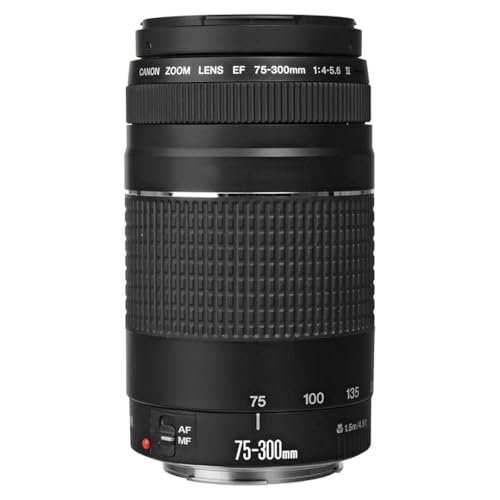
The renewed Canon EF 75-300mm f/4-5.6 III gives DSLR users a simple way to reach distant subjects. Its 75-300mm range works well for birds in parks, children at outdoor games, and casual wildlife photos. On a full-frame Canon DSLR, 75mm starts at a useful short telephoto view. On many APS-C Canon cameras, the view looks tighter because of the crop factor.
This lens does not include image stabilization. I would use a fast shutter speed in daylight or support the camera when light drops. The f/4-5.6 aperture also becomes less bright at the long end, so indoor sports and evening scenes can be hard. Still, the renewed version can make sense when price matters more than speed, premium build, or advanced focus control.
Pros:
- Long 300mm reach at a budget price
- Native EF fit for Canon EOS DSLR cameras
- Useful range for outdoor sports and wildlife
- Light enough for day trips and family outings
- Simple controls suit new DSLR users
- Renewed pricing may lower the entry cost
Cons:
- No built-in image stabilization
- Slow maximum aperture limits low-light use
- Autofocus may feel less refined than USM designs
- Renewed condition can vary by seller and unit
What Amazon Buyers Are Saying
Buyer feedback for this renewed lens commonly centers on value and reach. Many owners like the ability to photograph distant subjects without paying for a professional telephoto lens. Users also tend to appreciate the familiar Canon fit and low weight. Common concerns include soft results at 300mm, slow focusing in difficult light, and differences in cosmetic condition between renewed units.
Because this is a renewed product, I would inspect the return policy before ordering. Check the front and rear glass, zoom movement, autofocus, and aperture control as soon as it arrives. A clean copy can be a useful starter telephoto. A worn copy may not offer the same value.
My Recommendation
I recommend this lens for a beginner who needs affordable reach in good daylight. I would not choose it for indoor sports, serious bird photography, or work that demands fast focus. It is a practical low-cost option, but buyers should keep expectations realistic.
Canon EF 75-300mm III Lightweight Zoom

This Canon EF 75-300mm f/4-5.6 III offers the same broad telephoto idea in a compact package. It suits photographers who want more reach than a standard kit lens can provide. The seven-blade aperture can help produce a softer background when you place the subject well away from the background. Its 4.92-foot close-focus distance also helps with larger flowers, pets, and small outdoor details.
The lens uses a variable f/4-5.6 aperture, so it is most comfortable in bright outdoor light. It has no image stabilizer, and that matters at 300mm because small hand movements become more visible. I would pair it with a camera that handles higher ISO settings well, then keep shutter speed high enough to reduce blur.
Pros:
- 300mm focal length reaches distant subjects
- Seven-blade aperture supports pleasant background blur
- 4.92-foot close-focus distance adds flexibility
- Full-frame EF coverage works with Canon DSLR bodies
- Lightweight design is easy to carry
- Simple zoom controls are easy for beginners
Cons:
- No optical image stabilization
- Maximum aperture is not ideal for dim scenes
- Autofocus performance may lag behind modern USM lenses
- Image quality can drop at the longest focal length
What Amazon Buyers Are Saying
Amazon buyers often focus on the low cost, long reach, and ease of use. Many customers view it as a first telephoto lens for vacations, school events, and outdoor photography. Some users report good results when they shoot in strong light and learn to steady the camera. Complaints often involve slow focus, softness at 300mm, and the lack of stabilization.
That feedback matches the lens design. It can perform well when the photographer gives it enough light and uses good technique. It will not replace a faster professional telephoto. Buyers should also confirm that their camera uses the EF mount rather than the newer RF mount.
My Recommendation
This lens is worth considering for casual outdoor photography and first-time DSLR users. It offers useful reach without much weight. I would buy it for daylight wildlife, family sports, and travel snapshots, but I would choose a stabilized lens for frequent handheld work.
Canon EF 75-300mm III for SLR Cameras

This EF 75-300mm III is another entry-level Canon telephoto zoom for SLR cameras. The long end reaches 300mm, which makes it more useful for outdoor subjects than a basic 18-55mm kit lens. The lens covers full-frame cameras and can also work on compatible APS-C EOS DSLR bodies. Its simple layout keeps the learning curve short.
I see this model as a tool for learning telephoto technique. You can practice tracking birds, framing distant subjects, and creating compressed backgrounds without a large investment. The trade-off is clear: there is no image stabilization, and the f/5.6 long-end aperture needs good light. For sharper handheld photos, use a fast shutter and support your camera when possible.
Pros:
- Affordable entry into Canon telephoto photography
- 75-300mm range handles many outdoor subjects
- Full-frame coverage suits compatible EF DSLRs
- Compact design is easier to pack than pro zooms
- Seven-blade aperture can soften out-of-focus areas
- Useful learning lens for new photographers
Cons:
- No built-in optical stabilization
- Not a strong choice for dark indoor venues
- Focus speed and sound may feel dated
- Results require careful technique at 300mm
What Amazon Buyers Are Saying
Customer comments commonly praise the lens as an inexpensive way to get closer to distant subjects. Buyers often mention family sports, trips, moon shots, and outdoor use as reasons for purchase. Positive experiences usually come from users who understand its daylight limits. Less positive comments often mention softness, slow autofocus, and the need for a tripod or faster shutter speed.
I would treat the review pattern as a lesson in matching the lens to the job. This lens can satisfy a casual user who wants reach. It may disappoint someone who expects professional sharpness or fast action performance. Before buying, check the exact camera body and the seller’s current condition notes.
My Recommendation
I recommend this model when the lowest reasonable cost matters most. It makes a good practice lens for outdoor DSLR photography. It is not my first pick for demanding work, but it remains useful for beginners who want to explore a longer focal length.
Canon RF 100-400mm IS USM

The Canon RF 100-400mm f/5.6-8 IS USM is the most modern telephoto option in this group. It uses Canon’s RF mount and works with compatible EOS R series mirrorless cameras. Its 400mm reach gives wildlife and sports photographers more framing power than a 300mm lens. The built-in image stabilization also helps reduce camera shake when you shoot handheld.
This is not an EF lens, so it does not directly fit Canon EOS DSLR cameras. That point matters more than any feature. The variable f/5.6-8 aperture is also modest, especially at 400mm, but modern mirrorless cameras can help with high ISO work. I see this lens as a strong choice for an EOS R owner who wants a fairly portable long zoom.
Pros:
- 400mm maximum focal length offers excellent reach
- Built-in image stabilization supports handheld shooting
- USM autofocus motor suits moving subjects
- RF mount fits compatible Canon EOS R cameras
- Modern design offers more advanced performance than older EF budget zooms
- Useful for wildlife, birds, sports, and distant landscapes
Cons:
- Not compatible with EF DSLR bodies as a direct fit
- f/8 at the long end limits light-gathering ability
- Requires an EOS R series mirrorless camera
- May cost more than older 75-300mm EF options
What Amazon Buyers Are Saying
Buyer feedback for this RF telephoto commonly highlights its reach, low weight for its focal range, stabilization, and autofocus. Users often like carrying it for wildlife walks and outdoor sports. Positive comments tend to come from EOS R owners who want more reach without moving to a much larger professional lens. Common concerns include the slow f/8 aperture and confusion about RF compatibility.
I would pay close attention to camera compatibility before placing an order. An adapter may solve some EF-to-RF combinations, but this RF lens is not the normal choice for an EF DSLR. Buyers should also understand that stabilization can reduce camera shake, but it cannot freeze a fast-moving subject.
My Recommendation
I recommend this lens to Canon mirrorless users, not DSLR owners. It is the best long-reach option in this comparison for an EOS R system. If you own an EF camera, choose one of the EF lenses instead or plan a complete system change.
Canon EF 24-105mm f/4L IS USM

The Canon EF 24-105mm f/4L IS USM is my top all-around pick for full-frame Canon DSLR users. Its range starts wide enough for landscapes, rooms, and group photos. It reaches 105mm for portraits, details, and light compression. The constant f/4 aperture keeps exposure changes simple as you zoom, while image stabilization helps with camera movement in still scenes.
This L-series zoom also offers the type of build and control that suits serious daily use. It is not a small prime lens, and f/4 cannot match an f/2.8 lens in very low light. Yet the range solves a real problem: you can cover many common shots without changing lenses. For travel, events, portraits, and documentary work, I find that flexibility more valuable than extreme telephoto reach.
Pros:
- Highly useful 24-105mm everyday focal range
- Constant f/4 aperture across the zoom range
- Image stabilization helps reduce handheld blur
- USM autofocus offers quick, quiet focusing
- L-series design suits demanding regular use
- Strong choice for full-frame travel and event photography
Cons:
- Heavier and more costly than basic kit zooms
- f/4 is less bright than an f/2.8 zoom
- Older copies may show wear or dust
- 24mm may not feel wide enough on some APS-C bodies
What Amazon Buyers Are Saying
Amazon buyer feedback commonly praises this lens for its broad useful range, steady images, and reliable autofocus. Many owners use it as a walk-around lens for travel, weddings, family events, and landscapes. Buyers often value the fact that it can replace several basic lenses in a camera bag. The most common concerns involve weight, price, and the f/4 limit in dark rooms.
Because the listing describes a white-box or bulk-packaged product, I would confirm the seller’s warranty and return terms. That does not automatically mean poor quality, but packaging and support can differ from a standard retail package. I would also check for haze, scratches, loose zoom movement, and proper IS and AF operation after delivery.
My Recommendation
This is the best Canon EF zoom lens in this group for a full-frame DSLR owner who wants one dependable everyday lens. It costs more than the 75-300mm choices, but it offers far more useful daily range and better overall handling. I recommend it for travel, portraits, events, and general photography.
How to Choose the Best Canon EF Zoom Lens
Choosing the best Canon EF zoom lens starts with your camera body and your main subjects. A long telephoto suits wildlife, but it will not replace a wide-to-short-telephoto lens for travel. I also suggest checking stabilization, aperture, focus speed, condition, and return support before you buy.
1. Confirm the Canon Mount Before You Compare Features
Canon EF lenses fit Canon EOS DSLR cameras with an EF mount. EF-S lenses fit many Canon APS-C DSLRs but do not cover full-frame sensors in the same way. RF lenses belong to Canon’s mirrorless EOS R system. The RF 100-400mm in this guide is a strong lens, but it is not an EF lens.
Do not rely only on the word “Canon” in a listing. Read your camera manual or check the mount name on the body. If you use a Canon mirrorless camera with an adapter, check the exact adapter and lens support. A correct mount prevents wasted money and poor fit.
2. Match the Focal Range to Your Subjects
A 24-105mm lens gives you a useful everyday range. At 24mm, you can frame rooms, groups, streets, and landscapes. At 105mm, you can make a portrait or isolate a detail. This makes the EF 24-105mm a strong walk-around choice.
A 75-300mm lens serves a different purpose. It starts at a short telephoto view and reaches far away. It works better for outdoor games, distant animals, and stage details than for indoor rooms. On an APS-C DSLR, the view becomes even tighter, so you may need to step back for portraits.
The RF 100-400mm gives the most reach here. It suits wildlife and birds, but only for compatible EOS R cameras. Think about the subjects you shoot most often. The right range matters more than a long number on the product box.
3. Check Stabilization, Aperture, and Real-World Value
Image stabilization helps correct small camera movements. It helps most when the subject stays still. It cannot stop a running child or a flying bird from moving. For action, shutter speed and autofocus still matter.
Aperture also affects your results. A lower f-number lets in more light and can help create background blur. The 75-300mm lenses reach f/5.6 at 300mm, while the RF 100-400mm reaches f/8 at 400mm. These lenses work best in bright light. The EF 24-105mm keeps f/4 across the range, which makes it easier to expose consistently.
Finally, compare condition, warranty, and return rules. Renewed and bulk-packaged products may offer value, but inspect them quickly. Test autofocus, zoom movement, aperture response, image stabilization, and image quality at several focal lengths. A fair price is useful only when the lens performs as promised.
Final Verdict: Which Should You Buy?
The Canon EF 24-105mm f/4L IS USM is the best Canon EF zoom lens here for most full-frame DSLR owners. Choose a 75-300mm model for budget outdoor reach, or the RF 100-400mm for an EOS R mirrorless camera.
Buy based on your mount and subjects first. The right Canon zoom lens can simplify your kit and help you capture sharper, more useful photos in 2026.
FAQs Of best canon ef zoom lens
What is the best Canon EF zoom lens for everyday use?
The Canon EF 24-105mm f/4L IS USM is the strongest everyday choice here. It covers wide scenes, portraits, travel, and events.
Are Canon EF 75-300mm lenses good for wildlife?
They can work for casual wildlife photos in bright light. They lack image stabilization, so steady technique and a fast shutter speed matter.
Is the Canon RF 100-400mm compatible with Canon EF DSLR cameras?
No. The RF 100-400mm is made for compatible Canon EOS R mirrorless cameras. It is not a direct-fit EF DSLR lens.
Does the Canon EF 24-105mm have image stabilization?
Yes. The listed EF 24-105mm f/4L IS USM model includes image stabilization for reducing camera shake in still scenes.
Is f/4 bright enough for indoor photography?
It can work in many indoor settings, especially with stabilization and a capable camera. Very dark venues or fast action may require a brighter lens.