
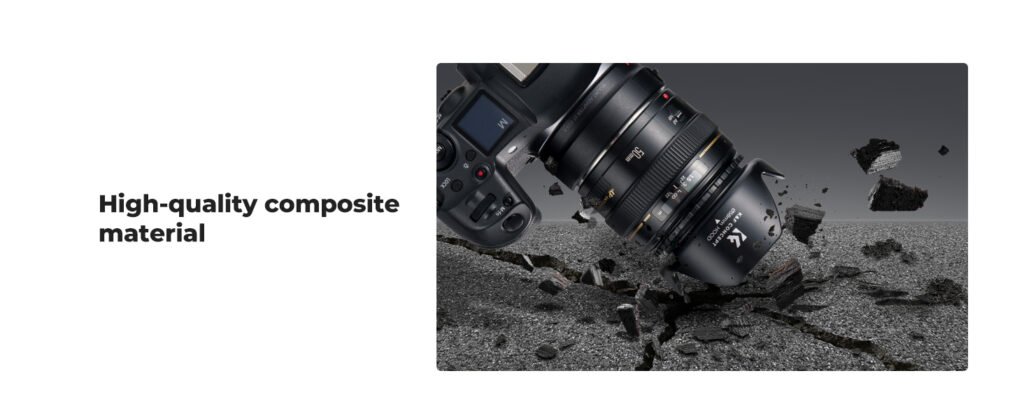
For photographers in the United States, the K&F CONCEPT 58mm Tulip Flower Lens Hood can help reduce stray light and protect the front of a compatible Canon lens. It is not a lens hood made only for the Canon Rebel T8i camera body. The key requirement is a lens with a 58mm front filter thread.
The Canon Rebel T8i, also called the EOS 850D in some markets, works with many Canon EF and EF-S lenses. These lenses do not all use the same filter size. Check the symbol on the front of the lens or its manual before buying this hood.
What the K&F CONCEPT 58mm Lens Hood Does
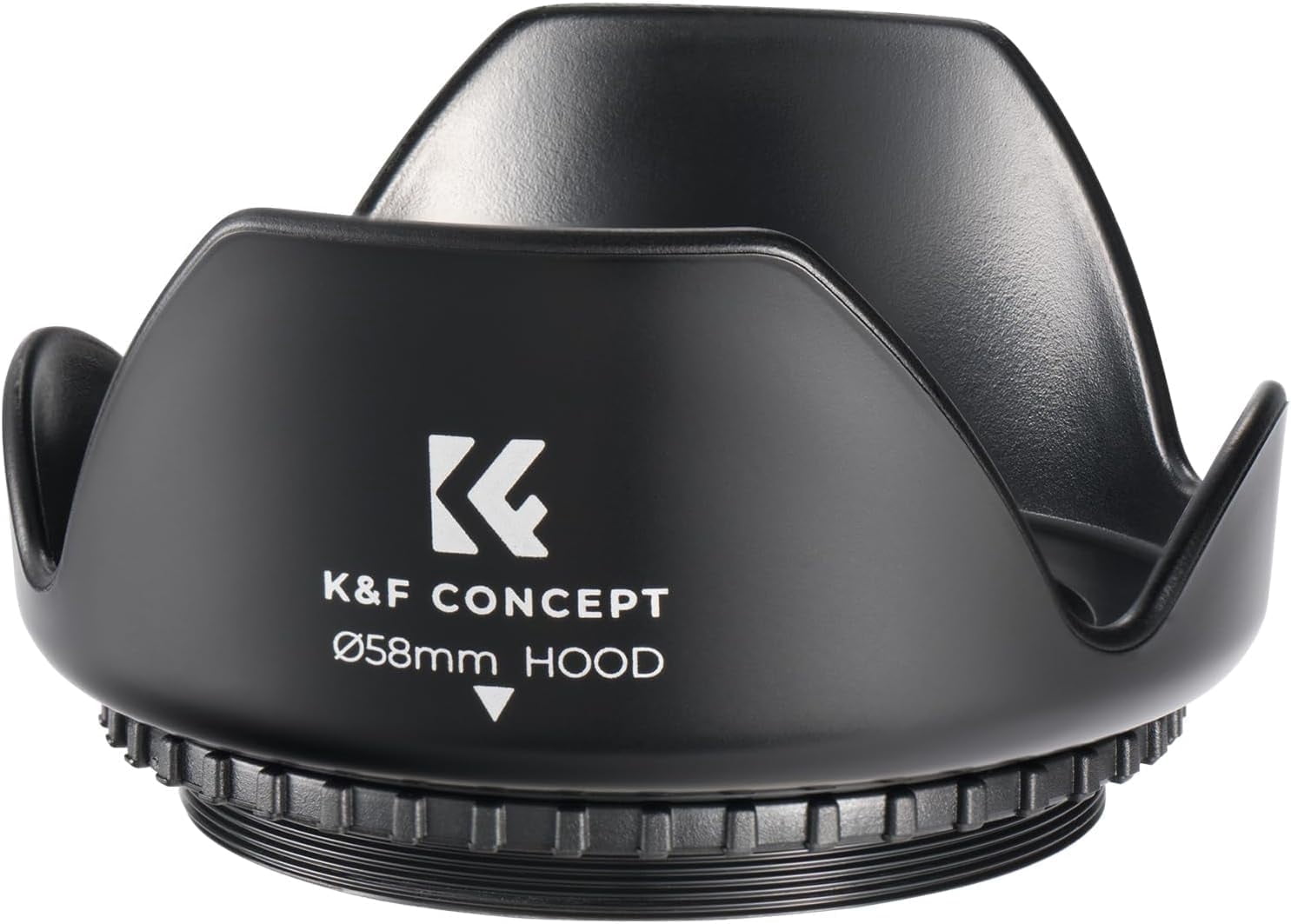
The K&F CONCEPT 58mm tulip hood attaches to the front of a lens with a 58mm thread. Its main job is to block light that enters the lens from the side. This can reduce flare and help preserve contrast in bright conditions.
A hood can also give the front element some protection from light bumps, dust, and raindrops. It does not replace a lens cap, filter, or weather seal.
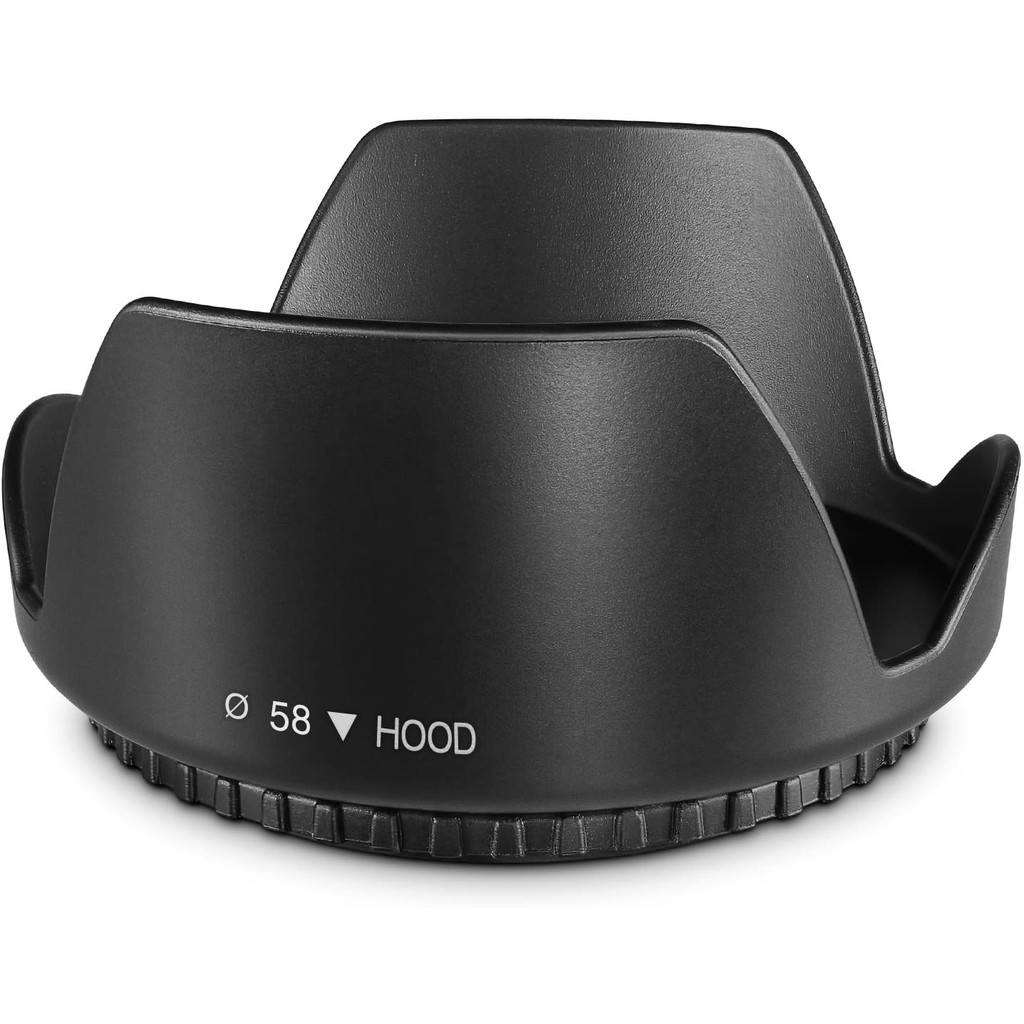
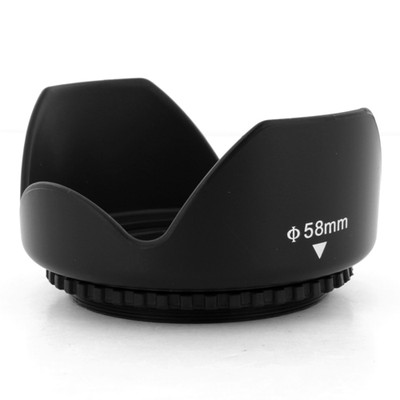
The “tulip” shape has curved cutouts. These cutouts are designed to block more light than a simple round hood while avoiding the corners of the image frame. The shape must face the correct way to work as intended.
What “58mm” Means
The 58mm number refers to the front filter thread diameter. It does not refer to:
- The Canon Rebel T8i sensor size
- The lens focal length
- The outside diameter of the lens barrel
- The camera’s lens mount
For example, a Canon lens marked with a 58mm filter symbol may accept this hood. A lens marked 52mm or 67mm will not accept it directly.
Basic Product Details
| Feature | What it means |
|---|---|
| Product type | Tulip-style lens hood |
| Thread size | 58mm |
| Main purpose | Reduce stray light and help protect the front lens element |
| Camera fit | Depends on the attached lens, not only the Canon Rebel T8i body |
| Mounting method | Screws into a compatible front filter thread |
| Best use | Outdoor photography, backlighting, and bright scenes |
| Main limitation | It will not fit lenses with another thread size without the correct adapter |
K&F CONCEPT sells camera accessories under several product names and revisions. Check the exact retailer listing for material, depth, included cap compatibility, and return terms. Those details can change between versions.
Is It Compatible With the Canon Rebel T8i?
Yes, the hood can work with a Canon Rebel T8i when the attached lens has a 58mm front filter thread. The camera body does not determine the hood size.
The Canon Rebel T8i uses the Canon EF lens mount. That means the camera can use compatible Canon EF and EF-S lenses, as well as some third-party lenses. Each lens may have a different front thread.
How to Check Your Lens
Look at the front rim of the lens. You may see a circle with a line through it, followed by a number such as:
- Ø58
- 58mm
- 58 mm filter size
That number is the filter thread size. You can also check the lens manual or the manufacturer’s specifications.
Do not measure the lens by guessing from its outside edge. The barrel may include raised grips, switches, or other parts that make visual measurement inaccurate.
Common Canon Lens Examples
Some Canon lenses used with the Rebel T8i have a 58mm front thread, while others do not. The following table shows why checking the exact lens matters:
| Lens example | Typical front filter size | Direct fit for a 58mm hood? |
|---|---|---|
| Canon EF-S 18–55mm kit lens versions | Often 58mm, depending on version | Usually, if marked 58mm |
| Canon EF-S 55–250mm versions | Often 58mm, depending on version | Usually, if marked 58mm |
| Canon EF 50mm f/1.8 versions | Commonly 49mm | No |
| Canon EF-S 10–18mm f/4.5–5.6 IS STM | Commonly 67mm | No |
| Canon EF-S 18–135mm versions | Varies by version | Check the lens marking |
These are examples, not a substitute for checking your specific lens. Canon has released multiple versions of some lenses, and filter sizes can differ.
Do Not Confuse Mount Size With Filter Size
The EF mount connects the lens to the camera. The 58mm thread connects accessories to the front of the lens. They serve different purposes.
A lens can fit the Canon Rebel T8i and still be incompatible with a 58mm hood. This is the most common buying mistake.

How to Install the K&F CONCEPT 58mm Tulip Hood
Installation is simple, but the thread should be handled with care. A cross-threaded hood can damage the accessory or the lens front ring.
- Remove the lens cap. Keep the camera and lens pointed away from strong dust or wind.
- Confirm the size. Check that the lens is marked 58mm.
- Inspect the threads. Remove dust, sand, or grit from the lens thread and the hood.
- Align the hood. Place it straight against the front thread.
- Turn it counterclockwise first. Rotate gently until the threads drop into alignment.
- Turn clockwise by hand. Tighten the hood until it is secure.
- Stop when snug. Do not use force or tools.
- Set the tulip position. The longer petals should normally sit at the top and bottom of the frame, with the shorter sections at the sides.
The counterclockwise alignment step helps reduce cross-threading. If the hood does not turn smoothly, remove it and start again.
Signs of a Correct Fit
A correctly installed hood should:
- Sit evenly around the lens
- Turn smoothly onto the thread
- Stay secure during normal use
- Avoid contact with the lens glass
- Leave the zoom and focus controls unobstructed
- Produce no dark corners in the image
Test the hood at the widest focal length. A hood that does not cause vignetting at the widest setting is less likely to block the image at longer focal lengths.
If the Hood Will Not Fit
Stop if the hood binds after only a partial turn. Possible causes include:
- The lens uses a different thread size
- The hood is not aligned with the thread
- Dirt or grit is present
- The hood is cross-threaded
- A filter or step-up ring is already installed
- The lens has a bayonet mount rather than a front screw thread
Do not force the hood. Remove it and confirm the lens specification.

Will It Reduce Lens Flare?
A lens hood may reduce flare when bright light comes from outside the image area. It cannot remove all flare, and it will not help when the bright light source is inside the frame.
Flare occurs when strong light reflects within the lens. These reflections can create hazy areas, bright spots, or a loss of contrast. A hood blocks some off-axis light before it reaches the front element.
The result depends on several factors:
- The position of the sun or light source
- The lens design
- The number and quality of filters attached
- The cleanliness of the front element
- The focal length and field of view
- The hood’s depth and shape
A tulip hood is not a guarantee against flare. If the sun remains in the frame, change the camera angle, use a building or tree as a shield, or shade the lens with your hand while keeping the hand outside the image.
Test the Hood Before an Important Shoot
You can perform a quick test at home:
- Mount the hood on a 58mm lens.
- Photograph a bright lamp just outside the frame.
- Take one image with the hood and one without it.
- Compare contrast and bright reflections.
- Repeat at the lens’s widest focal length.
This test shows how the hood behaves with your exact lens. It is more useful than assuming every lens and hood combination will perform the same way.

Does the Hood Cause Vignetting?
It may cause vignetting if the hood is too deep, mounted incorrectly, or used with the wrong lens. Vignetting appears as darkening in the corners of an image.
A tulip hood is cut to reduce this risk, but compatibility still depends on the lens and focal length. Wide-angle lenses require a shorter or specially shaped hood than telephoto lenses.
Check for vignetting at:
- The widest zoom setting
- The widest aperture
- The closest focus distance
- The corners of the image
- Both the optical viewfinder and Live View
Take a photo of a bright, evenly lit wall or sky. Review the corners at 100 percent on a computer. A dark corner that appears only with the hood suggests a hood or accessory conflict.
A filter stack can also cause dark corners. A polarizing filter, UV filter, step-up ring, and hood together may extend too far from the lens.

Can You Use Filters With This Lens Hood?
The answer depends on the exact K&F CONCEPT version and how the hood mounts. A screw-in hood may occupy the lens’s front thread, which can limit the use of another screw-in filter.
Before combining accessories, check:
- Whether the hood has a front accessory thread
- Whether the filter can be installed before the hood
- Whether the lens cap still fits
- Whether the combined setup causes vignetting
- Whether the filter controls remain reachable
A circular polarizer needs to rotate during use. A hood that blocks access to the filter can make adjustment difficult.
If filter use is central to your work, a lens-specific bayonet hood may be more practical than a universal screw-in hood. A bayonet hood is made for a particular lens model and may preserve easier access to the filter area.

Common Mistakes to Avoid
The most common mistake is buying the hood for the camera body rather than the lens. The Canon Rebel T8i can use lenses with different front thread sizes, so “for Canon Rebel T8i” is not enough information.
Avoid these errors:
- Buying by focal length: A 50mm lens does not necessarily use a 50mm filter or hood.
- Ignoring the diameter symbol: Look for Ø58 or 58mm on the lens.
- Forcing the threads: Resistance usually signals misalignment or an incorrect size.
- Installing the tulip shape backward: The longer petals should match the top and bottom of the frame.
- Leaving a damaged hood in use: Cracks or bent threads can cause poor alignment.
- Assuming all versions are identical: K&F CONCEPT product listings may differ by material or design.
- Skipping a wide-angle test: Vignetting may appear only at the shortest focal length.
- Using the hood as a lens cap: A hood does not seal the front element from dust or scratches.
Keep the lens cap in your camera bag. It remains the best basic cover when the camera is stored or transported.

Screw-In Hood Versus Lens-Specific Bayonet Hood
A 58mm screw-in hood is useful when you own several lenses with the same front thread. It is also a simple option when the original hood is missing or costly.
A lens-specific bayonet hood may be better when you want a secure custom fit. It is often shaped for one lens’s field of view, but it will not normally transfer to other lenses.
| Consideration | 58mm screw-in hood | Lens-specific bayonet hood |
|---|---|---|
| Compatibility | Any lens with the correct 58mm thread, subject to testing | Usually one lens model or lens family |
| Flexibility | Can move between compatible lenses | Limited to the intended lens |
| Filter access | Depends on the design | Often designed around that lens |
| Installation | Screws onto the filter thread | Locks onto a lens bayonet |
| Main risk | Cross-threading or vignetting | Incorrect model selection |
| Best for | Owners of multiple 58mm-thread lenses | Users seeking a dedicated fit |
Choose the K&F CONCEPT 58mm hood if your lens is confirmed to use a 58mm thread and you value a transferable accessory. Choose a lens-specific hood if exact fit, filter access, and minimal testing matter more.

Is the K&F CONCEPT 58mm Hood Worth Buying?
It can be a sensible accessory for a Canon Rebel T8i owner who has a compatible 58mm lens and often shoots outdoors. Its value comes from basic light control and added front-element protection, not from increasing lens sharpness or camera resolution.
It may not be the right choice if:
- Your lens does not use a 58mm thread
- You regularly use several filters
- You need a hood for an ultra-wide lens
- You want a replacement made specifically for one Canon lens
- The product listing does not clearly identify the mounting type
Before ordering, confirm three details: the lens’s filter size, the hood’s mounting design, and whether the hood works with your planned filters and lens cap.
Prices, stock, included parts, and seller warranties can change in the United States. Check the current listing before purchase rather than relying on an old product description.
Frequently Asked Questions
Does the Canon Rebel T8i need a 58mm lens hood?
No. The camera does not require one fixed hood size. The correct size depends on the front filter thread of the lens attached to the camera.
Will this hood fit the Canon EF-S 18–55mm lens?
Many Canon EF-S 18–55mm versions use a 58mm filter thread, but you should check the marking on your exact lens. If it says 58mm, the K&F CONCEPT hood may fit, subject to the hood’s design and clearances.
Can I use this hood on a 52mm lens?
Not directly. A 58mm hood requires a 58mm thread. A step-up ring may connect a 52mm lens to a 58mm accessory, but the setup can increase vignetting risk, especially with wide-angle lenses.
Does a lens hood improve image sharpness?
A hood does not change the optical resolution of the lens. It may improve the appearance of an image by reducing stray light, haze, and contrast loss in some lighting conditions.
Can I leave the hood on while storing the camera?
Usually, yes, if the hood fits securely and does not interfere with the camera bag. Use the correct reversible storage position if the product design supports it. Keep the lens cap available for longer storage.
How do I clean the hood?
Remove loose dust with a blower or soft brush. Wipe the hood with a clean, dry microfiber cloth. Avoid putting liquid on the lens threads, and do not force a hood that has become gritty or damaged.
Final Recommendation
The K&F CONCEPT 58mm Tulip Flower Lens Hood is a potentially useful, low-complexity accessory for a Canon Rebel T8i when the attached lens has a confirmed 58mm front thread. It can help block stray light and offer modest physical protection.
The buying decision should begin with the lens, not the camera. Verify the 58mm marking, install the hood gently, and test for corner shading at the widest focal length. If the fit is smooth and the image remains clear, the hood should meet the basic needs of many outdoor and everyday photographers.

